Wednesday, 2 November 2016

How to Write 16 Knockout Articles When You Only Have One Wimpy Idea

How to Write 16 Knockout Articles When You Only Have One Wimpy Idea

Serious content creators know that each article they publish is a piece of a larger content marketing arena.

But the thought of generating content ideas on a regular basis often knocks us out before the opening bell even rings.

It can be difficult to consistently write exceptional content that encourages visitors to stick around and learn about your unique selling proposition.

For example, let’s pretend you’re the marketing director for a store that makes and sells boxing equipment. You need to convey the passion, care, and expertise your company puts into creating its specialized gear, but the problem is that your message is only a couple paragraphs.

Your wimpy, single piece of content reads more like a press release or “About” page than a compelling story that spreads across multiple blog posts.

You’re stuck with limited material when you need to develop many different articles that help boxers and boxing enthusiasts find your merchandise. Instead of “throwing in the towel” and losing a marketing opportunity, view your situation from a creative perspective.

With that in mind, here are 16 ways a boxing equipment business could approach blog post writing. Note that each idea below can be applied to your niche to make your website a fresh and valuable resource in your industry.

knockout-1

Focus on products

1. Tell stories

Feature your individual products in separate blog posts, rather than merely listing that you sell gloves, bags, mouthguards, tape, etc. What are their special benefits? Which qualities make them the perfect purchase for your ideal customer?

2. Customer testimonials

After you’ve posted articles that spotlight each of your products, create complementary posts with testimonials about those products. Link the new posts to relevant old posts.

3. Reader discounts

Show your appreciation for your blog readers by rewarding them with special offers or giveaways. As an incentive to subscribe to your website, you may also want to offer a freebie or discount on a physical product.

4. Neighborly love

If you don’t sell clothing and accessories, such as boxing trunks and water bottles, promote other businesses that do sell those items. Write posts about your favorite boxing stores and link to their websites to initiate camaraderie.

knockout-2

Share your company’s story

5. Employee profiles

Demonstrate that your team members are true boxing aficionados — people with relatable interests. You can structure these posts in a “Question & Answer” format to make them easy to read. What’s his or her daily role? How does his or her skill set contribute to the company’s business objectives?

6. Behind the scenes

Tell stories about day-to-day activities. They may seem mundane to you, but routines at your organization give insight into your operations. What’s it like to work at your company? Which best practices differentiate you from competitors? Why do customers love your products?

7. Philosophy

Use your blog to describe your mission statement in a personable way. The casual tone that is appropriate on your blog allows you to make professional jargon more understandable. Why do you make and sell boxing equipment? What problems do your products fix? Why is your quality unparalleled?

8. Captivating visuals

Show your products in action with photos, slideshows, and videos. This is especially useful if you are in an athletic or active industry like boxing. Images help potential customers get a sense of what it’s like to own your specific brand.

knockout-5

Discuss important events

9. Journalism

Keep your content current by writing about local and national fights on a regular basis. You can make announcements about upcoming events and also write blog posts about their highlights and pitfalls after they’ve occurred.

10. High-profile fights

Standard blog posts may be 300–500 words, but special occasions are a chance for you to produce longer, in-depth articles closer to 1,000 words. Provide comprehensive details and analysis.

11. Field reports

Do you have correspondents at a big fight or tournament? Is a trade show or conference nearby? Explain what you’ve learned about your customers’ needs from associates who interact with a broader range of consumers.

12. Training and classes

Consider offering boxing training in your store, and use your blog to see if your customers would be interested. It might even be possible to create an online course that could help your target audience. If that’s not a possibility, discuss the classes or online courses you’d recommend.

knockout-3

Educate and illuminate

13. Exclusive interviews

Look for ways to educate your audience by tapping the wisdom of other people in your industry. Ask professional boxers and trainers to share their knowledge with your readers.

14. Insider instructions

Continue educating with boxing tips and techniques. What are the best ways to treat wounds? How do you strengthen your muscles for optimal performance? What should boxers eat?

15. Reviews and resources

You can review apps, websites, books, or magazine articles related to boxing. Are they helpful or a waste of time? Guide your customers to the right resources.

16. Direct correspondence

Listen to your customers’ questions. You probably don’t answer all of them on your website, so address them in blog posts. If you already have a thorough “Frequently Asked Questions” section, repurpose or update your text and publish it in a series.

knockout-4

Build your own content marketing arena

Content helps you expand the “know, like, and trust” factor that you need to satisfy before customers feel comfortable buying from you.

When you write content with a focused editorial strategy, your website becomes a channel that broadcasts your news. It’s a media outlet that potential customers regularly visit to get the next installment of your unfolding narrative.

Your readers focus their attention on your boxing ring and become interested in fighting the good fight with you.

How do you use blog posts to share your business’s unique story and attract customers?

Share in the comments below!


Learn how to connect with content

Want to learn more about how you can use content marketing to grow relationships with the audience you’d like to attract to your business?

Then claim your free My Copyblogger membership! You’ll get instant access to a treasure chest of proven content marketing training.

Get free content marketing training

Editor’s note: The original version of this post was published on January 7, 2014.

The post How to Write 16 Knockout Articles When You Only Have One Wimpy Idea appeared first on Copyblogger.


from Copyblogger http://ift.tt/1eEzQbZ
via IFTTT

Tuesday, 1 November 2016

How Bestselling Sci-fi Thriller Author Blake Crouch Writes: Part Two

wf-blake-crouch-file-2

International bestselling sci-fi and thriller novelist and screenwriter, Blake Crouch, took time out from his busy schedule to talk to me about his mind-bending new book Dark Matter and adapting his work for both film and TV.

The hybrid author has penned more than a dozen novels that have been translated into more than 30 languages, and his short fiction has appeared in numerous publications.

In addition to having his Wayward Pines trilogy adapted into a #1 hit TV show by FOX, Blake wrote the screenplay for his latest novel, Dark Matter, for Sony Pictures. He also recently co-created Good Behavior, a TNT show based on his novellas, starring Michelle Dockery (set to premiere November 15, 2016).

His novel Dark Matter was described by the NY Times as an, “… alternate-universe science fiction …. countdown thriller in which the hero must accomplish an impossible task,” and bestselling sci-fi author Andy Weir called it, “An exciting, ingeniously plotted adventure about love, regret, and quantum superposition.”

If you’re a fan of The Writer Files, click subscribe to automatically see new interviews.

If you missed the first half, you can find it right here.

In Part Two of this file Blake Crouch and I discuss:

  • The author’s tips for conquering writer’s block
  • Why versioning and backing up drafts is crucial
  • How to lean into procrastination and find your most productive writing time
  • Why understanding that “everything’s been written,” can set your creativity free
  • Why you need to write the kind of book you want to read
Listen to this Episode Now

The post How Bestselling Sci-fi Thriller Author Blake Crouch Writes: Part Two appeared first on Copyblogger.


from Copyblogger http://ift.tt/2fejaOE
via IFTTT

We Used the Latest Holiday Selling Data to Create These Cyber Monday Hacks

I’ve always been a little skeptical of Cyber Monday. It always felt a little forced. Black Friday is a media bonanza as well, but Black Friday always seemed more discovered than created.

Cyber Monday on the other hand came off a bit manufactured. I figured that while there were certainly sales to be made from an ecommerce-centered selling holiday, the real money in online sales would be made on Black Friday as buyers become increasingly resistant to the Black Friday hype machine.

So, we pulled the data. We wanted to see how Cyber Monday works and what makes it tick. Inventory tracking is our bread and butter, so we maintain a multi-tenant database comprised of sales data from our ecommerce business owners. That’s millions of sales. This gives us an overview of general trends within the industry across marketplaces, platforms, and niches. We extracted an SQL query of all sales data between November 25th and December 2nd minus POS systems, ensuring that our conclusions would be specific to ecommerce.

The goal? Discover what’s fact and what’s opinion behind the Black Friday vs. Cyber Monday debate and create a seller resource that allows retailers to be more methodical in their Cyber Monday strategy.

And I have to admit that looking at these data reports had me replacing my turkey with a big helping of crow. Cyber Monday is king.

Focus Your Efforts on Cyber Monday

ecommerce-sales-week

The buying public is biting hard at the Cyber Monday lure. While Black Friday does stand tall with over 1.5 times the sales and transactions of the previous day, Cyber Monday towers over the entire week, sticking out like a pimple on prom night. Nearly 2.5 times the sales and transactions occurred on Cyber Monday as on Thanksgiving Day. In fact, the Cyber Monday fallout stretching into Tuesday is nearly as good of an e-tail day as Black Friday.

But what does this all mean? How can you apply it in 2016 to increase your sales and maximize on perhaps the most important week of the year for your business?

Here are four actionable tips to get you started. These don’t require any expensive software systems or a huge amount of expertise, but they go a long way on capitalizing off the data-proven buying habits of shoppers during the first week of the holiday season. I’ve also provided some great examples of Cyber Monday sales from throughout the years from deep in my inbox. For extra fun, I only picked examples that personally made me convert. Let’s dive in.

Have Your Email Marketing to Inboxes by 6AM

The first thing I do every morning is check my email, and I’m not the only one. Smartphone usage for email spikes in the morning around 6AM according to data compiled by Movable Ink.

email-opens-by-device-time-of-day

That explains why our data found that Cyber Monday begins at 7AM. People are waking up, immediately checking their phones, and making purchases. The sales eclipse the transactions for the next three hours, indicating customers may be more receptive to your email marketing efforts for big ticket items in the morning.

cyber-monday-hourly

Data found by Marketing Charts drives the point home further. Average email open rates begin their daily upswing at 6AM and peak at 10AM.

open-rates-by-hour-marketing-charts

By the time your potential customers wake up, you need to have you email marketing efforts right in front of them. Why waste time? Feature your biggest ticket items and your best sales right off the bat. This example from Journeys hit my inbox at 2:10AM. It caused me to buy a pair of cream-colored Converse All-Stars. It shows us a couple of great ideas about how to cut through the sleepiness of someone’s brain and claim an early morning conversion.

journeys-free-shipping

What I find really interesting here is that Journeys doesn’t include a product photo. The email sells the deal rather than clothes. It reads as almost more of an announcement than an advertisement. There are three more replicable techniques for an early morning Cyber Monday email we can find here.

  1. Make the offer provocative and enticing. Words like “free” and “X% off” are sure to wake up your customers.
  2. Shove that offer directly and explicitly at your reader. Big, bold letters are a must.
  3. Dark colors that won’t blind your reader are a great idea. An email with a lot of bright colors might hurt their eyes and cause them to put down their phone.

Advertise a Lunch Break Flash Sale on Twitter

Going back to our hourly data, we can see that the most money is being made around lunch time. 1PM to 3PM is the largest peak you’ll see throughout all of Cyber Monday.

Conveniently, Hubspot has found that 12PM to 3PM on weekdays is Twitter’s most active period. Launching a 12-hour flash sale on Twitter at 12PM is a great way to get a great deal in front of the most customers at the time when they’re statistically most likely to convert. It’s a trifecta of data-driven methodology.

Use the hashtags #cybermonday, #flashsale, as well as any other relevent hashtags for your brand. Include an image, especially if you’re able to include it as an embedded link. I bought this wonderfully nerdy t-shirt for an English teacher friend of mine last Christmas. I was browsing the #flashsale hashtag on Twitter during my lunch break. The limited time offer and the fact my lunch break was also limited increased my urgency, leaving me less time to waffle and potentially abandon my cart.

Perhaps you’re a little wary of putting eggs into your social media basket. You’ve got that big fancy email list, but perhaps you’ve relied on it a little too much. Keep in mind that your customers are going to be bombarded all day with sale after sale in their inbox. You don’t want to blend into the background noise. Moving some of your marketing efforts over to social media gives you an opportunity to attract new customers on an open platform, Type A buyers who are looking for Cyber Monday sales. With that in mind, apply these three tips.

  1. Attach the flash sale to a lower selling item, or one in which you have excess inventory. Don’t risk it on a high selling item, especially if this is your first flash sale.
  2. Use Twitter’s audience management tools to create a targeted Twitter ad to promote your flash sale.
  3. The shorter the time for your flash sale, the more urgency you create for the buyer. On the other hand, they have less time to see the sale. It’s a delicate balance.

Send Out an End-Of-Day Marketing Email

After the work day ends, customers begin to spend less money. The number of overall transactions spikes at 7PM as a result of people getting off work who perhaps are in jobs where they’re not able to online shop on their lunch break. Similar spikes occur at 10PM and 11PM as the slowpokes among us suddenly remember its Cyber Monday, or finally have time to sit down and shop. That’s why you should send out one more marketing email at the end of the work day to capitalize on this group of buyers.

“But what about bombarding my customers? Won’t they get annoyed if I email them twice in one day?”

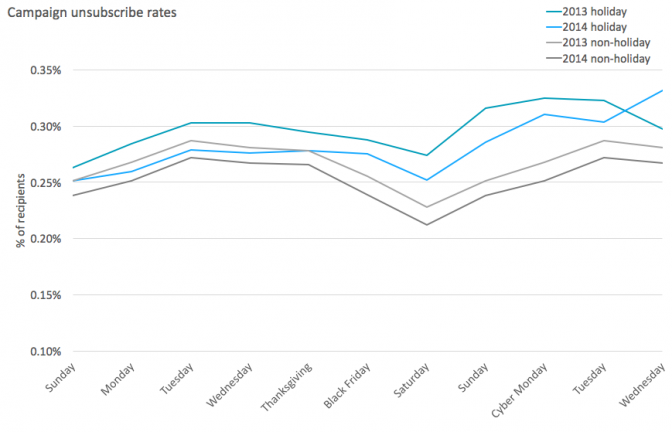
On Cyber Monday, they don’t. Mailchimp notes that the overload of email offers decreases open rates across the industry on Cyber Monday, but don’t significantly increase unsubscribe rates. They go on to note that the best way to get yourself noticed is to send more emails than normal. This is not the time to be quiet and hope you’ll get noticed. There’s too much money on the line to be timid.

campaign-unsubscribe-rates
(Image Source)

This sleek AT&T Cyber Monday sale landed in my inbox at 4:15PM. We were desperately trying to introduce some technology into my dad’s life at the time, so this seemed like the perfect present. Notice how they lead with the FREE tablet. I also really like the messaging that this is where the holiday cheer is “starts,” as it implies a season’s worth of deals and shopping is to come.

att-holiday-email-advertisement

Another key takeaway here is bundling your items. Since people seem to spend less in the evening, but the total transactions increase, it’s important that you can get as much as you can out of each transaction. Bundling items together means you can charge more for each transaction.

AT&T is technically doing two different bundles here, one much subtler than the other. Not only are they bundling the tablet and the phone, but they’re also offering a $200 credit. What could you use that $200 credit on? Maybe some of those wearables they advertise below. AT&T is not only bundling their products, but bundling the sale itself. A three step series of purchases that starts with the headline FREE is great marketing from this mobile giant.

Getting one last email out completes a nice full days’ worth of Cyber Monday digital marketing. Let’s make sure we’ve got our Cyber Monday marketing timed out to perfection.

kissmetrics-watch

You’ve taken advantage of the early birds, the night owls, and the lunch… larks? Being an active seller throughout the day ensures that you’re getting the most of out the holiday.

Allow Customers to “Earn” Free Shipping Rather Than Giving It Away to All

I’m a big believer in free shipping. What it does for ecommerce conversions is undeniable at this point. It’s worth the cost. According to Compete.com, over 93% of customers cited it as a factor that would make them more likely to buy an item. The same study found that 38% of customers found the shipping cost to be the least satisfactory part of their shopping experience.

free-shipping-increase-sales
(Image Source)

Our own research, however, appears to suggest perhaps buyers aren’t as sensitive to shipping costs as they say they are. We found that offering free shipping does not move the needle on your sales throughout the week of Cyber Monday.

percentage-free-shipping

I’ve got two theories as to why this is. The first is that Cyber Monday may be attracting some non-traditional online buyers. Those of us who shop online often throughout the year know that if one vendor isn’t offering free shipping, it’s probably worth the time to find a similar item with a vendor willing to ship for free. Cyber Monday shoppers may not be familiar with this, so it doesn’t become a major factor in whether or not they convert.

My second theory is that the event of Cyber Monday is outweighing the normal aversion to paying for shipping. People want to feel as if they are a part of something. It could make them less prudent than normal and more prone to paying for shipping, especially if they perceive the deal as being worth it.

Either way, we can make a few data-driven decisions based on this info. We could of course just take away free shipping altogether for the week of Cyber Monday. Customers are willing to pay for it, so we might as well just take their money, right? That feels a little wrong though, doesn’t it? After all, the benefits of free shipping outweigh the negatives. It’s good for the customers and the sellers.

With that in mind, offer customers a chance to “earn” free shipping. Check out what WWE Shop sent me on a Cyber Monday a few years back.

wwe-shop-cyber-monday-sale

WWE Shop set the free shipping limit to $15. Doing something similar with your business will allow you to increase the value of each transaction. Buyers may spend more to get the free shipping, and transactions that remain below $15 will be less expensive for you to process.

Consider other ways you can allow your customers to earn free shipping, such as in exchange for filling out a customer experience survey, registering on your site, or bundling the item with a less popular item.

Conclusion

Let me sum up all these graphs and examples for you as simply as possible.

  • Cyber Monday is a phenomenon, not a flash in the pan.
  • Be methodical about your digital marketing to capitalize on sales spikes throughout the day.
  • Allow customers to earn free shipping rather than giving it away to everyone.

I think data is beautiful, especially data that makes us money. By going about your selling in a data-driven manner, you can take full advantage of Cyber Monday. We’ll most likely see sales spike on this ecommerce holiday. But wasted motion is wasted money. Don’t fumble around in the dark and hope you’ll stumble on profit. Use these hacks instead, experiment to see which works best for you, and make Cyber Monday your best sales day of the year.

About the Author: Dion Beary writes about ecommerce for ecomdash, a software company that automates inventory management for small businesses selling online. His passions are Twitter, casseroles, and 00’s rap.


from The Kissmetrics Marketing Blog http://ift.tt/2f6Lh60
via IFTTT

5 Quick Wins for Content Marketers

cbfm-content-wins

Content marketing is a long game … but that doesn’t mean we can’t create some quick wins.

Strategic content marketing is all about long-term results — but there’s actually a lot you can do to create some momentum right away.

In this 19-minute episode, Sonia talks about:

  • The fastest way I know to create lots and lots of short, valuable, audience-friendly blog posts
  • Leveraging your contact list for some quick, high-value content
  • The technique I swiped from Seth Godin for creating juicy, engaging content from your everyday life
  • An efficient (and fun) process to improve a skill as quickly as possible
  • An ultra simple framework to use when you’re asking for the sale
Listen to this Episode Now

The post 5 Quick Wins for Content Marketers appeared first on Copyblogger.


from Copyblogger http://ift.tt/2eY1RSP
via IFTTT

Over Half of Global CMOs Are Making Data Driven Decisions

With topics such as predictive analytics and artificial intelligence growing in not only importance but popularity among the c-suite, the idea or concept of using data to determine and drive marketing decisions is hardly breaking news. 

In a recent Marketing Land piece, the writer put it perfectly and quite succinctly: "Data permeates every facet of business today, and marketing teams are evolving to reflect the data-driven culture. While there is still an art and creative science to marketing, even the creative aspects of the job are now driven by insights and analysis."

Another way of putting it succinctly goes something like this: Marketing leaders must create a data-driven marketing culture and organize the required people, processes and systems.

The Numbers Don't Lie

It would appear global marketing leaders are getting that message, at least based on the findings below via eMarketer. As you can see from the results of a survey of global executives including C-level and their direct reports, in 21 countries across various industries about their digital transformation.

Now the cynic would say these numbers should be higher across the board but let's not haggle. Let's enjoy the fact that over half of global leaders are using data to make decisions and in doing so are presumably eliminating data silos and create a single source of truth;  a 360-degree view of customers to reliably and efficiently target the right message, to the right person at the right time. 

Data = Increased ROI

Anytime you see anything that positively impacts ROI you can bet a CMO, let alone any marketer will be drawn to it. And data is no different. 

In more research via eMarketer 40% of marketers saw an increase in revenue as a result of utilizing a data driven marketing approach from Q1 to Q2 2016. Moreover, another 52% expected to see a revenue increase in Q3 2016 due to the use of data driven marketing. 

Singles Only

No, I am not going to talk about the latest dating site or the next chapter meeting of your local community association. This is all about the aforementioned single source of truth, the inherently important need for your organization to have a single customer identity that unites behaviors across all channels into one comprehensive profile.  

Today, certain technologies can link all the unique cross channel identifiers of a customer back to a single unique identifier. Once you have a single unique identifier, you can really know who your customers are across all channels, and begin to:

  • Personalize interactions based on channel preferences and behaviors. 
  • Reach a more precise level of targeting and segmentation by using cross channel behavioral information in real time.
  • And most importantly, integrate cross channel communications and speak to each customer with a single voice regardless of channel.
The Data Driven CMO

Today’s Chief Marketing Officer is tasked with many demands, made even more challenging with the ever-evolving digital domain. Their biggest challenge? Leveraging personalization to demonstrate and drive clear ROI to the executive team.

Download The Data Driven CMO to see how leading CMOs weigh in on other challenges, including how they can skillfully decipher, understand, and leverage the abundance of available data to engage with customers.


from Oracle Blogs | Oracle Marketing Cloud http://ift.tt/2f9H9A1
via IFTTT

3 Eye-Opening Techniques to Wake Up Your Readers with Your First Sentence

grab attention from the start

“I was only four years old when I saw my mother load up a washing machine for the very first time in her life …”

That is global health and data expert Hans Rosling’s opening line of a 2010 TED Talk, as he stands on stage with a bundle of laundry and a washing machine. Rosling does what the best presenters in the world excel at; in a matter of seconds, they get and keep your attention.

When you write content, your job is similar to someone standing on stage. Your readers are distracted and you have mere seconds to get their attention.

To grab and keep your audience’s attention, it’s best to use at least one attention-grabbing method that yanks your readers into your articles by creating intense curiosity.

Want to know three methods I recommend? Keep reading …

3 ways to hook your readers

In this article, I’ll present the following three attention-grabbing techniques, with examples of how they can be used in your content:

  • Method #1: Story of a demonstration
  • Method #2: Case study
  • Method #3: Opposing stance

Method #1: Story of a demonstration

Notice how this article started with a description of Hans Rosling standing on stage.

And what was he doing on stage? He was holding a bundle of laundry while standing next to a washing machine. He then proceeds to talk about the process of washing clothes. While he goes about the demonstration, your eyes are riveted to what he’s going to do next.

Rosling is lucky — he’s on stage and can do a physical demonstration. But when you write an article, you have to tell a story about a demonstration instead.

To do this, roll out your story as if the audience were watching and listening to find out what happens next. When you use a “demonstration” to start an article, the most mundane actions come to life.

Let’s say I wrote:

“Have you ever tried to peel a clove of garlic before? If you’ve done it the old-fashioned way, you’ve probably taken five minutes or more to separate the cloves, cut each clove in half, and peel off the skin. But what if you could peel the garlic in 10 seconds? Here’s what to do: Hit the garlic with the base of your palm so the cloves separate. Then take the separated cloves, put them in a container and cover it with another container. Then shake the heck out of the garlic and — like magic — the garlic is peeled.”

In the example above, you followed along, didn’t you?

Not only did you follow along, you wanted to know what came next.

When you use a story that involves a demonstration, you pull the reader through your content. Then once you’ve gotten to the end of your story, you simply connect it to the rest of your article.

Rosling’s washing machine demonstration may seem like a mundane example, but when placed at the start of an article, it forces you to follow along to find out what happens next.

A demonstration is only one way to get your readers’ attention. The second is a case study.

Method #2: Case study

Did you know Airbnb was suffering as a company until Barry Manilow’s drummer became a customer?

Sound interesting? Case studies — whether historical or current — attract readers because they want to know what happens next and why things unfolded the way they did.

Why was Airbnb in trouble in the first place? What’s the weird connection between Airbnb and Barry Manilow’s drummer? And how does all of this connect to the rest of the article?

As the Airbnb story goes, the founders were keen to offer accommodations similar to bed and breakfasts. That required the owner to be around when a guest arrived and stay in the house or apartment as well. But Barry Manilow’s drummer didn’t want just a room; he wanted an entire apartment.

That was a pivotal moment for Airbnb. And here’s the connection to the rest of the article:

We often formulate our own ideas when clients have much better suggestions for how we can run our businesses. By listening to their real customers, Airbnb found a way to offer lodging that has broad appeal.

See how the story got your attention? Remember how the washing machine demonstration kept you riveted?

Well, there’s one more method. It’s called the “opposing stance.”

Method #3: Opposing stance

An opposing stance is when you present an argument that seems to conflict with your own headline.

Let’s say you’re writing an article on “how to learn quickly.” In the first paragraph, you would offer a point of opposition.

You could deride “speed reading” and talk about how reading faster merely exposes you to more information, rather than creating a lasting understanding of the topic you’re reading about.

You’ll then explain that while slowing down and taking notes may seem time-consuming, it’s the most efficient way to retain what you’ve learned.

You teach your audience “how to learn quickly” — it’s just different from what they might be expecting to hear, so it wakes them up and gets them to focus on your content.

Keep your audience fascinated

Hans Rosling speaks about global health and data. They’re complex topics that audiences might have trouble connecting to, but Rosling’s speeches are adored by the public. And there’s a good reason why — he’ll use demonstrations, case studies, and even the power of opposition in a single speech.

He’ll start off with one concept, then move his way through the information and bring up the other elements — forcing you to pay rapt attention.

Great speakers know that the audience is restless. They know the previous speaker may have bored them out of their minds with graphs and endless facts and figures. That’s why they use stories, case studies, and opposition.

So, when you write, take a cue from a great speaker to keep your readers absorbed as you take them through the rest of your article.

Which attention-grabbing techniques do you use in your writing?

Share in the comments below.

The post 3 Eye-Opening Techniques to Wake Up Your Readers with Your First Sentence appeared first on Copyblogger.


from Copyblogger http://ift.tt/2fdd3Kz
via IFTTT

Make the Most Out of Social Coupons for Small Business Saturday

This holiday season, we’re all about using social coupons to boost business during the hectic last months of 2016. We recently blogged about social coupons in general, and also about how to use coupons to your business’s advantage during the holidays. With Small Business Saturday fast approaching on November 26, we wanted to take a look at how social coupons can prompt your customers to think of you when they “shop small” and “dine small.” 

If you’re not familiar with Small Business Saturday, it was an initiative first launched by American Express in 2010, prompting customers to shop and dine in their local communities on the Saturday after Thanksgiving. Black Friday belongs to the big-box national retailers, and Cyber Monday drives shoppers to online stores, but Small Business Saturday carved out a space for the local restaurants and businesses that are such an integral part of their communities. Since its launch, it’s grown steadily with every year; in 2015, 95 million customers shopped and dined small on Small Business Saturday, to the tune of $16.2 billion. 

Email marketing in one way to take advantage of Small Business Saturday. Social coupons are another tool in your Small Business Saturday kit. As we discussed in our recent blog post, social coupons are great for these reasons

  • They help you track which social media platforms drive the most traffic to your business.
  • They create word-of-mouth buzz by encouraging your followers to share the coupons with their friends and family.
  • They create urgency.
  • They can drive foot traffic.
  • They can generate sign ups for your email lists.
  • They take advantage of customers’ price sensitivity, which is often more important to them than brand loyalty. 

In the run-up to Small Business Saturday, all of these advantages come into play. Here’s five ways to make them work for you.

1. Use Small Business Saturday to create urgency.

Small Business Saturday is but a short day in one of the busiest holiday weekends of the season. Social coupons help focus your customers’ attention on the fact that they need to take action — either by visiting your business or your website — on that day in particular. Drive traffic with a social coupon that’s good only on Saturday, November 26.

2. Use social coupons to stand out from the crowd.

Small Business Saturday is a great way to call attention to all the small businesses in a community, of course. But in a world of increasing competition, giving yourself an edge never hurts. Social coupons click with price-conscious consumers who may pay more attention to the bottom line than to brand loyalty. Use your Small Business Saturday social coupon as a loss-leader to get traffic in the door (or on your site), and then upsell those visitors on other products and services. This is especially important if your business sells a common product line or service that customers can find elsewhere.

3. Use social coupons to raise money for charity.

Social coupons don’t have to be just for discounts or promotions, of course. Try running a social coupon campaign where your business donates a certain amount (or certain portion of sale proceeds) to a local charity. That way you can drive traffic to your business, upsell the customers while they’re there, and still do some good at the end of the day.

4. Social coupons can help advertise a Small Business Saturday event.

Two days after Thanksgiving, a lot of people are waking up from their turkey comas, or they’re sick of eating leftovers, or they’re feeling daunted about the crazed holiday weeks yet to come, or they’ve had enough football. Or maybe all of the above. Chances are they’re a little bit stir-crazy and ready to be out and about. Give them a reason to visit you by holding a Small Business Saturday event at your business, and use social coupons to dish out free beverages, extra discounts, or other holiday-themed treats to those who stop by. Encourage them to share the coupons with their friends and family to ensure you have a steady crowd.

5. Use Small Business Saturday hashtags so people can find your social coupons.

#SmallBizSat, #ShopSmall, and #DineSmall are some of the most common Small Business Saturday hashtags. Make sure to affix them to your social coupons so your posts are searchable in Facebook, Twitter, and your other social networks. 

If you haven’t already, Small Business Saturday is a great way to start using social coupons to boost your business. Follow these tips, and you’ll cut through the clutter this Thanksgiving weekend.

Get Started on Social

Ready to create your #ShopSmall social coupons? Deluxe has a team of specialists ready to help you get started on your new, easy to create campaigns.

Connect me with a social ads specialist


© 2016, John Habib. All rights reserved.

The post Make the Most Out of Social Coupons for Small Business Saturday appeared first on Vertical Response Blog.


from Vertical Response Blog http://ift.tt/2fqCays
via IFTTT