Tuesday, 5 December 2017

How to Acquire Customers with Facebook’s New Messenger Ads

Facebook recently released Facebook Messenger app ads to the general public.

Aaaaaannnnnddddd digital advertising just got even more creepy than ever imagined.

Thanks, Zuck.

You can now directly message potential prospects via Facebook Messenger right in their inboxes. Kinda like LinkedIn’s Sponsored InMail. Meaning you can nag people 24/7 now.

But with all of these new features comes white noise. Using the right tactic is like finding a needle in a haystack on new platforms.

Just like with any new digital advertising platform, it’s hard to know what works and what doesn’t.

What will help you acquire customers and what will get you reported for stalking.

Here’s how to find that proverbial needle in the haystack by using Facebook Messenger ads to acquire customers.

The Three Main Types of Facebook Messenger Ads

Currently, Facebook offers three main advertising formats or placements with their new Messenger ad services.

Each one is different. But you can use them all together to create one big, happy, harmonious user experience.

Here, we’ll look at each in-depth, analyzing the best practices for each to get the best bang for your buck.

First up: Messenger destination.

1. Messenger Destination Ads

Your first Facebook Messenger ad option is destination-based.

This works like any old display-style ad on Facebook.

It sits right in the news feed for someone to click on.

But instead of taking them directly to the Facebook page or a landing page on a website, it takes them into a conversation on Messenger:

Image Source

Instead of a call to action like “read more,” it says “Send Message.”

It’s a great conversation starter and strays from the normal display ads you see on Facebook.

For example, lead magnets are great, but they often get stale.

We’ve seen the same thing a thousand times over. And eventually, that means results decline, too.

These destination ads, though, can help streamline your customer acquisition process in two big ways:

  1. Qualification: You can initiate a conversation up-front before spending hundreds of dollars to get a user into your funnel. They work to start a conversation on topics that are either complex or expensive. For example, if you’re selling SEO services, these are perfect for initiating a qualification conversation before a full-scale consultation that costs time and money.
  2. Retargeting: Once you have a broad audience for your Messenger destination ads, you can funnel those engaged users into sponsored messages – the third format we’ll touch on today.

Messenger destination ads are best used to start a conversation. To get people interested in learning more about your offer without having to give up personal information or schedule a full-blown call.

(Who even talks on the phone anymore?)

These ads can also serve as a form of account-based marketing. Meaning you focus on qualifying prospects ahead of time rather than trying to get them into your funnel to qualify them at the end.

Account-based marketing seeks to narrow the pool early in order to spend more time on ideal clients.

This produces better clients that are more likely to convert, while trimming away the clients who are just there for a free eBook.

For example, Facebook expert Jon Loomer is already using the destination-based ads to start conversations ahead of time:

Image Source

Instead of simply offering an eBook and collecting thousands of emails that won’t convert, he takes a direct approach:

Message Me.

Is this training right for you?

He’s effectively qualifying leads before they are even leads.

Now he can narrow down the candidates and skip the traditional funnel process where most won’t convert even at the bottom of the funnel.

DigitalMarketer is using the same strategy to get qualified users to interact with their business (before they’re ready to sign on the dotted line):

Image Source

Once qualified users click “Send Message,” they are asked about subscribing to the newsletter and are allowed to ask any questions about how the platform can help their business.

These ads work just like a live chat on your site but without the need to drive that site traffic in the first place.

Meaning you can save money and time, all while qualifying prospects up-front.

To get started with these ads, head to your Facebook Business Manager and create a new ad based on the messages objective:

Under the messages section, make sure that “Click to Messenger” is selected:

This ad type will show up in the news feed and direct users to a message click, like the examples above.

After selecting your audience, scroll down to the ad format and choose either a video or a single image:

The key here is to get specific.

You don’t want a user to feel overwhelmed with ten options to message you.

Plus, it makes it easier to create a specialized message and offer by using a single image or video.

Next, upload an image or video:

Now comes the fun part. Start setting up your ad with a headline and text:

The goal here is to qualify prospects ahead of time and to get information on whether they’re right for your business or not.

You don’t want to appeal to everyone and waste your budget on clicks that don’t convert.

Ask the most burning question that your best customers ask when converting on your product, encouraging them to message you.

Be sure to select “Send Message” as your call to action, too.

This will start a conversation in their messaging inbox.

Now there is only one step left:

Setting up your welcome messages:

This will be the opening message that someone will receive when they click on your ad.

You can now start to customize your message format and even the customer actions available:

You can also add basic personalization to make each message feel personalized and targeted.

For example, in this ad, we are qualifying users up-front and allowing them to either click to a landing page off of Facebook or message us directly on the Messenger ad.

You can customize these buttons to your liking, driving traffic to your site or landing pages, or simply encouraging more conversation within Messenger.

Remember: Best practices for this ad focus on lead qualification and getting people to start a conversation with your business.

2. Messenger Home Placement

The Messenger home placement is slightly different than the destination-based ads.

This type focuses on sending messaging options directly to the home section of a user’s inbox.

Here’s what it looks like:

Image Source

It works the same way as the Messenger destination ads do in the sense that a user has to initiate the conversation.

Meaning you can’t just message them individually. They have to accept your invitation to message first.

Here’s how Jon Loomer has structured his home placement messaging ads:

Image Source

They work as a sponsored blast, just like your destination ads. But instead of appearing in the news feed, they show up in the messaging app.

It’s simply another way to get in front of your audience with targeted messages.

The majority of ads should focus on qualifying prospects and getting them interested in your business without asking for information just yet.

Thankfully, this one is extremely easy to set up.

All you have to do is check the “Home” box under the placement section of your ads:

This will allow your ads to show in the Messenger app as well as the newsfeed for a combined approach.

Follow the same strategy here of generating a conversation rather than trying to land prospects with a lead magnet or a quick sale.

3. Sponsored Messages Placement

Sponsored messages are one of the best new additions to advertising options on Facebook.

But you can’t use these sponsored message placements on just any audience.

Which is actually great if you think about it.

Imagine randomly getting a message from a company you’ve never heard of that asks you to buy SEO services or some other random, untargeted offer.

Blocked.

It’s safe to say that an approach like that would kill the user experience on Facebook. People don’t come to Facebook to get bombarded with ads.

They use the search network for that. The intent simply isn’t there.

Using these sponsored messages allows you to send a direct message straight to a user’s inbox. But the catch is that they have to engage with you first.

Meaning they have to start a message thread with you before you can message them again.

Once a user engages with you, then you can retarget them with sponsored messages.

For example, here’s how it would show up in your Messenger app:
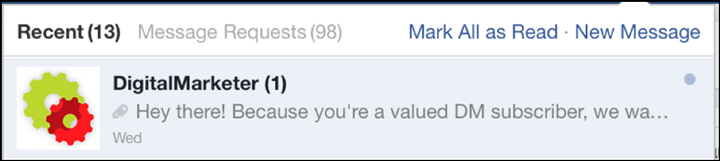
Image Source

It looks like any other message you’d get.

Plus, you don’t have to ask them to message you.

You can deliver a specific message without them needing to accept or initiate a call to action.

Since these users are already brand-aware, it’s best to message them with an offer or a discount now.

They know your brand, and you’ve likely qualified them up-front from your destination ads.

So you can push them further down the funnel.

DigitalMarketer has started using a coupon/discount-based tactic to convert these brand-aware users:

Image Source

Jon Loomer has taken a similar approach, attempting to drive qualified, brand-aware users to his training program:

Image Source

Sponsored messages are akin to lead magnets or purchase offers in traditional advertising.

You’ve already done the majority of the work:

  1. Finding the audience
  2. Generating brand awareness
  3. Evaluating their pain points
  4. Qualifying users

Now you just need to complete the last step:

5. Getting them to convert on an offer.

This should be your final step in customer acquisition with Messenger ads.

It should help you get their detailed information as a qualified lead. Then you can nurture them via other platforms like email or phone.

To set up this audience, you’ll need to create a new custom audience based on engagement:

Next, select the “Facebook Page” option:

Now, select “People who sent a message to your page” as the custom audience criteria:

This will allow you to create sponsored messages.

Now all you have to do is create another ad with the message-based custom audience you created, and you’re ready to convert these brand-aware users into full-on customers.

Finding your needle in the haystack doesn’t have to be hard.

Try implementing each one of these ad types to work together to fill your customer funnel.

Conclusion

Facebook Messenger ads offer great, new ways to reach customers.

But with any new platform or technique comes risk.

What works? What doesn’t? How do you know without wasting thousands of dollars on testing?

Start by using Messenger destination ads to qualify prospects up-front.

These ads take a cue from account-based marketing, where qualification is done at the beginning of the user journey rather than at the end.

Once you’ve done this, you can place Messenger ads directly within the app and even send more personalized messages to engaged users with sponsored messaging.

You can use Messenger ads to do a lot more than you may have thought possible. You can use them to build up brand awareness at the beginning, nurture newly-aware leads, and convert them into qualified prospects who are ready to buy.

All at a fraction of the competition you’re typically running up against. Which means if you do it correctly, a fraction of the cost you’d typically spend, too.

About the Author: Brad Smith is the founder of Codeless, a B2B content creation company. Frequent contributor to Kissmetrics, Unbounce, WordStream, AdEspresso, Search Engine Journal, Autopilot, and more.


from The Kissmetrics Marketing Blog http://ift.tt/2BGgZPT
via IFTTT

2017 Content Excellence Challenge: The December Prompts

Late last year, I had the wild-hair idea to create a year of prompts that I called the Content Excellence Challenge. We’ve had a year of these creativity and productivity challenges here on Copyblogger, and I think we’ve all arrived at a very special place. Spiritually, ecumenically, grammatically. The community has spent a year trying
Read More...

The post 2017 Content Excellence Challenge: The December Prompts appeared first on Copyblogger.

Related Stories


from Copyblogger http://ift.tt/2im9NzZ
via IFTTT

10 Things That Have Changed About Online Business In The Past 10 Years

Want to hear from some giants in the online business space about what’s changed in business the past 10 years? You should.

Why?

Ever wonder what is actually important to learn when it comes to building your own business? Are you getting left behind by the ever-changing entrepreneurial landscape? Then you better get into this episode.

Everyone knows there’s so much we need to learn when starting a business. We simply don’t know everything we need to before starting our businesses.

But that begs the question; what’s worth learning and what isn’t? If you waste your time learning unnecessary things, you are the only one who pays for it. Bottom line: you are just hurting yourself and your business.

In today’s episode, we are talking about exactly what has changed in online business for indie entrepreneurs over the last 10 years. Because if we can figure out and be smart about what has been changing, maybe that can help us better prepare for what will change in the future.

Today we welcome a very special guest, Pat Flynn, to discuss the way online business has changed over the past 10 years with Fizzle’s CEO, Corbett Barr.

Both Corbett and Pat are seasoned entrepreneurs who have supported themselves and their families through indie online business for 10+ years. Pat is the founder of Smart Passive Income where he teaches others, through his own experiments, exactly how to stop trading time for money and start building a business that works. And Corbett is the Co-Founder and CEO of Fizzle.co, which provides community feedback and friendship alongside high quality training for people earning a living doing something they care about.

Both these guys get into amazing insights that teach and inspire in this informal, conversational and entertaining episode! Enjoy :)

Subscribe (how to)   iTunes   Overcast   Pocket Casts   Stitcher   Google Play   RSS  

“2 online biz giants talk about what’s changed in the past 10 years”


Key Points From This Episode:

  • Overview of Pat’s entrepreneurial journey and shifts he’s experienced in the past. [0:02:59.0]
  • The consistency of content value, despite the changing multi-media landscape. [0:05:04.0]
  • How the mobile platform has increased its presence in online business. [0:07:46.0]
  • Understanding the future of mobile as augmented reality and virtual reality comes into play. [0:10:16.0]
  • Why now it is more valuable to first be present on one platform and mastering it. [0:13:00.0]
  • The turning point that pushed Pat to create his first online course. [0:16:39.0]
  • What has not changed about delivering an online information product? [0:19:55.0]
  • How to make your online course stand out in a very saturated market. [0:23:16.0]
  • Understanding the algorithms that are controlling how we connect. [0:29:18.0]
  • Recognizing how to capitalize on a business “wave” or trend. [0:31:00.0]
  • Why it is important to never put all your eggs in one “business basket”. [0:33:08.0]
  • Creating customized automation and a personalized experience with your email list. [0:36:18.0]
  • How team collaboration has changed with the introduction of new tech and tools. [0:39:33.0]
  • Increase in competition in the online space; podcasting, social media, and inbox. [0:43:16.0]
  • Why it has become easier to create a group of super-niched super fans. [0:46:08.0]
  • How people are now running entire businesses on social media platforms. [0:49:15.0]
  • Managing your expectations about online business and putting in the hard work. [0:51:03.0]

“When you know who you are and you utilize those super powers to help you with your business, you can’t lose.”— @PatFlynn


Links Mentioned in Today’s Episode:


from Fizzle http://ift.tt/2A86ojO
via IFTTT

Monday, 4 December 2017

Resistance to Reason: Why digital transformation is thwarted

There’s a scene in Cormac McCarthy’s book, All the Pretty Horses, in which the main character, John Grady, plays pool with his boss, a wealthy Mexican ranch owner. The reader feels tension because John, a transplanted Texan cowboy, has been covertly dating the owner’s daughter and it’s not clear whether the owner is aware. At the end of the story, It becomes clear that he does indeed know of the relationship because of a short story that he shares with John. The story is of his sister’s long ago and ill-fated romance with a revolutionary, a romance that went against societal norms. Both the sister and the revolutionary had been educated in Europe and were influenced by non-traditional notions such as, "people can be improved in their character by reason". They believed they could defy tradition, since the wealthy class did not cavort with those who weren’t members, and fulfill their desire for a long-term relationship. At that time (early 20th century), in that place (Mexico), and in that stratum of society (upper class), it seems that character was not something to be developed, no matter how reasonable the rationale for it may seem to an outside observer. Character was something that was a product of one’s station in life and reason was not accepted as a driver of change. The scene ends with the owner saying to John, “Beware gentle knight, there is no greater monster than reason."

Why Is There Resistance to Reason?

We’re about 70 years on from the time of those characters and yet it seems like many companies today treat reason much the same way society treated those lovers. Against the natural forces of science, experience, and emotion that surrounds them and bubbles up from within, companies resist change. Despite ample proof and despite the knowledge acquired from advanced educations and years of career experience of their employees, many companies seem to see reason as too disruptive a force, as something to be avoided, thwarted, or stopped altogether because it threatens the way things are, and the way things have always been. How else do we explain the slow embrace by companies to adopt a data-first approach to digital transformation than to conclude it threatens too much of how a company conducts its affairs (its culture), how it got to where it is (its story/history), the degree to which its stakeholders understand and even recognize risk (multi-dimensional thinking), and how its leaders view their time as stewards and, too often, their propensity to slide towards hubris? It’s a sad reality that for those companies taking their time to understand, plan, and execute a comprehensive digital strategy, they are inevitably also, and perhaps unwittingly, committing their companies to eventual irrelevance and decline in the market.

What Results from Resisting Reason?

Too often we see companies resisting reason and finding themselves stuck in an old-fashioned model where, for example:

  • Marketing takes direction from product management about what it should communicate to the market
  • Sales relies too heavily on cold contacting (calling, emailing) without sufficient contextual or business knowledge of the target customer
  • Support and Services wait until their customers trip up and fail when using the products before becoming engaged
  • Product teams design from a base of too little data about the unknown customer’s needs, wants, and desires

Modern companies with modern leaders shouldn’t allow these behaviors to perpetuate. Modern companies understand that the path to success lies in data that can be used to surface business insights and to:

  • Drive automated processes
  • Dissolve, and (finally) make obsolete, organizational silos
  • Recognize and reward truly efficient, engaged, and productive employees
  • More accurately project and attribute financial costs and assets
  • Deepen and strengthen a buyer or customer’s positive opinion of the company’s products, services, and brand.
Is This a Utopia?

No. There are companies that are behaving in the ways outlined above. It’s possible to achieve these results but it does take precious time, a considerable amount of coordination, and stellar transparency from the leadership team. But what’s the choice? To not transform means eventual failure. Successful companies are accelerating away from the pack and, arguably, are already uncatchable.

This Altimeter research report on The 2017 State of Digital Transformation offers up some pretty bleak findings on this topic.

  • Meager digital literacy within businesses is restraining the scope and extent of innovation to respond to consumers’ new expectations.
  • Often when companies do invest in digital-transformation initiatives, they are viewed as short-term cost centers with very limited budgets and other resources, not the long-term investments they must be for long-term success.
  • Many company cultures are risk-averse, and their leaders do not feel a sense of urgency to compete differently, despite global consumers’ embracing smart telephones and the Internet for more than a decade.
  • Politics, egos, and fear are the main obstacles to achieving the collaboration and solidarity needed within companies to make the changes digital consumers want.

We also observe these same findings from the vantage point of our practice. But it’s our belief that these obstacles are not impossible to overcome. It takes courage, yes, and persistence but the first thing it takes is an acceptance of, and an openness to, reason. The reason for transforming is everywhere we look. It’s everything we want in our experiences as consumers. It’s everything we should expect to see emerge in our demanding and rapidly evolving societies. It’s natural and inevitable.

Maybe monsters are occasionally misunderstood.

Are you read to introduce reason and change into your company? If you're ready to get the most out of your data but don't yet have a data management strategy, don't hesitate any longer. You can use Maximize Your Marketing: Eight Questions to Ask as You Introduce a Data Management Strategy to get started! 

Maximize Your Marketing: Eight Questions to Ask as You Introduce a Data Management Strategy

Featured Image Credit Source: Pixabay


from Oracle Blogs | Oracle Marketing Cloud http://ift.tt/2iPva0r
via IFTTT

Resistance to Reason: The reason why digital transformation is often thwarted

There’s a scene in Cormac McCarthy’s book, All the Pretty Horses, in which the main character, John Grady, plays pool with his boss, a wealthy Mexican ranch owner. The reader feels tension because John, a transplanted Texan cowboy, has been covertly dating the owner’s daughter and it’s not clear whether the owner is aware. At the end of the story, It becomes clear that he does indeed know of the relationship because of a short story that he shares with John. The story is of his sister’s long ago and ill-fated romance with a revolutionary, a romance that went against societal norms. Both the sister and the revolutionary had been educated in Europe and were influenced by non-traditional notions such as, "people can be improved in their character by reason". They believed they could defy tradition, since the wealthy class did not cavort with those who weren’t members, and fulfill their desire for a long-term relationship. At that time (early 20th century), in that place (Mexico), and in that stratum of society (upper class), it seems that character was not something to be developed, no matter how reasonable the rationale for it may seem to an outside observer. Character was something that was a product of one’s station in life and reason was not accepted as a driver of change. The scene ends with the owner saying to John, “Beware gentle knight, there is no greater monster than reason."

Why Is There Resistance to Reason?

We’re about 70 years on from the time of those characters and yet it seems like many companies today treat reason much the same way society treated those lovers. Against the natural forces of science, experience, and emotion that surrounds them and bubbles up from within, companies resist change. Despite ample proof and despite the knowledge acquired from advanced educations and years of career experience of their employees, many companies seem to see reason as too disruptive a force, as something to be avoided, thwarted, or stopped altogether because it threatens the way things are, and the way things have always been. How else do we explain the slow embrace by companies to adopt a data-first approach to digital transformation than to conclude it threatens too much of how a company conducts its affairs (its culture), how it got to where it is (its story/history), the degree to which its stakeholders understand and even recognize risk (multi-dimensional thinking), and how its leaders view their time as stewards and, too often, their propensity to slide towards hubris? It’s a sad reality that for those companies taking their time to understand, plan, and execute a comprehensive digital strategy, they are inevitably also, and perhaps unwittingly, committing their companies to eventual irrelevance and decline in the market.

What Results from Resisting Reason?

Too often we see companies resisting reason and finding themselves stuck in an old-fashioned model where, for example:

  • Marketing takes direction from product management about what it should communicate to the market
  • Sales relies too heavily on cold contacting (calling, emailing) without sufficient contextual or business knowledge of the target customer
  • Support and Services wait until their customers trip up and fail when using the products before becoming engaged
  • Product teams design from a base of too little data about the unknown customer’s needs, wants, and desires

Modern companies with modern leaders shouldn’t allow these behaviors to perpetuate. Modern companies understand that the path to success lies in data that can be used to surface business insights and to:

  • Drive automated processes
  • Dissolve, and (finally) make obsolete, organizational silos
  • Recognize and reward truly efficient, engaged, and productive employees
  • More accurately project and attribute financial costs and assets
  • Deepen and strengthen a buyer or customer’s positive opinion of the company’s products, services, and brand.
Is This a Utopia?

No. There are companies that are behaving in the ways outlined above. It’s possible to achieve these results but it does take precious time, a considerable amount of coordination, and stellar transparency from the leadership team. But what’s the choice? To not transform means eventual failure. Successful companies are accelerating away from the pack and, arguably, are already uncatchable.

This Altimeter research report on The 2017 State of Digital Transformation offers up some pretty bleak findings on this topic.

  • Meager digital literacy within businesses is restraining the scope and extent of innovation to respond to consumers’ new expectations.
  • Often when companies do invest in digital-transformation initiatives, they are viewed as short-term cost centers with very limited budgets and other resources, not the long-term investments they must be for long-term success.
  • Many company cultures are risk-averse, and their leaders do not feel a sense of urgency to compete differently, despite global consumers’ embracing smart telephones and the Internet for more than a decade.
  • Politics, egos, and fear are the main obstacles to achieving the collaboration and solidarity needed within companies to make the changes digital consumers want.

We also observe these same findings from the vantage point of our practice. But it’s our belief that these obstacles are not impossible to overcome. It takes courage, yes, and persistence but the first thing it takes is an acceptance of, and an openness to, reason. The reason for transforming is everywhere we look. It’s everything we want in our experiences as consumers. It’s everything we should expect to see emerge in our demanding and rapidly evolving societies. It’s natural and inevitable.

Maybe monsters are occasionally misunderstood.

Are you read to introduce reason and change into your company? If you're ready to get the most out of your data but don't yet have a data management strategy, don't hesitate any longer. You can use Maximize Your Marketing: Eight Questions to Ask as You Introduce a Data Management Strategy to get started! 

Maximize Your Marketing: Eight Questions to Ask as You Introduce a Data Management Strategy

Featured Image Credit Source: Pixabay


from Oracle Blogs | Oracle Marketing Cloud http://ift.tt/2jOmZxR
via IFTTT

What’s Actually Stunting Your Productivity (It’s Not Multitasking)

Lately, a common theme in productivity advice is bashing multitasking. “You suck at multitasking!” shrieks one headline. “Multitasking: the most dangerous productivity killer” hisses another. And they aren’t wrong. Studies have shown that trying to tackle different tasks simultaneously greatly reduces our cognitive abilities. But what if I told you there’s another type of multitasking
Read More...

The post What’s Actually Stunting Your Productivity (It’s Not Multitasking) appeared first on Copyblogger.


from Copyblogger http://ift.tt/2AMuhgf
via IFTTT

Friday, 1 December 2017

Adaptive Intelligence: Practical Tips for Bringing AI into Your Marketing

Artificial Intelligence is all over the news these days,  yet it can still be challenging to figure out how to make it work for your marketing team. This post outlines some practical tips for using the Oracle Marketing Cloud and AppCloud offerings like Motiva AI to bring new adaptive intelligence capabilities into the way you design, execute, and improve your marketing programs.

When you get beyond the term “Artificial Intelligence”, you’re really just talking about software that learns to do things. There are lots of AI subtopics, but suffice it to say the entire domain is exploding with activity and new ways to apply machine intelligence to solve important challenges. This will affect us — our work, our communities, and our societies — in profound and often unexpected ways.

However, it’s important to adjust expectations about what AI can and can’t do well when it comes to marketing. One of the more misleading ideas out there is that “predictive” AI will somehow magically run your marketing for you. It won’t. That’s a good thing.

And yet there are lots of opportunities where you can get started with AI today that will have a measurable impact on your marketing. Here are five tips on how to go about it:

1. Start Simple

Don’t try to take too much on with AI out of the gate. Start small, and then build on your success. Start with simple proof-of-concept use cases that you can measure easily. A good candidate here is message testing — but going beyond simple A/B type testing. You can use a tool like Motiva AI to test and automatically find winning messages that lead directly to campaign response improvement.

2. Match the Right Task with the Right Tool

There are some tasks that machines just do better than people. When you’re selecting machine learning applications to include in your marketing tech strategy, develop a list of areas where machines could make a difference. Here are some great candidates that you can take advantage of with the Oracle Marketing Cloud ecosystem right now:

  • Audience segmentation and definition
  • Message testing and optimization
  • Personalization
  • Content improvement
  • Send time optimization
  • Data cleaning
  • Advanced analytics

A large national healthcare company recently decided to focus on message testing and optimization, and used the Motiva AI Cloud for Eloqua on a patient-facing audience and saw a 200% difference in click-through rate by simply trying lots of message variations in the population. Motiva adapted to the audience preferences it observed, which allowed the campaign to adapt naturally. A simple place to start, with big impact.

3. Look for “10x” Opportunities

Many of these areas above are also huge time sinks for most teams, where humans have to sift through often large data sets and determine the best course of action. Ask yourself: where could we make the biggest impact in terms of customer response or savings? More often than not, machines can at least help the human marketers improve decision-making; in some cases, you can just outsource the entire workflow to intelligent helpers.

4. Measure and Improve

It’s vital to think about what your definition of success is for a given use of machine learning and how you’ll measure progress towards your goals.

  • Will it be in terms of time saved for your marketers? Then track their time — develop a baseline for the workflow you’re interested in and the difference over time.
  • Will it be in terms of campaign performance? Again, make sure you’re collecting the data and reporting for the story you want to tell.
  • Will it be in terms of effects downstream in the sales process? Ensure you can track your treatment effects all the way through your pipeline.

It’s not difficult, but you do have to do it. It’s just good modern marketing practice.

5. Remember It’s about Your Audience, Not Just the Tech

This may sound a little surprising coming from a technologist, but it’s true. Your number one concern should be how to develop that communication channel with your end audiences. Technology can be super useful here, but not all technology and not all the time. In terms of AI-driven tools, ask yourself:

  • Does this help me learn more about my customers and their needs?
  • Does it help me serve my customers better?
  • Does it strengthen the customer experience?

Make a connection between the tools you’re using and how they ultimately lead to positive customer impact.

The Adaptive Future

These tips are a place to begin to think about how to bring adaptive intelligence into your marketing. We are just seeing the start of a marketing revolution in which human intelligence and machine intelligence combine with groundbreaking results. You'll definitely need to find the best-in-class products and applications that will keep you ahead of the game and delivering the best possible experience for customers.

Make sure that you have covered your marketing automation fundamentals before implementing these best-in-class products and applications. Download the Marketing Automation Fundamentals: Account-Based Marketing to get started! 

Marketing Automation Fundamentals: Account-Based Marketing

Featured image source: Pixabay


from Oracle Blogs | Oracle Marketing Cloud http://ift.tt/2zUva6E
via IFTTT