Wednesday, 5 September 2018

Customer Success Leaders: Think & Act, Then Think & Act

As a customer success leader, how many times have you been in a meeting where the VP of sales asks what you’re doing to get strategic customer, ACME123, out of the ditch so that her salespeople can more smoothly pursue and close a growth deal? Once? Twice? Dozens of times?

From an industry perspective, product problems are often cited as a primary reason customers find themselves in that ditch. That’s followed closely by poor responsiveness of support and a perception that the installed solution is rife with complexity. Aggressive competitors pounce on these situations to create FUD (fear, uncertainty, and doubt) in the marketplace with marketing campaigns that attempt to woo away your customers.

So, what’s your normal response to the VP in those meetings? Do you try to deflect responsibility or do you assertively take ownership of the situation? After all, the VP looked around the room and communicated to all the other leaders what she knows the customer success mission to be. The words were familiar to you because you wrote them as your organization’s mission statement:

  • Ensure customers understand and adopt the solution.
  • Marshal all required resources to resolve situations that are inhibiting a customer’s ability to realize their expected value from their investment.
  • Be the customer’s advocate.
  • Create the right environment so the customer continues to renew the commercial relationship.

See what I did there? I used industry jargon to depict a common scene where someone outside customer success uses the jargon in an attempt to trap (maybe innocently) the customer success team into fulfilling a broad set of responsibilities it is believed belong to them.

What this power play scene boils down to is an argument about which side of a fine-edged sword the leadership team will choose. On one side is the clear language of that list. It’s tough to dispute those worthy goals. They’re clearly good for customers, and from the vendor’s point of view, they are abstract enough to not offend or overly inspire. It’s also too easy, though, to say that just because those items are on a list means that one organization can control everything required to achieve each goal.

Modern business dictates a new view of customer management, one based on the entire customer lifecycle. And that means we must acknowledge that while customer success is indeed responsible for those things, they do not control the results of the efforts made by other organizations all along the way. This team must be seen as the organization that will coordinate and guide; they should definitely be seen as the vanguard for driving value, but the reality is that they inherit the customer. In a sense, customer success is in the odd position of being charged with making the customer whole while simultaneously exposing what needs to change within the vendor’s own walls. That’s essentially a case to call customer success a transformational change agent.

Back to that scenario, here’s what customer success should do.

Manage the Rescue, But Only If All Agree to an Autopsy

I know in this scenario the customer isn’t deceased. But having experienced those meetings countless times in a number of companies, I feel it’s safe to say that if they aren’t dead the first or second time they end up in the ditch, by the third time around, they’ll almost assuredly be dead. So, thinking radically, conduct an autopsy on something that still has a chance to live, instead of waiting for it to die.

For the good of the customer and vendor, customer success should agree to manage the rescue of the customer (really, who else will?) only when each involved executive leader of that customer’s lifecycle agrees to determine what caused the customer to veer off course in the first place. An autopsy would examine if the customer was in the ditch because of:

  • Inappropriate solutions sold at the outset.
  • Poorly designed/architected/developed/tested product.
  • Poor documentation in the CRM by the sales team of customer goals, skills, influencer information, expectations of ROI, impact to long-term business, etc.
  • Or, all of the above was documented but the post-sales teams had no visibility into the account records.
  • Poorly scoped and/or poorly delivered services engagement.
  • A real product flaw that’s reproducible and will take some time to repair.
  • Cloud provisioning was flawed in some small, obscure way.
  • Customer onboarding was non-existent, rushed, too high-level, or lacked oversight.
  • Customer support’s processes reward rapid service request closures – even if root cause is not identified. As long as a workaround is devised, that is seen as sufficient.
  • Customer success missed all the clues that signal a struggling customer.

To all the naysayers out there who argue that autopsies take too much time and most companies wouldn’t be able to cobble together leaders from each organization to participate in such recurring exercises, I say this. Good luck keeping up with companies that aren’t thinking that way and are beginning to exploit machine learning and artificial intelligence. Still, think it would be impossible to conduct this type of exercise for all your at-risk customers? Then allow me to pull another word from the jargon bin.

Proactive.

To execute proactively in anything, one has to be thoughtful. Knowledge about what to do to avoid or forestall a negative thing from happening requires one to consider the problem that should be avoided and put in place methods for preventing it from happening. Or as the Cambridge Dictionary defines it, “taking action by causing change and not only reacting to change when it happens.”

Own the Shame, But Learn from It

There’s a whole lot of shame that can be cast around when customers end up in the ditch. Some of it has to go toward the customers for their own shortfalls in process and talent, but much of it has to be worn by the vendor. Vendors are the ones who are the product experts, who know why the product even exists, who know how it can be fixed when broken, and who know what it takes for a customer to extract value from it.

Own it, but whatever you do, don’t let your go-to reactive response (rescue) dictate how similar scenarios should be handled in the future. That’s a recipe for more rescues and more support for those opinions in the market about the complexity of your solutions. Understand that many customer problems have common causes, typical patterns that result in outcomes they didn’t expect. Apply a scientific approach to the data associated with the customer’s experience and identify those patterns. Study what should change in your processes, your products, the skills of your people. Customer success should be the organization that leads that effort, but they can’t do it alone.

I’ll close with a story. I once worked for a large enterprise software company whose SVP of customer support was renowned as a great customer advocate, as someone who would do what it took to get the customer over the product bumps they were experiencing. I’d only worked with the company for a few months, but I became skeptical. I began to investigate those experiences with my portfolio of clients (I was in customer success at the time), and it quickly became clear why that SVP had the reputation he had. It turns out it was a completely internal reputation, not an external opinion that customers shared.

Here’s how things worked. Customers knew enough to game the system to the extent that they opened every single service request with a severity one. There they sat, even the most critical ones, until the customer raised hell with their sales rep. If it was important enough to the sales rep (meaning, there was revenue on the horizon) they would contact the EVP who would then triage that severity one against all the others he’d been alerted about. He would then direct the effort of the support organization accordingly.

We lived then in a world like the madness of Madness of King George (though he wasn’t named George for all you sleuths out there). What was he then, besides an impressive and logic-challenged human robot? He was a bad habit enabler. He was controlled by the sales organization. He was a culture and productivity killer. And ultimately, because of his 100 percent reactive style, he was also a very poor advocate for customers.

It wasn’t all his fault, but the company’s NPS never budged, and its reputation drifted aimlessly. He was canned after I left that company when customer experience became an industry focus and rose in importance to finally register at the board level.

Reactive doesn’t work. Think and act. Think and act.


from Oracle Blogs | Oracle Marketing Cloud https://ift.tt/2LUjZMB
via IFTTT

Tuesday, 4 September 2018

We Analyzed 5,860,631,392 Articles From 64 Countries. Here’s What Facebook Loves!

data marketing facebook

Facebook reach has continually declined over time.

Nowadays everyone tells me there is no point in even sharing content on Facebook.

But you know what? You can still generate traffic from Facebook.

Yes, traffic has declined. Even so, in the last 31 days, I’ve generated 20,420 visits from Facebook.

facebook traffic

That’s not too shabby considering I’m only publishing 4 articles a month. That’s an average of 5,105 visitors per article from Facebook.

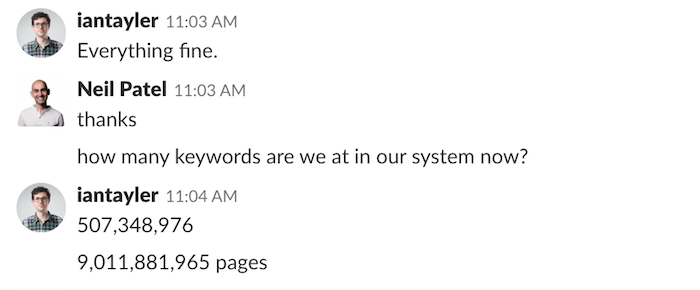
And because I’ve been building the ultimate SEO tool, I’ve been gathering social sharing data on over 9 billion URLs.

database size

But a large portion of the URLs in our database aren’t articles. So, for this analysis, we looked at 5,860,631,392 articles.

Before I dive into what we have learned, there are few things you ought to know about the data:

  1. Technically we have gathered social sharing data on 11,721,262,784 articles. For each URL we gather data on the HTTP and the HTTPS version to get an accurate count as more sites have transitioned to HTTPS over time.
  2. We only looked at articles. A lot of URLs such as nike.com have over a million Facebook shares, but they aren’t articles.
  3. We looked at articles in multiple languages as English isn’t the main language everyone speaks in the world.
  4. When I say “social shares”, that includes reactions, comments, and shares from Facebook.
  5. We excluded scraper sites. A lot of the articles shared on Facebook are scraper sites. They barely have any shares and it skews the data.
  6. In total, the 5,860,631,392 articles came from 163,968,722 domains.
  7. Our list of articles started with Google search results. Because we have data on 507,348,976 search engine results from 64 different countries, we were then able to find the sites that you read on a regular basis, which then helped us crawl and find more articles that you may read.

Let’s dive into the learnings.

What type of content generates the most Facebook likes overtime?

There’s been countless articles published showing that list posts and infographics generate the most social shares.

And that makes sense because who doesn’t love a visual piece of content such as an infographic?

But what if you want social shares over time?

By looking at how many social shares each article generates on a monthly basis, we were able to see the growth rate and the types of article that generate the most social shares over time.

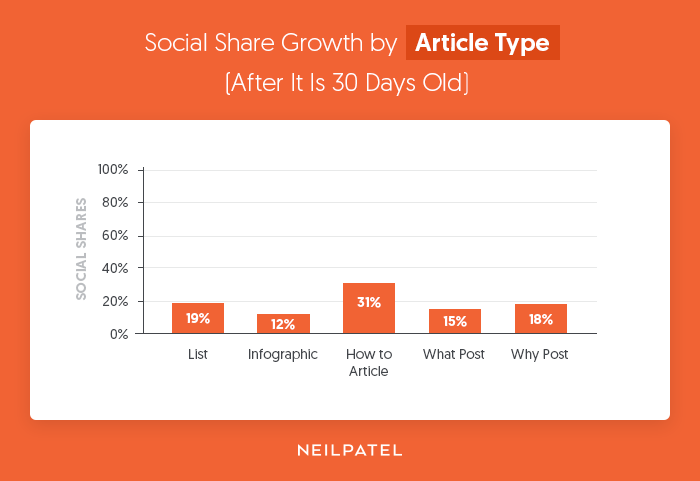
Here’s the share growth rate over time per article type:

how to

If you want a quick boost in Facebook traffic, consider creating infographics.

But if you want more consistent Facebook traffic each and every month, focus on “how to” articles. They don’t do as well right off the bat, but over time they produce more consistent Facebook traffic.

how to trends

The reason for this is that infographics are harder to rank on Google because they don’t contain a lot of text.

By creating content like “how to” articles that tend to get searched frequently, you can get consistent traffic to your articles which will cause more social shares.

How long (or short) should your headlines be?

Do Facebook users prefer short or long headlines? If you had to take a guess, what would you think?

Most people think the shorter the better…

Let’s look at the data:

headline length

Users prefer headlines that are roughly 7, 8 or 9 words.

You can’t really explain what an article is about in 4 words. By having your headline long enough, it will allow you to be more descriptive.

Don’t focus on making your headlines as short as possible, focus on making them descriptive.

How do images impact shares?

You already know people love images. If they didn’t, Facebook wouldn’t be as popular.

But the question is, how many images do you really need per article to get the maximum number of social shares?

images shares

In general, the more images the better.

The one thing to note is that a lot of the articles that had over 7 images weren’t really articles per say.

A lot of them were articles that have a clear objective of getting you to browse through an image gallery, such as someone showing off stunning images of the Milky Way or image galleries of silly cats.

When writing content, consider including images to describe your message. The more the better.

How long should your lists be?

Based on our data, most people prefer writing list-based articles with the number 10. In other words, their lists only have 10 items.

When we looked at the average share count based on list size, it was clear that lists that were 10 items long won.

But there is a problem: the data is skewed because everyone focuses on smaller lists.

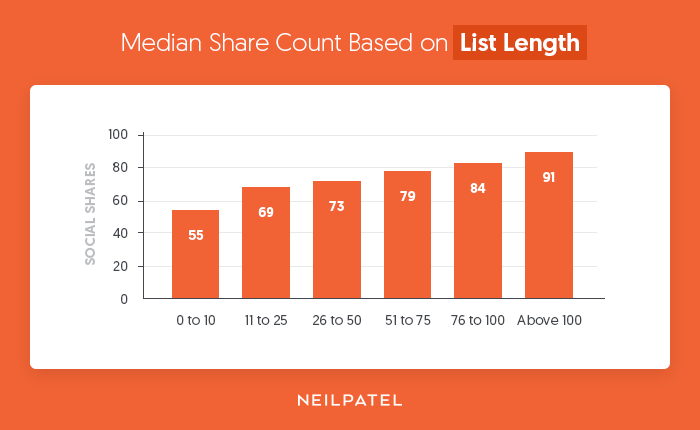
When we started to look at the median share count per list size, the data got interesting.

list length

The more detailed the list, the better.

If you ever decide to write a list-based post that is over 100 items, there is a good chance people will share it assuming it is super detailed.

Shortlists have been beaten to death for years. That’s why longer ones that leverage the skyscraper technique perform better these days.

How long should your articles be?

Should you write short articles or long ones? And how sort or long should they be?

This question has been asked and discussed in marketing circles for years.

content length

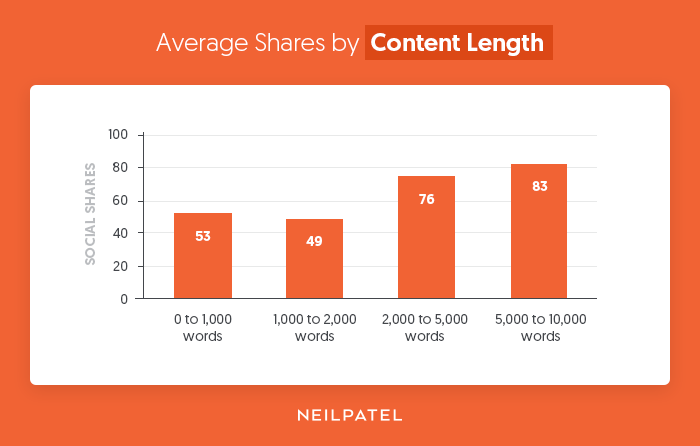
The data shows, the longer the better.

If you were to write 10,000-word blog posts that are super actionable, you would generate more social shares than if you wrote 2,000-word blog posts.

I know I’ve mentioned in the past that writing super long content is like throwing money out the window. And it is especially true when it comes to Google traffic.

So for a nice balance, I would still stick with the advice I gave in that article, which is to write roughly 2,000-word blog posts. Then expand upon it over time. And every time you expand upon the article, you can share it again on Facebook.

If you don’t care about Google and you only want to focus on Facebook, then just go for that 10,000-word article.

You’ll also notice that 1,000-word articles generate more shares than 2,000-word articles.

We were curious why this was so we dug into the data a bit more and found that articles that contained less than 1,000 words in many cases contained more images than 2,000-word articles.

In addition to that, many of the shorter articles were also news based.

And speaking of news…

Is it better to write news-based content or evergreen content?

Over time, evergreen content gets more traffic. It’s not just because of Facebook, it’s that they rank better in Google and get more consistent traffic over the years.

No one is Googling about what happened in the news a year ago.

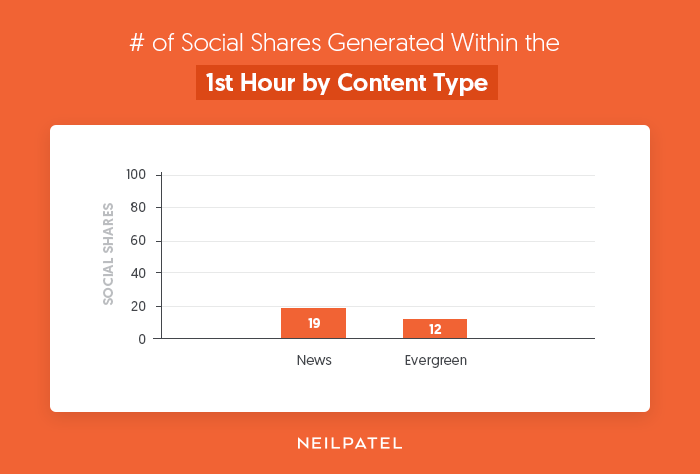
None-the-less, let’s look at the first hour of when an article is published.

news shares

News based articles win in the short run. I already discussed above how “how to” articles will get you the most consistent search traffic over time, but if you want a quick hit, consider covering news related topics.

Do emotions affect social sharing?

I used to love writing articles that pushed fear because they generated a lot of traffic for me. But the issue with doing this is that I used to get emails from people asking me if I was depressed or needed help.

I’ve always been fine, but many of you told me how you don’t like when I push fear in my articles. So, I naturally stopped.

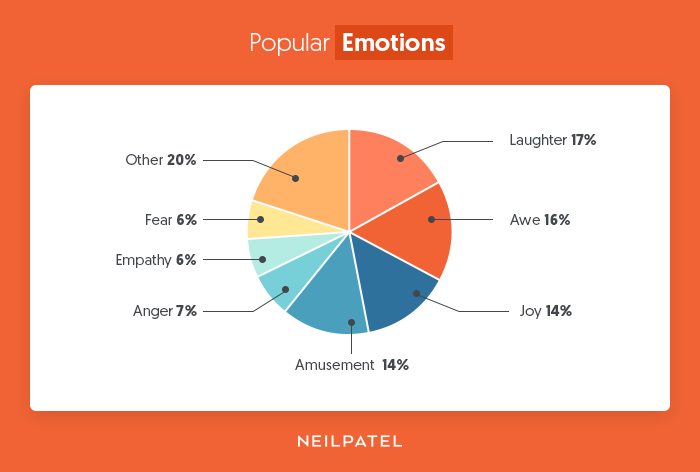
And although fear is an effective way to generate more social shares, it isn’t the most powerful emotion (at least when it comes to Facebook).

emotions

People love content with laughter, awe, and joy. Or at least, that’s what people prefer sharing, as opposed to fear.

You can clearly see by the image above that people prefer laughter roughly 3 times more than they prefer fear.

When should you post your content?

Writing an amazing article isn’t enough. If you write content on a bad day and release it during a time when no one is online, then you won’t go viral on Facebook.

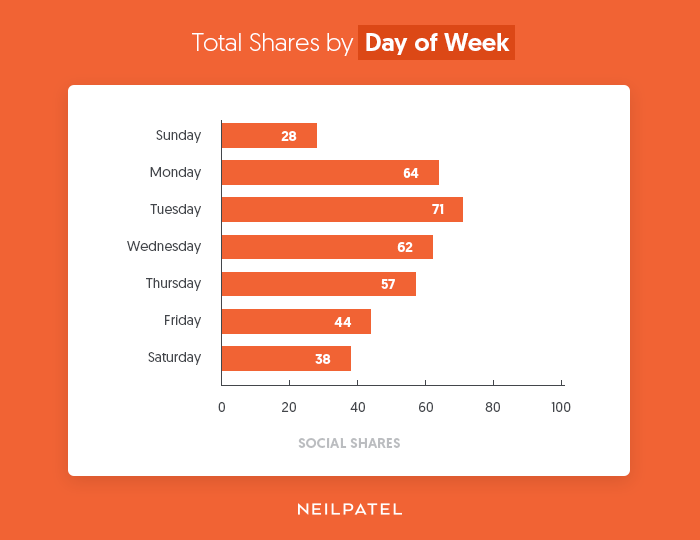
day of week

People prefer sharing content on Tuesday over any other day.

If you are going to write only one article a week, release it on Tuesday. If you are writing multiple articles a week, focus on Monday, Tuesday, and Wednesday as they are the most popular days.

And as for the time of day…

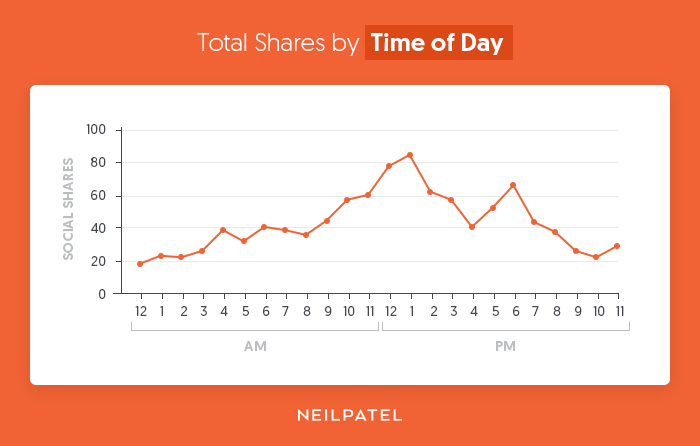
time of day

You tend to share content between 11 am and 1 pm.

That’s right before you are about to leave for your lunch break and it’s right when you come back. A lot of people get tired during the middle of the day and they need a break.

That’s why you will see many people within your office on Facebook during the afternoon.

If you miss the 1 pm publishing window, you can always shoot for the 6 pm slot. The share count goes back up around the time people are finishing up with work.

Conclusion

Yes, it is hard to get traffic from Facebook. They do limit your reach compared to 4 or 5 years ago because they don’t want you driving people from Facebook off to your website. That and they want you to boost posts to increase your reach (and their revenue).

The longer people stay on Facebook the more money they make. That’s why they love video content.

But that doesn’t mean you still can’t do well. If you follow the data above it will give you the best shot of getting the most traffic from Facebook.

What do you think about the data and stats? Are you going to follow it?

The post We Analyzed 5,860,631,392 Articles From 64 Countries. Here’s What Facebook Loves! appeared first on Neil Patel.


from Blog – Neil Patel https://ift.tt/2NcSr9Q
via IFTTT

5 indispensable email list management best practices

The email marketing world no longer revolves around sending mass emails to a huge list and hoping some take the bait. Instead, it’s about engaging email recipients with content they want and look forward to getting. To help you with your email list management, here are five best practices:

1. Respect permission levels

There are a few layers for this part of list management. For one thing, if you haven’t reached out to someone in a while, it can be worth it to regain permission to email them. This prevents confusion and high bounce rates by ensuring that the people you email want to hear from you. But if these people ask to be removed or don’t respond to your attempt at regaining permission, it’s best to remove them from your mailing list.

Another thing to consider is subscription management: Let people manage their email preferences, so they don’t have to unsubscribe altogether just to reduce one specific type of content they don’t want. Also, understand that there are email laws. And if you’re sending to countries around the world, there’s special legislation you need to be aware of. The passage of GDPR, even though it applies mainly to Europe, also may affect communications with some of your recipients.

2. Be prepared for the worst-case scenario

Make it easy for subscribers to leave. It’s not ideal, but it’s better in the long run to have a simple unsubscribe option, and it’s definitely better than having your emails marked as spam. Put the unsubscribe button somewhere that’s easy to find, such as in the footer of your email or at the top in the preheader area. Don’t hide it in a long paragraph of terms and conditions.

3. Know your audience

Consider surveying email recipients to understand how they like to receive information. If your subscribers prefer to receive information via written online content, like traditional blogs, you will not be able to reach them effectively with podcasts. Also, ask them demographic questions that yield valuable insights into their age, location and the like. These questions will help you tailor content. For example, if you realize most of your email list is made up of 30-year-old investment bankers, you may use a different tone and voice than if your list is primarily young mothers. 

Editor’s note: Although purchasing a third-party email list may be faster and easier on your end, the results are less than stellar. Not only have people from these lists likely never come in contact with your business, but they also didn’t ask to receive emails from you. This significantly reduces your ROI (return on investment) and reduces the odds that they will even open your emails in the first place. Instead, for best email list management, build your list by letting people sign up from your website, blog and social media, and at in-person events.

4. Look for hard bounces

Hard bounces are emails that get returned because the email address is invalid. This can happen because the recipient’s email address has been mistyped or the account has been disabled or closed. It’s a good idea to audit your contact list weekly, monthly or in between big email campaigns to remove any bounced email addresses.

5. See what’s working

Another idea for list management is to look at engagement metrics to see if people respond better to receiving multiple emails a week versus receiving two a month. Check out what kind of content gets higher open rates, and what time of day gets the most opens. This may seem obvious, but don’t just glance at the metrics once in a while to say you did it. Dig into what the data means. Check out the hidden nuggets of information that can help you better your emails. Also, try A/B testing. Only change one thing at a time so you can pinpoint any differences in responses. 

Maintaining your email list is like maintaining your relationships. Put in the time to get it right. 

Join 140,000 small business owners

Get expert tips and email inspiration delivered to your inbox every two weeks.

© 2018, Lindsey Bakken. All rights reserved.

The post 5 indispensable email list management best practices appeared first on VerticalResponse Blog.


from VerticalResponse Blog https://ift.tt/2Q8Pi9Q
via IFTTT

How to Stop Comparing Yourself to Other Content Marketers (and Start Getting Better Clients)

People in your life mean well. They really do. They want to protect you. They want you to have a...

The post How to Stop Comparing Yourself to Other Content Marketers (and Start Getting Better Clients) appeared first on Copyblogger.


from Copyblogger https://ift.tt/2oBq1bH
via IFTTT

Don’t Make These Web Hosting Mistakes! (FS283)

How much do you know about your website’s hosting? Has finding the right host been a challenge that you wish you could put to rest? What really is the best hosting platform for you and your business?

Whether you are tech savvy or not, chances are you have had some issues with website hosting during your entrepreneurial life. Almost all businesses require an online presence and thus a homepage for customers to visit, but setting this up has historically been a tricky business.

In this episode we look at some the developments in this field over the last decade or so and speak particularly on our experiences with WordPress and Squarespace. From there, we look at the different hosting options available to WordPress users and talk about the two main lanes that these fall into.

We also talk about domain purchasing and how your host can effect everything related to your website. The last part of the episode is dedicated to to announcing a great web hosting offer that is now available through your Fizzle membership. We are extremely excited about this, so make sure to stay tuned for that!

For all this and more, listen up in and get it all, Fizzlers!

Subscribe (how to)   iTunes   Overcast   Pocket Casts   Stitcher   Google Play   RSS  


Key Points From This Episode:

  • Why the majority of entrepreneurs and Fizzlers are on WordPress. [0:05:15.7]
  • Some of the dangers and horror stories related to web hosting. [0:07:47.6]
  • Getting what you pay for with web hosting. [0:12:40.2]
  • Chase’s experiences with domain purchasing and managed hosting. [0:14:39.6]
  • The effects that your host will have on your and your users’ experience. [0:18:50.8]
  • Why managed WordPress hosts offer so much to new users. [0:23:53]
  • Some information on Flywheel, and a special offer for Fizzlers. [0:28:12.2]
  • Getting the most out of the host! [0:36:21.7]
  • The added bonuses of having a built in host within the Fizzle membership. [0:40:15.5]
  • Why this conversation is the essential step after your product. [0:43:30.3]
  • And much more!


Links Mentioned in Today’s Episode:


from Fizzle https://ift.tt/2MOD3RN
via IFTTT

Monday, 3 September 2018

Let Your Business Stand Out With Instagram Stories

Ever since Instagram Stories debuted, this feature has been a big hit with Instagram users, enabling them to combine photos and video clips into one coherent narrative in order to share important (and sometimes, not so important) moments from their lives. And now businesses are exploring new uses for Instagram Stories to engage with customers and fans.

Experiment with Stop-Motion Ads on Instagram

One interesting use of Instagram Stories is to create quick, catchy ads to run on Instagram. The one type of ad that Instagram is promoting right now is the stop-motion ad. This type of ad refers to a product that appears to be moving in a series of herky-jerky movements, such as a pair of shoes moving across your screen. This might seem like a bit of Hollywood-caliber special effects magic, but it’s actually incredibly easy to pull off with Instagram Stories. All you have to do is use the “stop-motion” mode on your camera within the Instagram app, and then capture the product moving. Add some text, change the font to match your brand logo, and you’re good to go. All that remains to be done is to save the story and then upload it as an ad within the Instagram ad manager.

Add Creative Touches to Any Story

And there are plenty of other ways that you can be creative with your Instagram Stories.  For example, if you are a fashion brand, you can use the “rewind” feature to take apart an outfit and then put it back together. So, if you are looking to promote your new summer fashion line, you might look for ways to pair different accessories – like a chic pair of sunglasses – with a t-shirt and pair of shorts. And, you can also use the “superzoom” feature to zoom in on a product. Say, for example, that you want to highlight the craftsmanship of a particular handbag – you could easily zoom in on the fabric and stitching, and maybe even add in some funky music. It all makes for a very compelling visual experience.

Instagram is trying to get the word out that you don’t need to be a creative or graphic genius to play around with all the features within Instagram Stories. For example, as long as you have a basic product photo, you can add on stickers and text and turn it into a compelling visual for an upcoming promotion.

Go Behind-the-Scenes with Instagram Stories

For many brands and small businesses, one easy way to tap into the power of Instagram Stories involves simply filming “behind-the-scenes” moments at your business. If you are a restaurant, for example, show what happens in order for a meal to make it to your table – even something as simple as the head chef giving a pep talk to his or her team could be very compelling, and help to bring out the story of your restaurant brand and make every meal more special.

Make Product Demos for Your Fans

Another easy application of Instagram Stories could be a basic product demo. In just a few seconds, you can show how a product works, and maybe showcase a creative use for the product that most people don’t know. Or, you might want to switch things up and have a celebrity or some other prominent person appear in a brief video clip, showing how they use the product in everyday life.

People respond to stories, and every business has a story. And now, using the Instagram Stories features, you can help to bring those stories to life.

*This post originally appeared on socialmedia hq.


Guide to Social Media Marketing


from Oracle Blogs | Oracle Marketing Cloud https://ift.tt/2Q2coPp
via IFTTT

Happy Labor Day!

Today is Labor Day in the U.S., a time to celebrate the potency and dignity of work — and the...

The post Happy Labor Day! appeared first on Copyblogger.


from Copyblogger https://ift.tt/2oxXmUV
via IFTTT