Monday, 5 November 2018

How To Develop A Social Media Policy For Your Business

For any small business, a social media policy should clearly outline how all employees should conduct themselves online – such as the type of content they can post, how they should interact with people online, and how they should respond to any negative crisis event. Here are several key guidelines on how to develop a social media policy for your business.

Encourage Employee Participation

First and foremost, social media policy should encourage, not discourage, online activity. If you think about most corporate policies, they describe what you can't do, not what you can do (e.g. you can’t take more than X days of vacation each year). So you have to take a different approach with social media. You should clearly encourage employees to engage online and to practice common sense while doing so.

Establish Basic Guidelines for Social Media Use

You should establish certain “rules of the road” for social media use. For example, if employees are posting content via their own social media accounts, they should make clear what their relationship to the company. For example, say that your company has just released a fantastic new product, and your employees want to talk about it via social media. They should clearly point out that they are employees of the company, and what their role is. This prevents any awkward situations, where it appears that a company is “hyping” its own products using stealth social media accounts.

Focus on Common Sense Principles

It’s tempting to try to create a massive, 30-page document outlining every possible situation on social media and how employees should act. But guess what? That’s self-defeating for two key reasons. One, nobody is going to read a boring 30-page document. Two, social media is constantly evolving. As soon as you think you’ve covered everything possible, a new social media use case will appear.

So, focus more on common sense principles – and keep it brief. For example, popular retailer Adidas has a simple, two-page document. It focuses on common sense principles. For example, you have to be careful about non-disclosure agreements and confidentiality agreements on social media – if you have a super-secret product about to launch, you don’t want your employees posting Instagram photos of it!

Include Guidelines on Dealing with Crises

Sooner or later, your company will have to deal with a social media crisis. And you will want your employees to know how to deal with it. For example, some companies designate a single person to be the point of contact for any social media crisis. Others tell their employees to respond immediately to any crisis. Adidas, for example, tells its employees that they have to be “the first to respond to a mistake.” The goal, of course, is to contain any fire so that it doesn’t become a conflagration.

With these basic guidelines, it’s possible to create a flexible and effective social media policy. Remember – your goal is not to list every possible contingency, it’s to provide a framework for action. You should empower employees to share their enthusiasm and energy, not make them jump through a lot of hoops to get the word out about your company.

 *This post originally appeared on socialmedia hq.


from Oracle Blogs | Oracle Marketing Cloud https://ift.tt/2ALNcXM
via IFTTT

In Search of Better Introductions

Pause. I couldn’t watch another minute of the movie. It was a 10-hour flight, though, so I had to find...

The post In Search of Better Introductions appeared first on Copyblogger.


from Copyblogger https://ift.tt/2qvFnzA
via IFTTT

Friday, 2 November 2018

The Battle For Customers

“We tend to fight the next war in the same way we fought the last one. We are prisoners of our own experience.”

Sam Wilson, Lieutenant General US Army

He spoke those words a few years before the Vietnam War plummeted to its nadir (from America’s perspective). The conflict was gradually slipping out of control of the US government and a thought was emerging amongst a circle of military leaders, troubling and difficult for many to accept, that the US involvement had been predicated on a miscalculation about how wars should be fought. From the start, the war was different in the predominant mode of operations (guerrilla warfare) of the US enemy and in that respect, it had not followed the familiar patterns of the previous two significant conflicts (WWII and the Korean War). Leaders like General Wilson began voicing concerns that the US was up to its neck with the wrong strategy and that they couldn’t win if they maintained their current course. We know what happened after that. That message was smothered and so too were US hopes of victory.

While this article begins with a focus on war, the rest of it is not about that subject or geopolitics. It is about history, though—the history of business and how it tends to view customers.

Taking a longer view is a noble endeavor 

The second sentence in General Wilson’s quote came to mind when I recently read, Successful companies more likely to say marketing function “owns the customer” [stats] from Econsultancy, an agency I subscribe to and whose research I admire. This article calls for a reorientation of marketing’s mission so that it can begin focusing on working with a company’s existing customers in a similar way that it focuses today on buyers and prospects. In other words, cover the complete lifecycle of a customer, providing them with the guidance they need to make the best decisions at each step of their journey. That strategy is so virtuous that it’s hard to debate and as a person who spends a lot of time thinking about how the customer’s experience could be improved, it made me want to stand up and applaud.  

Taking a step back

A reorientation is indeed necessary for two reasons: 1) because we know marketing struggles to prove to sales (primarily its historical master) that the work it performs makes a difference in whether a customer decides to purchase and, 2) because effort spent working with loyal customers has a larger impact on profit over time than does the effort involved in securing new customers. Focusing on existing customers will be a departure for marketing, however, and will involve: an entirely new way of thinking about revenue, designing new processes that haven’t even yet been considered, cross-organizational conversations to drive decisions that produce mutually agreeable outcomes, and in convincing the entire company that marketing should take a lead role in influencing customer growth.

Prisoners of our own experience

And this is where General Wilson strides back on to the scene. Another perspective on the above-mentioned article would be to consider the idea from a wider lens, past just sales or marketing “owning the customer”. Setting aside the internal turf war that will eventually erupt because of that assertion, there is one perspective that isn’t considered in that scenario. When you think about it more expansively, the question of ownership has always been about money. Who has the relationship with the customer decision-makers? That’s why it has historically rested on sales to carry that responsibility. But what about in the new world of cloud where the customer experience is increasingly seen as the linchpin to renewals and growth? Is it marketing? A case can be made that they are better prepared for that than sales but how will marketing get the full picture of the existing customer without an intimate partnership with those organizations that work most closely with those customers? That would be customer success, customer support, and education.

Much of what’s being written about marketing’s new need to focus on existing customers, unfortunately, repeats the refrain (owning the customer) from an old hymn book and it sounds discordant in the world of cloud businesses. While I don’t disagree with the underlying research in the article, I do believe obsessing about who owns the customer is a waste of corporate energy that should be diverted towards more substantial concerns like organizational alignment around the customer experience. Wanting to be seen as the organization that owns the customer perpetuates a questionable strategy that has historically failed at addressing customer need and sees a company’s organizations pitted more against each other than in being cooperative. 

Who owns the customer?

No one really “owns” the customer in subscription companies. It’s actually more accurate to say that the customer owns the customer because, although many companies seem to have difficulty coming to terms with this truism, the customer is in control. McKinsey implied as much in this piece, called Organizing for the Future, in which they framed the need to redesign our corporations in response to digitization, which is ultimately driven by consumer and customer preferences.

Tien Tzuo, CEO of Zuora, attempted to speak to this too in his book, Subscribed. Where he depicted a modern corporation operating in the manner shown below, one in which the customer forms the nucleus and all processes flow around them. That new model contrasts sharply with the conventional (and increasingly risky in the digital age) hierarchical model that sees the product as the source of a company’s work and its reason for being.

So instead of saying any particular organization owns the customer, it might be wiser and more digitally efficient and accurate to ask “since the customer owns their own experience with products and services, how can we all work together to make sure they get optimal value from those things?”

I’ve been calling for a convergence of customer success and marketing going back at least five years and if I co-opt the main message of that research I called out earlier, it looks like we might be approaching an opportunity for it to come true. If marketing and customer success can collaborate and build integrated and automated processes, they can drive the kind of digital transformation that would see the customer benefit in the end (and naturally, therefore, the company would too). Customers will receive the targeted guidance they need in near real-time and it will be based on a full picture of their preferences and on their rate of adoption against the business goals they’ve articulated for the solutions in which they invested. It’s worth mentioning that our recently announced CX Unity holds great promise for moving the industry down that road.  

Let’s break with the past

It has been said that the most difficult aspect of digital transformation is the "cultural". I see language as a key element of the cultural component. It can hinder or accelerate depending on how it’s used. For companies to be truly customer-centric in today’s economy, lots of things need to happen. But, first and foremost is the need for organizations, and the people who work within, to reimagine how they focus their effort around the customer. They need to understand that collaborating cross-organizationally is the only pathway to success.

With the power of AI, Oracle Marketing Cloud technology connects, thinks and adapts to optimize the CX journey with every engagement. Get our guides here.


from Oracle Blogs | Oracle Marketing Cloud https://ift.tt/2AHZ50X
via IFTTT

10 ways to prepare for Small Business Saturday

Whether you’re a seasoned Small Business Saturday pro or hearing about it for the first time, customers care about the Saturday following Thanksgiving. On Nov. 24, 2018, thousands of consumers will show their support for small businesses. For encouragement and motivation leading up to the big day, see what research says about these consumers:

Do consumers care about Small Business Saturday? 

Research proves yes. According to Business Wire, 65 percent of people who plan to shop on Small Business Saturday this year say they will support local, independently owned businesses because of the contributions small businesses make to their community. Additionally, the 2017 Small Business Saturday Consumer Insights Survey by American Express found:

  • As many as 80 percent of all consumers surveyed say they will do some of their holiday shopping at small, independently owned retailers or restaurants.
  • Three-quarters of all consumers surveyed are planning to visit one or more small businesses to do their holiday shopping.
  • 90 percent of all consumers surveyed agree it’s important for them to support small, independently owned restaurants and bars.
  • Of consumers who are aware of Small Business Saturday, 89 percent agree that the day encourages them to shop small all year long, not just during the holiday season.

How can I make a great experience for my customers? 

Now’s the time to prepare your promotion plan to get in on the action. The National Federation of Independent Business reports that the most popular types of businesses frequented on Small Business Saturday are: 

  • Restaurants, bars and pubs 
  • Clothing and accessories stores 
  • Food stores 
  • Coffee shops 

But no matter your business, you can take advantage of Small Business Saturday. Use your social media platforms, email marketing and print marketing to communicate with customers about Small Business Saturday. Although many are already aware of Small Business Saturday, reaching out to customers will alert them to the fact that your business is taking part and will have special offers or events going on that day. Customers want to support you, and reaching out will encourage them to make your business one of the small businesses they frequent this year.

Here are six other ideas that will create a memorable experience for customers:

  1. Make sure you’ve got the bandwidth to serve customers: Doing things like prepping your website for more traffic and making sure you have enough product in stock will help create a seamless experience for customers. Also, make sure you’ve got enough in-store help to serve an influx of customers.
  2. Offer special discounts: Give customers an urgent incentive to stop in by offering special promotions or discounts. 
  3. Brand yourself: Use the Shop Small® logo on your marketing materials and website to generate awareness and interest early on.
  4. Try a small event like offering free coffee or demonstrating a new product. Events engage customers and will likely keep them in store afterward.
  5. Cater to holiday shoppers: Consider offering gift cards or certificates so people can purchase in advance for others. It takes the pressure off them finding a gift and ensures that someone else will be visiting your store later to use their gift card or certificate.
  6. Ask for email addresses: Email marketing is one of the most powerful ways to connect with customers. Build your list of contacts by collecting sign-ups on Small Business Saturday. You can use a paper list or add a landing page with a sign-up form to your website. 

How will I persuade customers to return after Small Business Saturday?

The boost from Small Business Saturday is great, but when it’s back to business as usual, try some of these ideas to show your customers you care:

  1. Create coupons for those who recently shopped at your business. Try 20 percent off their next purchase, free content of some kind, or free shipping or delivery. 
  2. Send thank-you notes to those who visited to show appreciation.
  3. Start an email campaign to connect with customers and stay on their mind with information and promotions. 
  4. Communicate with consumers on social media.

You’re in the business of people and, with the above tips and tricks, you’ll be well-suited to understand what consumers want on Small Business Saturday. 

Join 140,000 small business owners

Get expert tips and email inspiration delivered to your inbox every two weeks.

© 2018, Lindsey Bakken. All rights reserved.

The post 10 ways to prepare for Small Business Saturday appeared first on VerticalResponse Blog.


from VerticalResponse Blog https://ift.tt/2SBXwsl
via IFTTT

Thursday, 1 November 2018

Get Your Free Test Discovery Tool to Help Log all the Results and Discoveries from Your Company’s Marketing Tests

Come budget time, do you have an easy way to show all the results from your testing? Not just conversion lifts, but the golden intel that senior business leaders crave — key insights into customer behavior.

To help you do that, we’ve created the free MECLABS Institute Test Discovery Tool, so you can build a custom discovery library for your organization. This simple tool is an easy way of helping your company create a repository of discoveries from its behavioral testing with customers and showing business leaders all the results of your testing efforts. Just click the link below to get yours.


Click Here to Download Your FREE Test Discovery Tool Instantly

(no form to fill out, just click to get your instant download of this Excel-based tool)


In addition to enabling you to show comprehensive test results to business leaders, a custom test discovery library for your brand helps improve your overall organization’s performance. You probably have an amazing amount of institutional knowledge stuck in your cranium. From previous campaigns and tests, you have a good sense of what will work with your customers and what will not. You probably use this info to inform future tests and campaigns, measure what works and build your knowledge base even more.

But to create a truly successful organization, you have to get that wisdom out of your head and make sure everyone in your marketing department and at your agencies has access to that valuable intel. Plus, you want the ability to learn from everyone in your organization as well.


Click Here to Download Your FREE Test Discovery Tool Instantly

(no form to fill out, just click to get your instant download of this Excel-based tool)


This tool was created to help a MECLABS Research Partner keep track of all the lessons learned from its tests.

“The goal of building this summary spreadsheet was to create a functional and precise approach to document a comprehensive summary of results. The template allows marketers to form a holistic understanding of their test outcomes in an easily digestible format, which is helpful when sharing and building upon future testing strategy within your organization. The fields within the template are key components that all testing summaries should possess to clearly understand what the test was measuring and impacting, and the validity of the results,” said Delaney Dempsey, Data Scientist, MECLABS Institute.

“Basically, the combination of these fields provides a clear understanding of what worked and what did not work. Overall, the biggest takeaway for marketers is that having an effective approach to documenting your results is an important element in creation of your customer theory and impactful marketing strategies. Ultimately, past test results are the root of our testing discovery about our customers,” she explained.


Click Here to Download Your FREE Test Discovery Tool Instantly

(no form to fill out, just click to get your instant download of this Excel-based tool)


Here is a quick overview for filling out the fields in this tool (we’ve also included this info in the tool) …

Click on the image to enlarge in new window

How to use this tool to organize your company’s customer discoveries from real-world behavioral tests

For a deeper exploration of testing, and to learn where to test, what to test and how to turn basic testing data into customer wisdom, you can take the MECLABS Institute Online Testing on-demand certification course.

Test Dashboard: This provides an overview of your tests. The info automatically pulls from the information you input for each individual test on the other sheets in this Excel document. You may decide to color code each test stream (say blue for email, green for landing pages, etc.) to more easily read the dashboard. (For instructions on adding more rows to the Test Dashboard, and thus more test worksheets to the Excel tool, scroll down to the “Adding More Tests” section.)

Your Test Name Here: Create a name for each test you run. (To add more tabs to run more tests, scroll down to the “Adding More Tests” section.)

Test Stream: Group tests in a way that makes the most sense for your organization. Some examples might be the main site, microsite, landing pages, homepage, email, specific email lists, PPC ads, social media ads and so on.

Test Location: Where in your test stream did this specific test occur? For example, if the Test Stream was your main site, the Test Location may have been on product pages, a shopping page or on the homepage. If one of your testing streams is Landing Pages, the test location may have been a Facebook landing page for a specific product.

Test Tracking Number: To organize your tests, it can help to assign each test a unique tracking number. For example, every test MECLABS Institute conducts for a company has a Test Protocol Number.

Timeframe Run: Enter the dates the test ran and the number of days it ran. MECLABS recommends you run your tests for at least a week, even if it reaches a statistically significant sample size, to help reduce the chances of a validity threat known as History Effect.

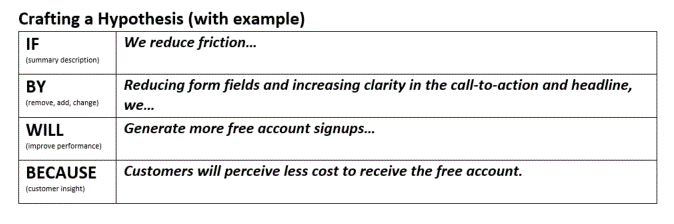
Hypothesis: The reason to run a test is to prove or disprove a hypothesis.

Do you know how you can best serve your customer to improve results? What knowledge gaps do you have about your customer? What internal debates do you have about the customer? What have you debated with your agency or vendor partner? Settle those debates and fill those knowledge gaps by crafting a hypothesis and running a test to measure real-world customer behavior.

Here is the approach MECLABS uses to formulate a hypothesis, with an example filled in …

# of Treatments: This is the number of versions you are testing. For example, if you had Landing Page A and Landing Page B, that would be two treatments. The more treatments you test in one experiment, the more samples you need to avoid a Sampling Distortion Effect validity threat, which can occur when you do not collect a significant number of observations.

Valid/Not Valid: A valid test measures what it claims to measure. Valid tests are well-founded and correspond accurately to the real world. Results of a valid test can be trusted to be accurate and to represent real-world conditions. Invalid tests fail to measure what they claim to measure and cannot be trusted as being representative of real-world conditions.

Conclusive/Inconclusive: A Conclusive Test is a valid test that has reached the desired Level of Confidence (95% is the most commonly used standard). An Inconclusive Test is a valid test that failed to reach the desired Level of Confidence for the primary KPI (95% is the most commonly used standard). Inconclusive tests, while not the marketer’s goal, are not innately bad. They offer insights into the cognitive psychology of the customer. They help marketers discover which mental levers do not have a significant impact on the decision process.

KPIs — MAIN, SECONDARY, TERTIARY

Name: KPIs are key performance indicators. They are the yardstick for measuring your test. The main KPI is what ultimately determines how well your test performed, but secondary and tertiary KPIs can be insightful as well. For example, the main KPI for a product page test might be the add-to-cart rate. That is the main action you are trying to influence with your test treatment(s). A secondary KPI might be a change in revenue. Perhaps you get fewer orders, but at a higher value per order, and thus more revenue. A tertiary KPI might be checkout rate, tracking how many people complete the action all the way through the funnel. There may be later steps in the funnel that are affecting that checkout rate beyond what you’re testing, which is why it is not the main KPI of the test but still important to understand. (Please note, every test does not necessarily have to have a main, secondary and tertiary KPI, but every test should at least have a main KPI.)

Key Discoveries: This is the main benefit of running tests — to make new discoveries about customer behavior. This Test Discovery Library gives you a central, easily accessible place to share those discoveries with the entire company. For example, you could upload this document to an internal SharePoint or intranet, or even email it around every time a test is complete.

The hypothesis will heavily inform the key discoveries section, but you may also learn something you weren’t expecting, especially from secondary KPIs.

What did the test results tell you about the perceived credibility of your product and brand? The level of brand exposure customers have previously had? Customers’ propensity to buy or become a lead? The difference in the behavior of new and returning visits to your website? The preference for different communication mechanisms (e.g., live chat vs. video chat)? Behavior on different devices (e.g., desktop vs. mobile)? These are just examples; the list could go on forever … and you likely have some that are unique to your organization.

Experience Implemented? This is pretty straightforward. Has the experience that was tested been implemented as the new landing page, home page, etc., after the test closed?

Date of implementation: If the experience has been implemented, when was it implemented? Recording this information can help you go back and make sure overall performance correlated with your expectations from the test results.

ADDING MORE TESTS TO THE TOOL

The Test Dashboard tab dynamically pulls in all information from the subsequent test worksheets, so you do not need to manually enter any data here except for the test sequence number in Column A. If you want to create a new test tab and the corresponding row in the “Test Dashboard,” follow these instructions:

    • Right click on the bottom tab titled “Template – Your Test Name Here.” Choose “Move or Copy.” From the list of sheets, choose “Template – Your Test Name Here.” Check the box “Create a Copy” and click OK. Right click on your new “Template – Your Test Name Here (2)” tab and rename as “Your Test Name Here (7).”
    • Now, you’ll need to add a new row to your “Test Dashboard” tab. Copy the last row. For example, select row 8 on the “Test Dashboard” tab, copy/paste those contents into row 9. You will need to make the following edits to reference your new tab, “Your Test Name Here (7).” This can be done in the following way:
      • Manually enter the test as “7” in cell A9.
      • The remaining cells dynamically pull the data in. However, since you copy/paste, they are still referencing the test above. To update this, highlight select row 9 again. On the Home Tab>Editing, select “Find & Select (located on the far right)>”Replace,” or use “CTRL+F”>Replace.
      • On the Replace tab of the box, enter Find What: “Your Test Name (6)” and Replace with: “Your Test Name (7).”
      • Click “Replace All”
      • All cells in the row should now reference your new tab, “Your Test Name (7)” properly.


Click Here to Download Your FREE Test Discovery Tool Instantly

(no form to fill out, just click to get your instant download of this Excel-based tool)


Special thanks to Research Manager Alissa Shaw, Data Scientist Delaney Dempsey, Associate Director of Design Lauren Leonard, Senior Director of Research Partnerships Austin McCraw, and Copy Editor Linda Johnson for helping to create the Test Discovery Library tool.

If you have any questions, you can email us at info@MECLABS.com. And here are some more resources to help with your testing …

Lead your team to breakthrough results with A Model of your Customer’s Mind: These 21 charts and tools have helped capture more than $500 million in (carefully measured) test wins

Test Planning Scenario Tool – This simple tool helps you visualize factors that affect the ROI implications of test sequencing

Customer Theory: How we learned from a previous test to drive a 40% increase in CTR

The post Get Your Free Test Discovery Tool to Help Log all the Results and Discoveries from Your Company’s Marketing Tests appeared first on MarketingExperiments.


from MarketingExperiments https://ift.tt/2SECDwG
via IFTTT

Last Day to Join Persuasive Copywriting, and a Punch in the Mouth for Facebook

Heads up: The introductory rate for our Persuasive Copywriting 101 Course is ending today, November 1, at 5:00 p.m. Pacific...

The post Last Day to Join Persuasive Copywriting, and a Punch in the Mouth for Facebook appeared first on Copyblogger.


from Copyblogger https://ift.tt/2OiQYvi
via IFTTT

5 marketing tips to attract local customers

Looking to boost your local search results with a better online presence? 

Our teammates at Deluxe have partnered with SCORE to host a free webinar, 5 Marketing Tips to Attract More Local Customers, on November 15, 2018, at1:00 p.m. EST.

Register today to learn how small businesses can bring in more customers beyond relying on word-of-mouth alone. Gain insider marketing tips and inspiration, whether you’re in startup mode or have been in business for generations.

In this webinar:

  • Get email marketing strategies to drive repeat visits and sales
  • See how to rework your website to highlight what makes you unique
  • Get quick fixes to drive more traffic to your Google and Yelp listings
  • Learn how to elevate your Google search rankings for your business
  • Get tips on boosting your brand identity online

Register for this free webinar today.

About the presenter

Amanda Brinkman, Chief Brand Officer at Deluxe Corp., leads a team of experts who provide marketing services to millions of small businesses across America. Brinkman also produces and stars in the acclaimed Small Business Revolution — Main Street series, in which she and her team provide a $500,000 revitalization to one lucky small town and its Main Street businesses. 

Join 140,000 small business owners

Get expert tips and email inspiration delivered to your inbox every two weeks.

© 2018, John Habib. All rights reserved.

The post 5 marketing tips to attract local customers appeared first on VerticalResponse Blog.


from VerticalResponse Blog https://ift.tt/2AEjPXl
via IFTTT