Wednesday, 30 January 2019

Two SMB Content Marketing Strategies the Fortune 500s Can’t Afford to Ignore in 2019

If there’s one thing we’ve learned over the past few years, it’s that David really can take it to Goliath in a 21st century marketplace. Today's Davids are small and medium-sized businesses (SMB) that act as “disruptors,” while modern-day Goliaths that have been swept into the dustbin of economic history include Sears, Toys R Us, and RadioShack.

The way that consumers connect with brands, make a buying decision, and receive goods and services is changing. Innovative companies, like Amazon and Lyft, are doing an excellent job positioning themselves where customers need them.

Massive Fortune 500s, with multi-million-dollar marketing budgets, are not insulated by their size from savvy marketers and innovators in today’s digital landscape. This is proven by the fact that Fortune 500s are gobbling up smaller startups through acquisitions at a break-neck pace.

Goliaths needs to take note of the strategies that Davids are using to outmaneuver them. Let’s talk about two of the best strategies SMBs are using to steal market share and build their brands:

  • Leveraging personalization to finesse the digital journey of every market segment
  • Leveraging AI to prepare for the next evolution in content marketing
Leveraging Personalization to Finesse the Digital Journey of Every Market Segment

What is the first thing you do when considering a major purchase? Google it! You reach for your smartphone, tablet, or laptop and dive into what the review sites have to say and what competitors have to offer.

This isn’t shocking news. The problem is that Fortune 500s are trying to fight too many battles while SMBs might be better off focusing their limited resources on winning a few key digital battles.

In a recent article, Digital Marketer Justin Morgan weighs the pros and cons of SMBs diving into a PPC campaign. The relatively inexpensive barrier to entry (around a couple of dollars per click) might sound more palatable than diving into a content marketing digital bonanza.

But, as he outlines, smaller businesses need to build a digital foundation before bringing in traffic to irrelevant or sub-par landing pages that fail to immediately address the needs of the visitor. He advises that SMBs first invest in high-quality digital branding and ensuring a uniform experience across every digital platform. Then they need to craft a digital experience that is hyper-focused on the journey of the visitor, allowing traffic (organic and paid) to have the best conversion rate possible.

This same advice can and should be applied to large companies. While their generic, brand-wide digital footprint is usually consistent and high-quality, they sometimes forget to customize the experience for different segments of their customer base.

I’ve worked with my fair share of corporate juggernauts that mistakenly believed they can send customers through their generic, branded digital assets and score a conversion. If the little guy is aggressively targeting a single type of customer, while you fail to personalize the experience, your flagging conversion rate will make customer acquisition a lot more expensive.

Leveraging AI to Prepare for the Next Evolution in Content Marketing

If you’re looking for inspiration to help you market your startup effectively, this Forbes article provides plenty of success stories. My personal favorite is Casper’s use of AI to provide a digital companion to insomniacs via interactive text messaging.

Casper launched their mattress-in-a-box concept in 2014. In the hyper-competitive mattress arena, they now have a respectable market share, approaching 1%. If you consider that their largest competitor only has 11% of the market, 1% starts to sound more respectable.

While the retail mattress chains leveraged traditional broadcast and print advertising to drive foot traffic to their stores, Casper drove their message home via multiple viral YouTube videos and digital advertising. Then they took things to the next level with their AI-powered chatbot. And by targeting insomniacs, they’ve positioned themselves as a brand that cares about your sleep, even if you aren’t sleeping on one of their products.

Their push to reach insomniacs means that they are connecting with those most likely to invest in a better mattress.

Large brands could more easily afford to invest in AI-powered, two-way content marketing strategies. Casper had to eat up some valuable runway to launch theirs, but the media buzz has more than vindicated their financial gamble.

Large brands cannot afford to be one dimensional in a digital world. Customers need to feel like they are interacting with a brand that uniquely understands their needs and desires. SMBs get to leverage their smaller target by becoming more personalized. And with the rise of AI, it’s clear that content marketers will be evolving in 2019 to better deal with inbound content from the customers they want to win over.

Goliath needs to get up to speed  or prepare to surrender market share to the new kids on the block.

Find out how you can win over customers with your content marketing with “Do More with B2B Content Marketing.”

Read the guide


from Oracle Blogs | Oracle Marketing Cloud http://bit.ly/2UmhAyS
via IFTTT

Tuesday, 29 January 2019

10 questions to ask in your business demographics survey

Discovering valuable information about your customers has always been coveted in the business world: If you understand who your customers are, you can strengthen your relationship with them while building trust and credibility. You can also collect the information needed to make the right decisions for your company. A business demographics survey is a great tool to unearth and collect these kinds of insights. Here are some tips to help you prepare an effective business demographics survey:

Asking the right questions

When conducting a survey, you first need to decide what to ask based on the goal of your survey. For instance, if your customers are businesses that you’re looking to understand better, try using a business demographics survey. Data from this kind of survey can help you widen your customer base, or you can use the information collected to tailor your product or service to better serve your customers.

Here are 10 sample questions to consider:

  • How long has your company been in business?
  • In which industry is your business?
  • What is your title at your company?
  • How long have you been in your current position?
  • How many people are employed at your company?
  • What was the annual revenue for your company last year?
  • Does your company have more than one location?
  • Does your company do business online?
  • Does your company serve consumers, businesses or both?
  • Which marketing channels do you use to promote your business?

Choosing the number of questions

While it would be nice to ask customers 100 questions, it’s not realistic. So how many questions should you ask? According to Small Business Trends, customers don’t want to take a survey that requires more than five minutes of their time, which amounts to about 10 questions (depending on the complexity of the question).

What this means is that the more questions you ask, the less time people will devote to each individual question and the more likely it is that they’ll stop taking the survey. While there are no hard and fast rules on how many questions to ask, keep the question count low to receive higher quality data.

Increasing response rates

Not only will you receive more reliable responses by asking fewer questions, but you’ll also get higher participation. Additionally, make it easy to answer your survey from any device. A questionnaire that is mobile-friendly prevents people from abandoning the process simply because the interface is funky.

Don’t be shy about throwing in a little something for those devoting time to your survey. Give your survey recipients motivation and thank them for filling out your survey by including a cash reward. This can be done on an individual basis or as a drawing for everyone who participated.

Keep in mind that the average email survey response rate is around 30 percent. So, be sure to send your survey to a large enough pool of recipients to keep it statistically relevant and meaningful.

Using a survey tool

Finally, let’s talk about how to physically conduct your survey. Tools like VerticalResponse Surveys take away the grunt work, so you can focus on reaping the feedback that will help improve your company. VerticalResponse’s Surveys ensures your questionnaire is mobile-friendly and allows you to build and distribute surveys in a few clicks. Best of all? You can send as many surveys as you want and gather as much feedback as you need, at any time. With most tools, including VerticalResponse’s, you can email the survey URL to your email lists, share it on social media and add it to your website or landing page.

These business survey tips will get you on your way to collecting the information you need to grow your business. Start interacting with customers through surveys today, and get impactful feedback that will improve your company continually.

Join 140,000 small business owners

Get expert tips and email inspiration delivered to your inbox every two weeks.

Editor’s note: This article was originally published in 2015 and has been rewritten for accuracy and relevance.

© 2019, Contributing Author. All rights reserved.

The post 10 questions to ask in your business demographics survey appeared first on VerticalResponse Blog.


from VerticalResponse Blog http://bit.ly/2HDxyTz
via IFTTT

Use this Research-backed Landing Page Template for Your Next Offer Page

After running thousands of a/b tests across hundreds of different companies in our research services program, we’ve seen significant patterns emerge. These patterns have led to some helpful tools like our conversion heuristic and our design of experiments planning method.

But they have also led to several page templates we use regularly to achieve wins inside of companies in every industry and of every business model.

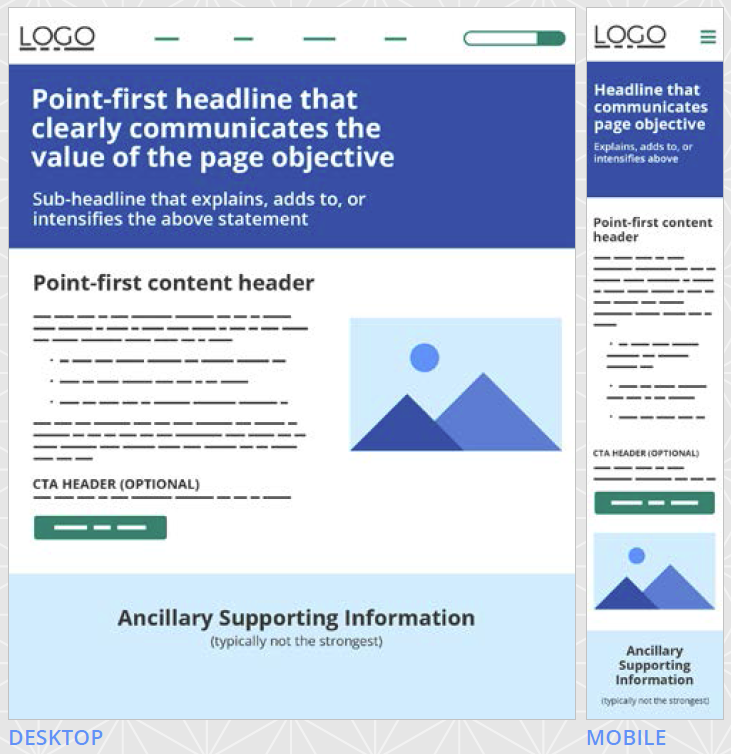
Landing Page Template

One page that is generally consistent in almost any business is the main offer page for a product or service. This “landing page,” as it is often called, accounts for the main idea behind the offer.

After thousands of a/b tests, we’ve meticulously put together a template that draws from a meta-analysis of these tests. We examined the patterns common among most landing page tests we’ve run that have achieved a business result. What we found was a series of common denominators that we then integrated into our offer page template.

We’ve also added explanations into the template on how to conform it to meet your own marketing needs. For example:

Headline and Sub-Headline

An online interaction with a prospect is like a conversation with a potential love interest. You hopefully do not begin the conversation with, “I am available for dates. Here is my number. Call me.” That is too vague and offers no reason to actually call — also it is rude.

You need a pick-up line that clearly communicates your value proposition and a sub-headline that further delineates that value proposition and how this page helps the prospect obtain that value.

Image

If your page is going to include an image, which is worth a test, the image must be instantly recognizable and reinforce the value proposition raised in the headline and sub-headline.

It must not tax the prospect’s mental faculties trying to make sense of the image. You do not want to slow down their cognitive momentum.

Primary Information Column

This is where your main body copy goes, including some easy-to-scan bullet points. You want the reader to be able to skim through this copy and pick out the main details they need to come to an informed purchase decision.

It is one column because multiple columns of vital information disperse attention and confuse. One column creates simplicity and velocity toward the call-to-action.

One Emphasized Call-to-Action

The call-to-action should emphasize in the actual wording the value proposition of the offer. In other words, “Get Instant Access Now” is preferable to “Click Here.”

There should not be multiple equally weighted calls-to-action because this forces the prospect to weigh the options, which decreases momentum and often stalls purchase intent.

Supporting Content

The primary information column will not suffice for some prospects. They will want more information before coming to a decision.

For these prospects, you can include additional information below the call-to-action. Supporting content can also include elements like testimonials, trust logos and additional copy and images.

Also, if you would like to get the other funnel-specific page templates we’ve put together along with a few case studies and explanation for how we conducted our research, you can download the complete PDF here.

The templates also include the following:

  • The case studies these templates draw upon
  • A walk-through of each template explaining how to use every element
  • An overview of the methodology behind each template so you can iterate and make them fit your own marketing needs

landing page templates

Please let us know in the comments if you find it helpful or if you see any way to improve it.

You might also like …

Landing Page Optimization on-demand certification course

Landing Page Optimization: Simple, short form increases leads 40%

Landing Page Optimization: Free worksheet to help you balance segmentation and resources


The post Use this Research-backed Landing Page Template for Your Next Offer Page appeared first on MarketingExperiments.


from MarketingExperiments http://bit.ly/2WsiXhq
via IFTTT

How to Become a Better Copywriter by Selling Your Own Product

The first time I created and tried to sell a product of my own was way back in 1996. My...

The post How to Become a Better Copywriter by Selling Your Own Product appeared first on Copyblogger.


from Copyblogger http://bit.ly/2UpVMlI
via IFTTT

The Ultimate SEO Tool: Ubersuggest 3.0

ubersuggest

In 2018, I promised you I would release a better version of Ubersuggest for free, and I did that.

But there was one big issue: Ubersuggest only worked on a keyword level. When you put in a keyword, you get a list of more keyword ideas and content ideas.

And then when you put in a URL, nothing happened.

Well, that was before.

You can now get domain level metrics!!!!

So let’s dive into the new Ubersuggest.

Traffic Analyzer Overview

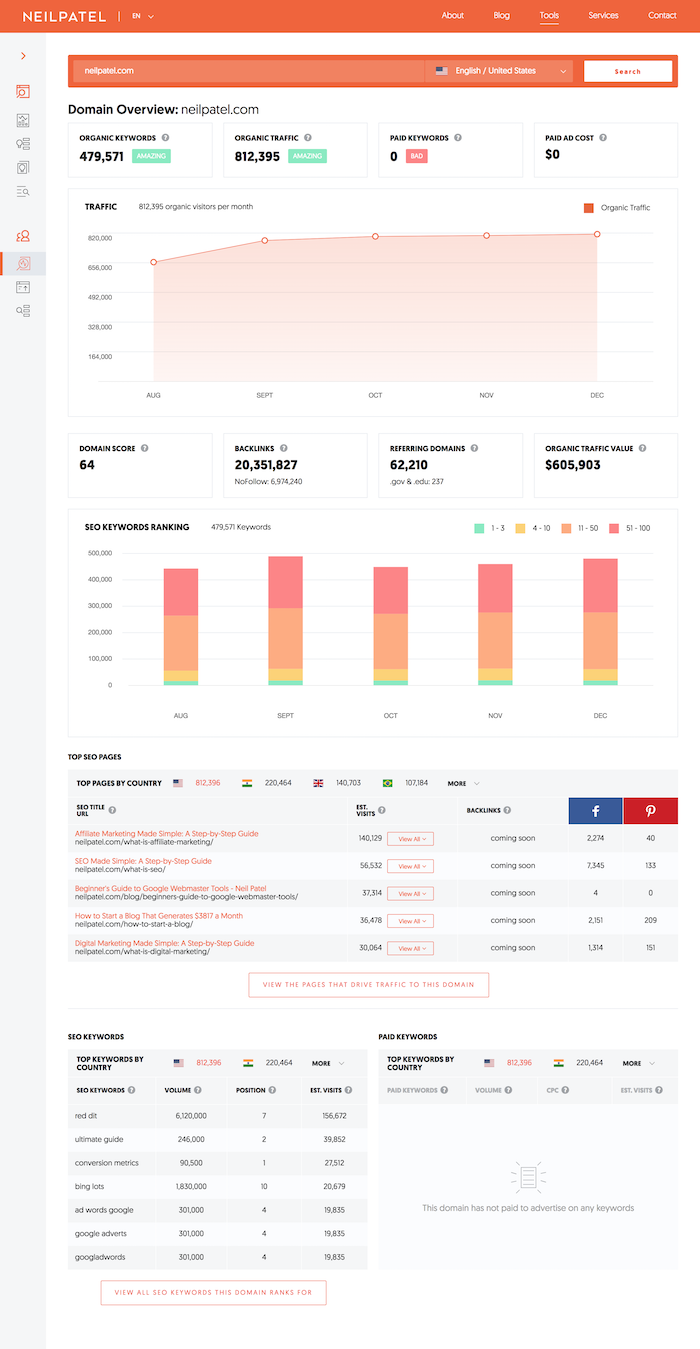
The traffic analyzer is broken down into 3 main sections: overview, top pages, and keywords.

The overview looks like this:

overview

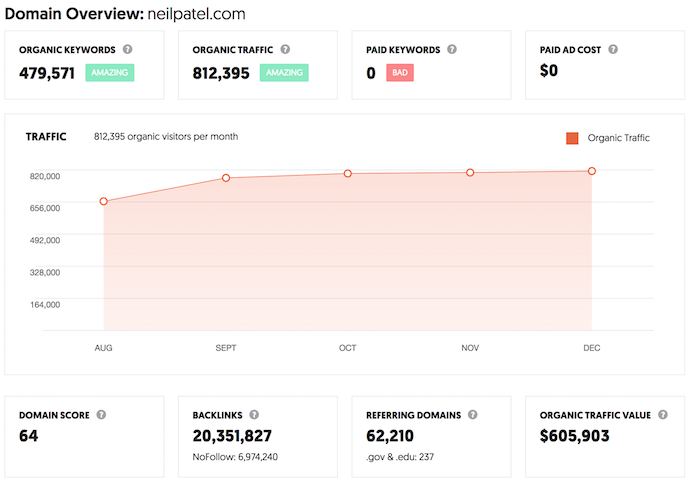
The first section breaks some basic stats and a graph of the domain’s search traffic.

domain metrics

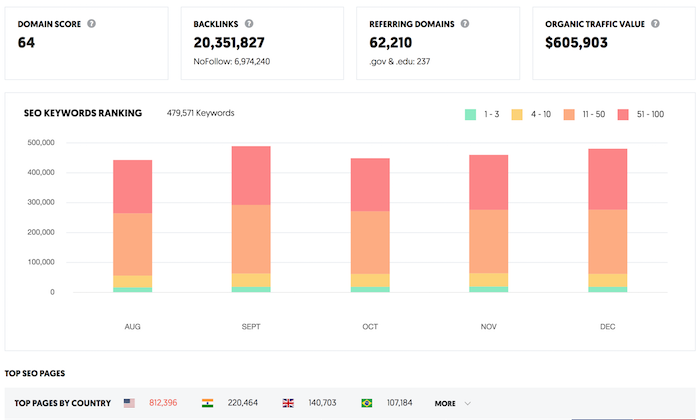
As you can see from the screenshot above, you’ll see how many keywords a domain ranks for, the total estimated search traffic from that region, the number of paid keywords a site is bidding on, and how much they are spending on Google Ads.

In addition to that, you’ll see a traffic graph that shows estimated search traffic a site receives over time.

And of course, a domain level overview won’t be complete without data such as backlinks, referring domains, the number of .edu and .gov links, and how much the organic traffic is worth if you had to pay for it.

Now, before you head over to Ubersuggest and type in a domain, there is one thing you need to keep in mind… Ubersuggest treats subdomains as a separate site. So if you enter in store.nike.com you will get different results than if you typed in nike.com. By typing in nike.com, you would NOT see any of the data from their store unless you typed in store.nike.com.

We did this on purpose as it allows you to analyze sites more thoroughly.

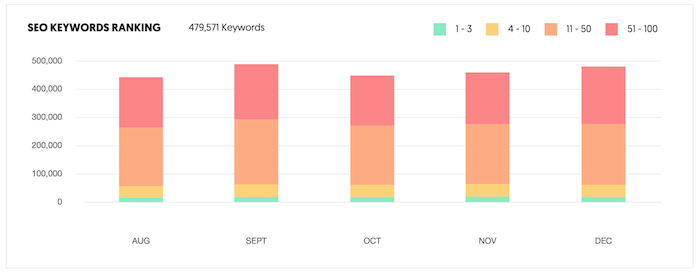
Also, within the traffic analyzer, you’ll see bar graphs that contain the overall positioning of the keywords you rank for over time.

keyword rankings

The chart above shows how many keywords a domain ranks for that are in the top 3 positions in Google, the top 10 positions, the top 50 positions, and the top 100 positions.

You already know no one clicks beyond page one, but over time you’ll want to see your site climbing the ranks. Hence, we track how many keywords are ranking in the first 100 positions.

Now let’s get into my favorite feature of the traffic analyzer.

Top SEO Pages

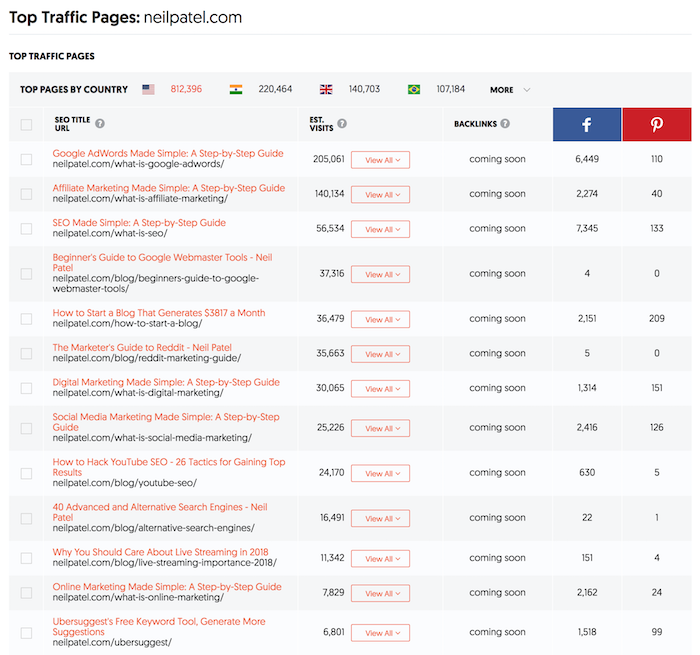
The second part of the traffic analyzer is a list of the most popular pages for a given domain.

top pages

For each page, you are given the title, URL, the number of visits a page receives from Google on a monthly basis, and the number of times the URL has been shared on the social web.

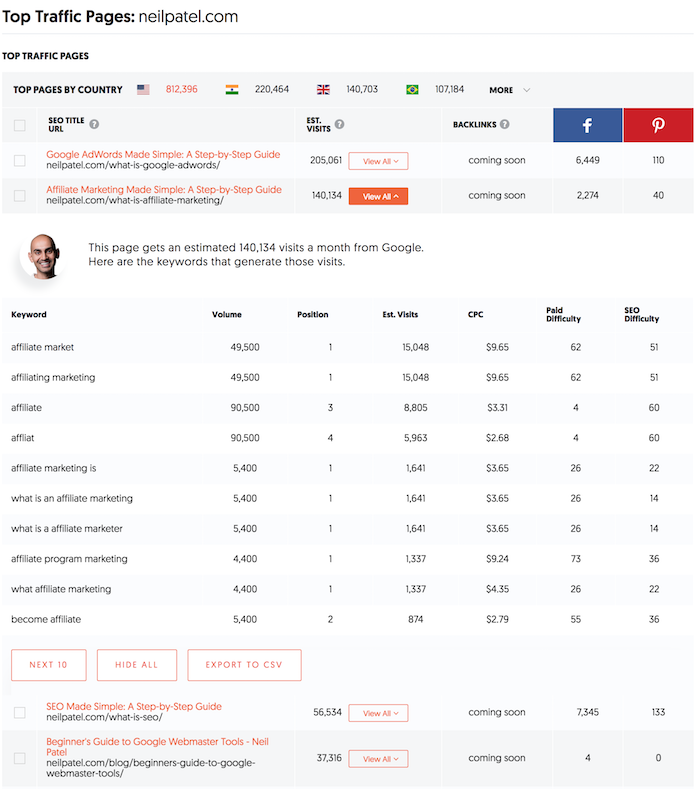
My favorite part about the top SEO pages report is when you click on “view all” you’ll see a list of keywords a page ranks for.

top pages

This one report will not only list out each keyword a webpage ranks for, but the position, estimated visits, cost per click data if you paid for that keyword, and how difficult it would be to rank for it.

What I love about this report is that I can put in a competing URL and see what’s working really well for my competition and then copy them. Or even better, create a more in-depth page than my competition.

Plus, if you have clients who are global, you can click on the flag at the top and see the top pages for any domain in all of the major countries.

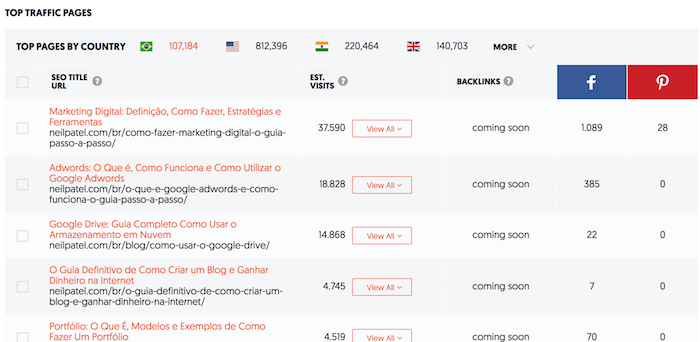
For example, here are my most popular pages in Brazil.

top pages brazil

Top Keywords

The last section in the new Ubersuggest is top keywords.

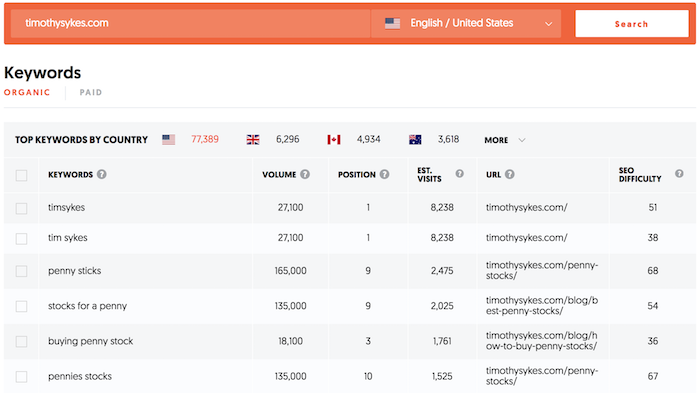
Whether you put in your own domain or competitors, you’ll be able to see all of the organic keywords and paid keywords a site is going after.

organic keywords

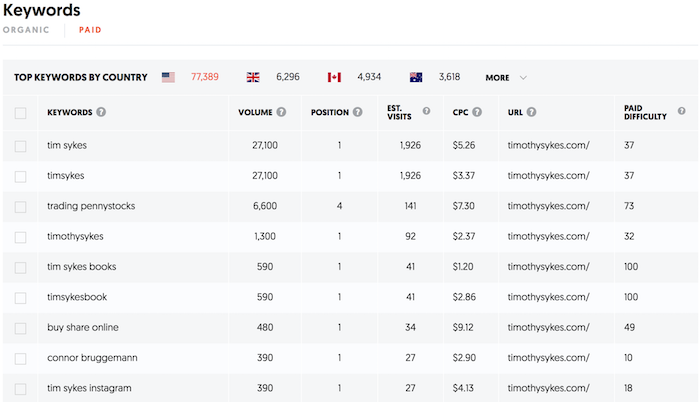
When you click on the “paid” button you’ll see the list of paid keywords as well.

paid keywords

And just like the keyword research reports within Ubersuggest, you’ll have data on URLs, paid difficulty and SEO difficulty.

Conclusion

I hope you enjoy the new version of Ubersuggest. I know there are still some bugs in which the reports don’t load as fast as you want (Top SEO Pages can take up to 20 seconds to load) and you may have to clear your cache to see the new features, but hopefully, you enjoy the updates.

There are also some issues with duplicate keywords and misspellings. The engineering team is continually looking to fix this.

We do know there are many issues with duplicate keywords and misspellings in our Japan database, but we are working on fixing this as soon as possible.

So overall, I know it’s not perfect, but what do you think so far?

And if you haven’t tried it, head over to Ubersuggest and type in a domain.

PS: If you find any bugs, please email carlos@neilpatel.com

The post The Ultimate SEO Tool: Ubersuggest 3.0 appeared first on Neil Patel.


from Blog – Neil Patel http://bit.ly/2MDtSQO
via IFTTT

Monday, 28 January 2019

Testing Business Ideas: How to Figure Out if You’re On the Right Track Today! (FS304)

How do you go about testing business ideas? How can you test one easily and quickly? In what ways can using tests like these help you to grow and propel your business forward?

Running experiments can teach you so much about how to progress. What areas need attention? What is possible? There may be things that you thought were beyond you that are completely achievable!

In this episode, we talk about testing business ideas by running business experiments. We talk about how to structure them to gauge success, build confidence and jump to the next level. We talk about engines of growth, goal setting, clarifying the process and how asking yourself what you want can kickstart this mode of thinking.

This discussion also covers five essential areas of these tests and Aiden breaks down the anatomy of the test body! Included are controls, variables, experiment structure and more. We use the “growing an audience” example to explain these parts so that you can go out and get started testing business ideas right away!

For all that and whole lot more, join us today!

Listen to the episode:

Subscribe to The Fizzle Show in your favorite podcast player:

iTunes | Overcast | Pocket Casts | Stitcher | Soundcloud | RSS


Key Points From This Episode:

  • What is a business experiment? [0:07:22.4]
  • Maintaining momentum and laying out enough track for your train. [0:12:02.8]
  • Heading out into the unknown and using an experimental approach. [0:16:01.2]
  • Don’t be a donkey! Make some decisions and take some action! [0:20:30.5]
  • The difference between lookers and leapers. [0:23:01.1]
  • An overview of the five elements of a great business experiment. [0:30:40.9]
  • The intuitive gut feeling around uncertainties and ambitions. [0:37:58.0]
  • Variables at the heart of your business. [0:44:10.4]
  • The controls and keeping parts of the experiment static. [0:52:10.6]
  • Focussing on specific and consistent engines of growth. [0:59:30.3]
  • Designing your own tests and experiments according to what you need. [1:04:51.3]
  • And much more!

Links Mentioned in Today’s Episode:

The post Testing Business Ideas: How to Figure Out if You’re On the Right Track Today! (FS304) appeared first on Fizzle.


from Page Array – Fizzle http://bit.ly/2WnSwJA
via IFTTT

The Sophisticated Content Marketer’s 3-Part Plan for Using Templates

Some content marketers think about using templates like the herb cilantro. They either love it or hate it. But the...

The post The Sophisticated Content Marketer’s 3-Part Plan for Using Templates appeared first on Copyblogger.


from Copyblogger http://bit.ly/2RWxmnp
via IFTTT