Wednesday, 15 January 2020

TPC: Memorize this Acronym if You Want to Grow Your Email List in 2020

TPC stands for Traffic, Placement and Conversions. It’s a simple acronym that holds the key to growing your email list in 2020 and beyond.

I’m always so happy when I hear from someone who finally cracked the code to growing their email list.

Some people take forever to figure this out, but once they do, BAM! their email list finally starts growing beyond just friends and family.

Just last week I heard from a Fizzle member who had this to report:

”I’m happy to report that my email list is up to 62 people in the last two days! Which may not be much, but just a few days ago I had 6 people on my list, all of them family members.” — Serena, Fizzle Member

62 people might not sound like a lot, but the number doesn’t matter so much. What matters is Serena cracked the code to finally growing her list. Once that happens, growing to the next level and beyond is simply a matter of rinsing and repeating what works.

Whether your list has grown to 62 people or 62,000 people, the formula for growing further is the same.

To grow your list, you need to memorize one simple acronym: T. P. C.

TPC stands for Traffic, Placement and Conversions.

Memorize this, and follow the steps below to finally get your list growing in 2020 and beyond.

Traffic: how many people are visiting your website?

Here’s a simple one to start with. The more people who visit your website, the more you can expect to subscribe to your email list.

No matter what your conversion rate is (which we’ll cover in just a minute), if you increase your traffic, you’ll increase the number of subscribers.

Simple, right?

Well, I can’t tell you how many people I hear from who are frustrated because their email list isn’t growing, only to find out they have just a trickle of people visiting the site each month.

The bottom line is this: if you have less than 1000 visitors coming to your site each month, you shouldn’t expect your list to grow much, no matter how good your placement or conversions.

Of course, there are exceptions to this rule (especially for very targeted landing pages), but for the standard blog or content marketing play, getting to 1,000+ visitors per month should be your main goal.

If you’re close to or beyond that 1,000 visitor mark, it’s time to start thinking about placement and conversions

Placement: where are the subscription forms on your site?

Another mistake I see people making when trying to grow an email list is weak or sparse placement of opt-in forms on their websites.

Sometimes I’ll scour a website only to find a teeny tiny little “join my newsletter” mention off to the side buried under a bunch of other stuff. As the website owner, YOU may know the subscribe option is there, but very few of your visitors are even seeing it.

Placement matters. You can’t expect visitors to subscribe if they aren’t even seeing the option to sign up.

The websites with the best email subscription rates are the ones that place the sign-up form somewhere it can’t be missed.

Get your sign-up box out of the sidebar and put it front-and-center at the top of the page, big and bold, and you’ll see an increase in signups.

But wait, there’s more to placement than just making your form more obvious…

Lots of visitors might see your subscription option, but decide to skip signing up anyway. In fact, 99% of them probably won’t subscribe, even if your form is in the most prominent place on your website.

How do you fix this problem?

Repeated exposure.

Some of those people who didn’t subscribe might decide to later, if they like what they find on your site and see another subscribe option.

You aren’t limited to putting your subscribe form in just one place on your site. If one form nets you X subscribers per day, how many could you get from two forms, or three, or four?

Sure, there’s probably an upper limit to how many subscribe forms you have on your site, before you feel like you might be annoying your visitors. But I guarantee you can have more than one form without annoying anyone.

Here are some places you could add a subscribe form:

  • On your home page
  • On your about page
  • In your navigation
  • At the top of your blog posts
  • In the middle of blog posts
  • At the end of blog posts
  • In your sidebar
  • In your footer

Here’s a great example of a big, bold subscribe box from Nathan Barry (founder of ConvertKit and our guest in Episode 361 of The Fizzle Show):

You can even get fancy with special kinds of forms like pop-overs, welcome mats, slide-ins, etc. using something like OptinMonster.

Here’s a nice example of a fairly unobtrusive and effective popup from Minimalist Baker. This appears if you’re about to leave the site:

I’m not saying you should put forms in all of these places, but if your goal is to grow your email list in 2020, you should try adding multiple forms to see what it does to your overall subscribe rate.

Just remember: placement matters, and adding additional forms on your site will probably bring you more subscribers.

Conversions: how well are your forms converting?

There can be massive differences in the conversion rates of various signup forms.

One form might convert 1 out of 1,000 people who see it, and another in the exact same spot might convert 5 out of 100.

What makes one form convert so much better than another?

Everything about your signup form can affect conversion rates. The layout, the colors, the size, whether you use an image and what the image contains can all have an impact.

But the thing that matters most is what you are offering, in the context it is being offered.

There are some general rules of thumb. For example, an offer like “sign up for emails from me” is probably going to be less effective than something like “get my free 5-day mini course on how to ______ and ______.”

Every website is different, so the best way to find out which form converts the most visitors is by testing regularly.

Start by asking yourself, “what would be irresistible to my visitors?” Usually this will be related to the thing that attracted your visitors to your website in the first place.

You’ll want to wrap that irresistible offer in an attractive package. Usually something like a quiz, or download, or short online course, or tool will work well. Look at what other websites in your space and in other spaces are offering for inspiration.

My favorite way of testing forms is using OptinMonster. You can simply create multiple versions of an opt-in form and OptinMonster will run them simultaneously and tell you which one converts best.

Here’s an example of how OptinMonster reports on the performance of your campaign. This is from one of the main pop-up forms on Fizzle’s blog:

There’s a chance your email provider might have built-in support for A/B testing opt-in forms, in which case you could use that functionality. OptinMonster is nice because it works with pretty much any email platform and makes switching platforms later much easier because you don’t have to replace any forms.

You should optimize all of the forms on your site for conversions using this same approach for each. If you haven’t tried optimizing conversions yet, you’ll probably find some easy gains.

Bonus: what’s your overall email conversion rate?

Here’s a fun and important number to watch. What is your overall visitor-to-email-subscriber conversion rate?

In other words, for every 100 people who visit your website, how many subscribe to your email list?

If you haven’t done any optimization or work on placement, you might see less than 1 in 100. It could be 1 in 200 or 1 in 1,000. It’s not uncommon for a site to have less than a 1% overall conversion rate.

Through conversion optimization and smart placement, you should be able to get this number above 1%. Even better, you’ll get this above 2% or higher. The Fizzle website has an overall email conversion rate of over 4% as I’m writing this, for example.

To calculate your overall conversion rate, you just need two things: 1) the number of visitors to your website, and 2) the number of new subscribers during that same period of time. For example, if 23 subscribers signed up during January out of 1,054 visitors, that would be a 2.2% conversion rate. Not bad!

TPC: Each is important

Remember: TPC stands for Traffic, Placement and Conversions. Each part of the acronym is important. Optimize for all three and your list will start growing like never before.

Imagine if you were converting 2-5% of all your visitors to email subscribers. How big would your list be at the end of this year?

The post TPC: Memorize this Acronym if You Want to Grow Your Email List in 2020 appeared first on Fizzle.


from Page Array – Fizzle https://ift.tt/2RdH1CA
via IFTTT

Nathan Barry – from Self-Taught to $20 Million in Revenue (FS361)

Nathan Barry is a creator, author, speaker, designer, and the founder of ConvertKit. Nathan got his start as a software designer and self-published author before founding ConvertKit in 2013. Since then, the business behind ConvertKit has grown to an incredible $20M annual run rate.

In this episode, Nathan shares why being self-taught and self-made are so important to him. He also clears up exactly what led to ConvertKit’s meteoric rise and how the business finally got over the $5k/month hurdle.

Listen to the episode:

Subscribe to The Fizzle Show in your favorite podcast player:

iTunes | Overcast | Pocket Casts | Stitcher | Spotify


Today’s episode is brought to you by Gusto. Gusto offers modern, easy payroll and benefits to small businesses across the country. Get three months free when you run your first payroll. https://gusto.com/fizzle

The post Nathan Barry – from Self-Taught to $20 Million in Revenue (FS361) appeared first on Fizzle.


from Page Array – Fizzle https://ift.tt/36YmZCO
via IFTTT

Forrester Report: Getting Customer Data Management Right

As the volume and sophistication of customer data continues to expand, marketers now face the challenge of transforming it into useful information that can:

  • Give you a better understanding of your customers and the business challenges they face
  • Optimize your marketing efforts
  • Deliver hyperpersonalized experiences that drive engagement, loyalty, and build trust in your brand


In August 2019, Oracle commissioned Forrester Consulting to evaluate the market maturity of customer data unification. Forrester conducted an online survey of 337 marketing and advertising professionals in North America and Europe who are responsible for customer data, marketing analytics, or marketing/advertising technology. The findings showed that many firms do have some version of a customer data platform (CDP). However, their ability to use unified customer profiles to personalize experiences, provide a consistent experience across channels, and generally improve customer lifetime value and other business outcomes varied widely from firm to firm.

Only 11% of firms with a CDP use a wide variety of data types in a unified customer profile. These firms, in turn, are 2.5 times likelier to increase customer lifetime value. Moreover, firms with better customer profiles drive increased revenue growth and profitability.

Why is this?

It is because a unified customer profile is critical to personalization, which allows for crafting a superior customer experience. A superior customer experience, of course, builds your brand, makes conversions, and drives repeat business.

Therefore, it has become crucial to invest more in customer data management. Firms that do and more effectively leverage unified customer profiles tend to:

  • Invest more in marketing technologies

  • Become more effective at gauging metrics

  • Focus more on driving customer centricity

  • Run more personalized and targeted campaigns

  • Prioritize omnichannel strategies

All of this put together is what garners better business results.

What steps can marketers take to improve their organizations’ customer data practices then?  You can:

  • Leverage third-party solutions

  • Earn key stakeholder buy-in

  • Closely collaborate with data professionals


Learn how to more effectively use customer data platforms (CDPs) to create better customer experiences that result in increased revenue growth, profitability, and higher customer lifetime value.

Download the report à


from Oracle Blogs | Oracle Marketing Cloud https://ift.tt/3a5ENy1
via IFTTT

Tuesday, 14 January 2020

Using Design Analytics to Identify and Solve Actual Problems

Marketers have access to innovative technologies and massive amounts of data to enable connected customer experiences, but time and time again we see our clients struggling to activate it all. Marketers are defining their strategies, selecting key performance indicators, and determining the customer experiences they need to drive those KPIs. Then they’re working with their data scientists and analytics experts to get the reports and models they need.

And that’s the source of the problem. 

To understand why, let’s compare marketing to the evolution of car engineering. As automotive technology advanced, the industry recognized the need for a new kind of worker, engineers, who became critical to the design and innovation phases of product development. While modern marketing has acknowledged the need for engineers to execute as our technology and capabilities have advanced, we’ve left our data and analytics teams on the production line.

We’ve siloed our analytics team members, so even though they’re doing what we’re asking them to do, we’re often not driving the results we want. The problem isn’t in the execution, but in the design phase. We’re strategizing and building solutions without one of the key engineers in the room—the analyst.

Enter Design Analytics

Design analytics is a method for developing analytics solutions that enable business strategies and drive measurable business impact. It operates under three beliefs:

  1. That analysts are designers, not producers. 

  2. That analysts provide solutions, not facts. 

  3. That analysts’ work should be measured in impact, not reports created.

In practice, design analytics has two major components. First, it brings together a holistic team that at least includes the following:

  • Strategist: This person owns the business strategy and must clearly outline the state of the business, its goals, and key performance indicators.

  • Analyst: The analyst and strategist work together to provide analytic-based solutions that enable the strategy and address the business goals.

  • Data Steward: Once the strategist and analyst are aligned on the best strategy, they work with a data steward to determine how to get and then leverage the necessary data.

  • Project Manager: After helping identify any additional stakeholders needed to executive a strategy, the project manager works with all stakeholders to ensure the solution fits within budget, scope, capabilities, etc.   

And second, to ensure that the team comes up with the most effective marketing and customer experience solutions, design analytics applies the Design Thinking methodology so that any solution truly addresses root causes and actual problems rather than symptoms and assumed problems. The five steps of the Design Thinking process are:

  1. Empathize: Research and understand your users’ needs.

  2. Define: State your users’ needs and problems.

  3. Ideate: Challenge assumptions and brainstorm solutions to those needs and problems.

  4. Prototype: Create and quickly build and experiment with solutions.

  5. Test and Optimize: Iterate on the most impactful solutions.

What does all of that look like in action? Let’s explore an example…

Design Analytics: A Sample Scenario

Meet marketer Margaret, who wants to know, “How many promotional emails should I send to my customers per month?” To determine the answer, let’s task our analytics expert with determining the ideal number of emails to send based on subscriber feedback and customer engagement.

But wait… We’re practicing design analytics, so we’re not going to do that. Instead, we’re going to stop and Empathize. Why does Margaret want to know this? How does it impact her company? What are customers currently experiencing?

“My CEO thinks we send too many communications to customers around promotions,” says Margaret. “We’re afraid our customers are opting out because they get too much. If we knew how many to send to each person, we’ll be able to adjust accordingly.”

This is a key point of discovery: Margaret assumes their problem is email frequency. However, do we have data to even support that frequency is a problem? Have we quantified opt-outs are a real problem? Do we understand the customer experience?

In design analytics, we take what started as a request for an answer and focus on identifying a problem that requires a solution. Rather than trying to find a solution to a frequency problem, an analyst might recommend that we begin by looking at what is currently happening to customers in a baseline analysis. For instance, we’d determine…

  • How many communications do customers get on average? Does this vary greatly between segments or by persona?

  • Are subscribers opting out of communications from the brand at a higher rate than is deemed acceptable?

  • Is there a relationship between frequency and opt-outs?

In this case, answering these questions reveals that customers are opting out from certain communications from Margaret’s company at a higher rate than is acceptable, but there is no relationship between frequency of communications and engagement. However, there is a correlation between content and engagement. We see while some customers respond to almost all content, a significant number of customer segments are only engaging with certain types of content. Simply put, our problem is content, not send frequency. Now we’ve been able to accurately Define the problem.

Knowing that, we can begin to hold some brainstorming sessions and Ideate some potential solutions that might remedy the content problem we now know we have. Together, Margaret and an analyst might come up with several solutions, including a content testing strategy, a content recommender solution, and a new send strategy all together.

At this point, our stakeholders need to align to consider the feasibility, scope, and impact of our new ideas. We ultimately want to land on a solution is...

  • Feasible, in that the data and technology allow it to be designed

  • Actionable, in that a marketer can easily understand and leverage the output

  • Profitable, so that the time spent to develop it is justified by the impact on the business

In this scenario, the content recommender ticks all three of those boxes. Our data steward tells us we have the data to know who the unengaged customers are and what they engage with. Our project manager confirms access to this data takes little effort. Our analyst knows we can quickly build a prototype content recommender, given that we have access to this data. And our strategist, knowing they can leverage the content recommender to send the content each subscriber is most likely to engage with, can shift their overall send strategy. Once all stakeholders have given the green light, we quickly Prototype a content recommender solution.

However, sometimes things don’t move forward this smoothly. For example:

  • The project manager or data steward might have discovered that we already have an existing solution for what we are trying to do. This happens more than you’d think, especially in large organizations. At this point, we’d take a step back and Ideate more about how we might use the newly discovered solution.

  • The data steward may tell us we don’t have the necessary data to build the solution we want to. At this point, we might design a plan that allows us to collect the needed information, assuming our project manager confirms the effort to do so would be appropriate.

  • The marketer may hear a solution from the analyst and when they identify a hiccup in how it applies to their marketing strategy or process. This might result in the analyst approaching the solution differently.

But thankfully, our content recommender is feasible, actionable, and profitable, so we move on to the Test and Optimize step. The analyst delivers the content recommender and Margaret applies it to her send strategy over the next month. The results are verified, and we see that by applying the model we are improving engagement and reducing opt-outs. We then begin to dive into discovery for future iterations that might do even better.

Enabling Design Analytics at Your Organization

In our example above, a design analytics approach helped our marketer, Margaret, identify her real problem, ultimately helping her focus on a solution that would impact her company’s marketing communications. You can do the same.

Applying design analytics to your organization will take time as it requires a big shift in thinking and alignment, but getting started doesn’t have to be hard. Here’s a few tips to get started:

  1. Introduce the key stakeholders to the method, being sure to give your analysts a seat at the table. Ensure your internal processes enable this new way of collaborating.

  2. Focus on one or two key business problems that you want to solve. Work through them with pilot groups.

  3. Check in regularly. As you work through this within your own organization, ensure you’re recording and paying attention to what’s working and not working with the process. Every organization will have their own set of unique needs and may customize to work for them.

Once you get the hang of it, design analytics—and Design Thinking, more broadly—will help you come up with better solutions and avoid wasting time on misdirected solutions that address symptoms and non-problems. And who doesn’t want that?

—————

Need help with design analytics or Design Thinking? Oracle Marketing Cloud Consulting has more than 500 of the leading marketing minds ready to help you to achieve more with the leading marketing cloud, including a Strategic Services team that’s experienced with design analytics and a dedicated Design Thinking & Innovation Services team.

Learn more or reach out to us at OMCconsulting@oracle.com

For more information about data-driven marketing and the tools needed to succeed in it, such as a DMP, CDP, and digital analytics platform, please visit: https://www.oracle.com/marketingcloud/


from Oracle Blogs | Oracle Marketing Cloud https://ift.tt/2No46BC
via IFTTT

Monday, 13 January 2020

Modern Marketing Blog Influencer Series - Scoring Big: Understanding the Buyer’s Journey is ...

When it comes to lead scoring for account-based marketing (ABM), marketers have tended to take a binary approach: A prospect’s action adds points to a score. No action, no points. But I think we need to take an approach that is both broader and more nuanced. Broader because technology today allows us to cast a much wider net for buyer intent data, and more nuanced because while individual actions—downloading content, signing up for a webinar, etc.—are interesting, they don’t fully describe the buyer’s journey.

Take the case of a website visit. A prospect’s visit itself constitutes an action, but how much time did they spend there? What type of content were they looking at? How engaged were they with that content? Marketers should be able to prioritize and score these qualitative data points to create as clear a picture as possible in order to pass leads on to the sales team that are genuinely ready to buy.

When Is a Lead Really a Lead?

Many companies focus on what I consider the marketing of more: more likes, more retweets, more volume, and more leads. The problem with this approach is that while you’ll wind up with a lot of leads, only a small percentage will be qualified. At a certain point, you’ll likely lose credibility with the sales team.

Instead, I'm seeing more companies create scoring models that result in fewer leads, but more qualified ones. They’re scoring a lot of actions, but they've placed a higher threshold for when that lead will move to sales. Here are a few strategies I believe lead to more effective leads:

  • Broaden the data: Too often, marketers limit their lead scoring to whatever their marketing automation solution observes directly, such as email opens and click-throughs. If you’re doing that, you’re missing out on a lot of intent data that your CRM and/or event marketing platform is tracking, such as stopping by a booth at a trade show, interacting with your sales team, etc. There’s also activity on your website, social media activity, and demographic data, among others. Your technology solution should be able to pull this activity in and score it according to your model.

  • Consider timing: Fast data is more important than big data. Remember that there is a ticking clock on the behavior you’re scoring, and the longer you wait to react to it, the less relevant your response will be. Technology can help by providing instantaneous updates so you can gauge the momentum of your prospect’s journey.

  • Evaluate the sequence: Sometimes a single activity isn't as important as the sequence it occurs in. That is, if the prospect performs three actions in sequence or within a certain period, their score would be higher than if they performed those actions separately. Why? Because the bundle of activity might be a strong indicator that they’re at the beginning of the buying cycle.

  • Subtract as well as add: Lead scoring is an active measure of engagement with your content, your brand, and your organization, so it should go down as well as up. The longer a lead remains inactive, for example, the more their score should decline.

Understanding the Buyer’s Journey

All of these considerations paint a picture of a buyer’s journey, which you can use to further modify your scoring model in a virtuous cycle of learning, testing, and refining. One effective way of doing this is to reverse-engineer the journeys of your most successful customers: What happened before they talked to sales? What did those prospects do? How did they engage with your brand before they had a positive interaction with sales? The better you understand buyer’s behavior, the more accurately you can score a new prospect’s sequence of activities.

While I don't think marketing can be automated, lead scoring absolutely can. Best-in-class lead management solutions can pull in data from multiple sources in real time and evaluate actions according to sophisticated scoring models. These solutions can then leverage those results to perform the appropriate next step to help increase velocity and conversion.


To learn how Oracle Marketing Cloud can help your organization drive integrated cross-channel marketing, higher engagement across your content marketing campaigns, and gain real-time analytics and insights, visit https://www.oracle.com/marketingcloud/.


from Oracle Blogs | Oracle Marketing Cloud https://ift.tt/2QLJYeS
via IFTTT

Sunday, 12 January 2020

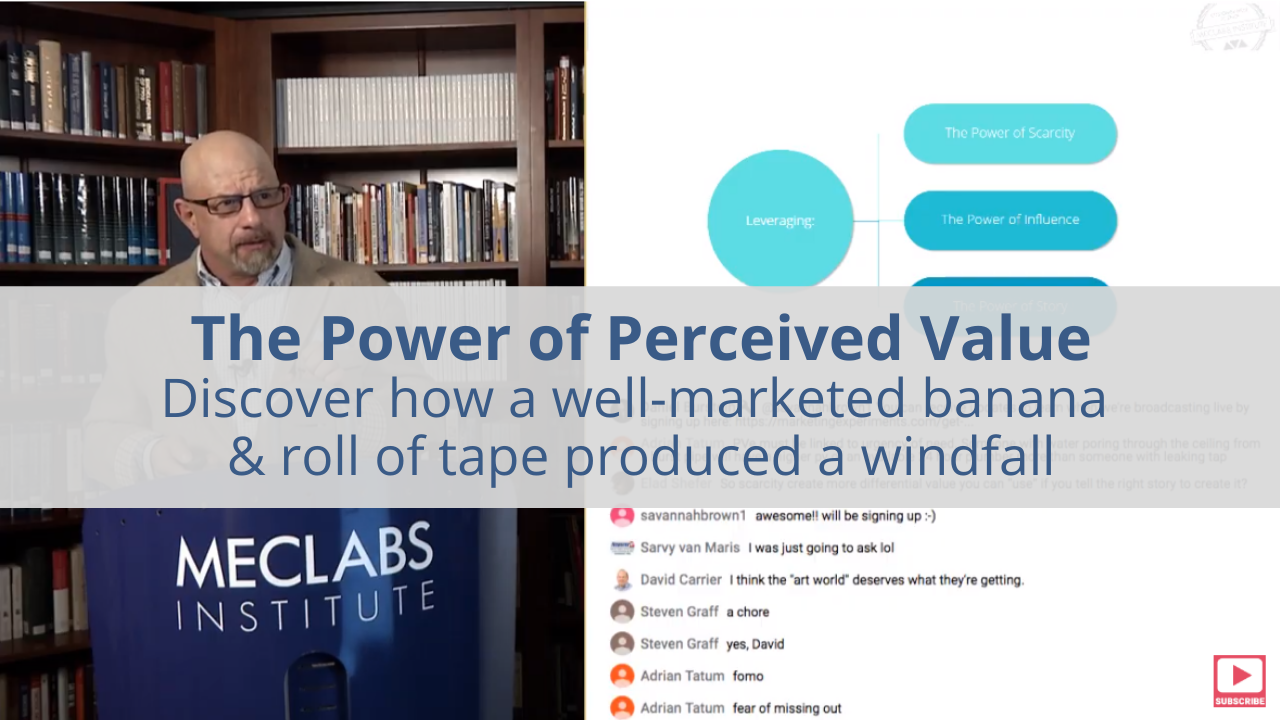
The Power of Perceived Value: Discover how a well-marketed banana & roll of tape produced a windfall


(This article was originally published in the MarketingExperiments email newsletter.)

“If you have something unique — even a single dimension of exclusivity — that’s meaningful and significant to the customer, you help them conclude they can’t get this anywhere else.”

— Flint McGlaughlin, Managing Director, MECLABS Institute

If you are experienced in business, you have heard of using marketing tactics like scarcity, story and influence to increase your sales.

But there is a right way and a wrong way to apply these psychological drivers. Negative manipulation used by marketers to achieve a business objective not only hurts their own brand but also negatively impacts those who are making honest efforts to sell their goods or services.

In today’s video replay, Flint McGlaughlin explains ways to identify and avoid dark patterns some businesses employ to increase sales. He also gives examples of real case studies where people are using the power of scarcity, story and influence in a positive way — and increasing conversion.

Watch the video to learn how to tap into these three motivators in the most effective way.

Here are some key points in the video:

  • 8:01 Three factors can impact a customer’s perceived value of your offer.
  • 11:02 PVD is the difference between the customer’s perceived value and the actual value.
  • 16:40 Scarcity — Examples of using this internal motivator inappropriately.
  • 22:37 Dark patterns — Negative manipulation used by marketers to achieve an objective in their business.
  • 25:19 Examples of using Scarcity appropriately.
  • 29:10 Influence (celebrity, social proof, authority, etc…) — Examples of using it appropriately.
  • 32:05 Examples of using Story appropriately.
  • 35:33 Value Proposition — Four conclusions to evoke in the mind

Related Resources

Princeton Dark Patterns Study:Dark Patterns at Scale: Findings from a Crawl of 11K Shopping

Dark Patterns on Scarcity and Influence: The Endless, Invisible Persuasion Tactics of the Internet D

Landing Page tests:A/B Testing: How a landing page test yielded a 6% increase in leads

Web Clinic tests:Email Copy Tested: How adding urgency increased clickthrough by 15%

Social Media: Social Media Optimization: Engineering contagious ideas

Ecommerce:New Chart: Ecommerce – It’s Not All About Price

Print Ads: Marketing Chart: Which advertising channels consumers trust most and least when making

Leveraging Influence in a winery:Interactive Email: 6 tactics to leverage the influence of social reinforcement

Behavioral Triggers:Marketing Psychology: The behavioral triggers behind success at Amazon, Groupon and FarmVille

Social Media:How to Use Social Media to Increase Your Marketing Conversion

Non-profit analytics:Data Analysis 101: How a nonprofit used data to secure a critical business decision and help find 125 missing children

Sales Increase through Story: Ecommerce Marketing: 150% increase in sales from product storytelling and site redesign

Newsletter tactics: Content Marketing: How a farm justifies premium pricing

Copywriting: Copywriting on Tight Deadlines — How ordinary marketers are achieving 103% gains with a
step-by-step

Internal Story: 5 steps to telling your team’s story

The post The Power of Perceived Value: Discover how a well-marketed banana & roll of tape produced a windfall appeared first on MarketingExperiments.


from MarketingExperiments https://ift.tt/2FJFu20
via IFTTT

Friday, 10 January 2020

A New Year, A New You: Why Content Marketers Always Succeed by Always Failing

Often times, content marketers (and marketers in general) can forget that they are artists. Marketing is an artform. Content can be as beautiful as any painting or poetry, be it a landing page, what you think is a perfect line of copy, a brilliant design, a funny email, or a great tweet.

However, all marketers have restrictions placed upon them. They have to:

  • Operate under brand guidelines
  • Pay attention to metrics
  • Do some A/B testing of their content, subject lines, offers, or approaches
  • Take the pulse of their audience and the industry that they’re in
  • Personalize to your audience
  • Follow along with their brand’s messaging
  • Run a cohesive campaign
  • Work together with sales, social media, IT, management, partners, influencers, and everyone else

And, of course, your content marketing has to in some way positively contribute to ROI.

You can’t just let go and create. You can’t just let your imagination run completely wild and unfettered—not when you have guidelines and rules to follow. You have stakeholders you have to satisfy. If your campaign manager asks for an email, you write the email to their specifications. If your events team asks for signage, you don’t put whatever you want or think sounds awesome. You write copy that they prefer and can work with.

After all, content marketing is your job. This is business and not playtime, but that doesn't mean that you can't enjoy yourself at least somewhat. 

The Limit

Sure, at times, you can be funny, creative, quirky, and clever with your content. You can send an event invite out shaped like origami. You can send cheeky, lighthearted emails out. You can post riddles and weird facts in your social media posts. The marketer and cartoonist Tom Fishbourne once said, “The best marketing doesn’t feel like it’s marketing.”

But it still is marketing. There’s a limit. You can only go so far with your creativity.

Or is there?

Say you’re writing a novel. If the book has a serious tone throughout, suddenly making it really odd and comical would be quite jarring. The characterization has to stay consistent, the plotting has to be sharp and make sense, and the mystery has to offer a satisfying conclusion.

So, actually, when writing fiction, you don’t have complete creative freedom. You still have to operate under the restrictions you put on yourself, audience expectations, and common sense. You have to ask yourself things like:

  • What genre is it?

  • Is it for adults? Children? Everyone?

Yet, even when faced with such restrictions, novelists still put their all into their works. They pour their creativity into them. They try out idea after idea on the page.  

It’s just that not everything makes the cut.

Don’t Fear Your Editor(s)

Editing means proofreading and also going through your work and seeing what works and what doesn’t. You prune and cut out what doesn’t work and sharpen the rest. Often times, this means what’s simplest and most powerful is what to use. In school, I was taught that good writing is concise writing, and good marketing is concise and powerful marketing that gets an easy-enough message across in the most eye-catching and informative way possible.

How does this all tie in?

Any artist or creator, be they a content marketer, email marketer, journalist, inventor, writer, poet, sculptor, actor, director, or whatever else you can think of, always sets some limits on themselves depending on what they’re actually doing. They narrow their focus to get their point most effectively across.

And their work still isn’t done. It needs to be edited. It needs to be looked at objectively. It has to be whittled down to the sharpest and most powerful points. You can be your own editor, but you need someone else looking over as well. Sometimes, you need multiple sets of eyes (and as a content marketer, this will often be the case anyway).

Never a Final Draft

No one ever produces the absolute perfect piece of content. There’s always room for tweaking. Someone will always see something they want changed. But don’t fret. Rejoice. This will only make you a better and better writer, designer, artist, and content creator.

Think of it like this. You never completely finish a project. At some point, you give up on, it as the old saying goes. You failed. It wasn’t perfect. The whole world didn’t applaud the moment you published it. Still, it went out and it might have gotten results, and you can learn from the experience.

There’s always room for improvement. You see it in the metrics, ROI, audience engagement, or you just know deep down what else you could have done.

Your content might still reasonably well, but if you couldn’t improve upon the next time, why bother? Why do anything?

Because you’re an artist, and you just can’t stop. You realize that there is no final mountain to climb or ultimate moment of success. You keep on going and producing.

It’s a new year, and it can be a new you. Every project gives you a chance to be a new you, though. The important thing is you get started and get something done. If you need a new mindset, make this your New Year’s resolution: I will put work out there. My job needs content.”

After all, the marketer Lee Odden pointed out that “Content is the reason search began in the first place.”

You have to get something down first to have that content, however. The novelist Jodi Picault said, “You can always edit a bad page. You can’t edit a blank one.” Everyone has to start somewhere, and no matter how bad or rough it might be, you can shape it into something better over time.

Never Fear

With all the edits and tweaks and drafts, you might start doubting yourself. You shouldn’t. It’s natural. It happens. Sometimes, yes, you don’t need to edit as much and you don’t need everyone in the company and your city and state or province weighing in, but that’s a judgement call for who provides feedback and when you should take it. You shouldn’t let it all get to you. You are a content marketer, ninja, and superstar because your talent brought you there. It got you in the door. Now it’s time to produce, and that means putting in the hard work, doing the revisions, taking the heat, compromising when you have to, and hitting deadlines. What separates the greats from everyone else is what they put into their work process.

Stephen King said, “Talent is cheaper than table salt. What separates the talented individual from the successful one is a lot of hard work.”

Get it done. That is your mission. Keep everything moving and get content the door and make adjustments when you have to.


Working with a brand might be frustrating, but marketers can still find ways to be creative. Learn “How to Find the Right Voice and Tone and Work with Your Brand’s Style Guide.”

Check out the blog.


from Oracle Blogs | Oracle Marketing Cloud https://ift.tt/3074PfD
via IFTTT