Monday, 4 January 2021

The Best CRM Software (In-Depth Review)

Disclosure: This content is reader-supported, which means if you click on some of our links that we may earn a commission.

Without customers, your business wouldn’t exist. 

It’s critical to understand how your customers behave and what they want from you. Doing so makes their experience better.

And helps you generate more money. 

The best customer relationship management (CRM) software helps streamline, simplify, and improve your business processes to create better experiences for the one thing your business revolves around — your customers. 

With countless CRM software options to choose from, it’s easy to feel paralyzed.

To help sort things out, I reviewed the top CRM software available and put together a list criteria to help you make an informed final decision.

The Top 5 Options for the Best CRM Software

  1. Hubspot – Best free CRM software
  2. Salesforce – Best CRM software for versatility
  3. Zoho CRM – Best for small to midsize businesses
  4. Freshsales – Best CRM for sales teams
  5. Creatio CRM – Best enterprise-grade CRM solution

How to Choose the Best CRM Software for You

With so many options and types to choose from, finding the best CRM software for your business can feel like looking for a four-leaf clover.

Start with this. All of these products have been built to respond to problems that businesses face every day.

Yes, there are a lot of parts to CRM software, but each has a purpose.

You know the problems you face. And by reaching out to your customer service agents, sales reps, IT team, and anyone who will be using the CRM software, you can get a rich picture of their daily challenges.

There is CRM software that will help everyone at your organization make the most out of every customer relationship.

Finding it is a matter of understanding where your company is, and where it wants to go.

Business Size

The size of your business plays a role in which CRM software is best for you. If you have separate departments for marketing, sales, IT, and customer service, you need more advanced functions than a business with five employees. 

Furthermore, you need to consider who’s going to manage the software. Choosing and paying for software isn’t the same as using it to its full potential. 

You have to set it up and take advantage of its features for the investment to be worth it. 

For small teams, it may be a collaborative effort of everyone pitching in. However, large teams may have dedicated employees to set everything up and maintain the software moving forward. 

The size of your business also plays a role in how much the software is going to cost. The more user seats you need, the more expensive the software. 

Your Challenges

What’s not working? What could be working better?

Consider what systems you want to streamline and improve. It may help to think about current inefficiencies and how a CRM can help. 

Typically, CRM software helps with sales, marketing, IT, and customer service. Which of those do you want to improve, and do you have the capacity to set everything up and maintain it?

There are specific CRM solutions for particular industries.

These tend to be more expensive, but if they are the right fit for your situation, it’s worth it. Teams will have to spend less time configuring such purpose-built CRM software, which is an ongoing savings. 

Basic CRM Features

Most CRMs include a basic set of standard features. The CRM you choose should include them as well.

While the specifics of each feature vary from software to software, there should be a system in place to help you handle things like:

  • Contact and lead management
  • Document sharing and storage
  • Workflow automation
  • Interaction tracking
  • Mobile access

Look for these core CRM features before making any final decisions. It’s probably also a good idea to watch some videos of how these users manage these features.

Something like contact management is handled differently in each platform. Which one fits best with the way your teams work?

Advanced CRM Features

It’s also important to consider advanced CRM features that can have a big impact on your business.

The ability to automate routine workflows, process payments, and send invoices can save countless hours from every employee’s day.

Really rich automation capabilities are only available with high-tier plans. There’s definitely an added cost, but what about the benefit?

In the end, having advanced features for marketing automation and lead scoring can really drive revenue. Is the juice worth the squeeze?

Also, note that these advanced features are not distributed the same way by vendors. One may offer the high-end tools you need as part of a mid-level plan.

Third-Party Integrations

To really streamline and automate your business processes, your CRM tool needs to play well with the tools you’re already using to run your business.

Make a list of the tools you use and double-check to make sure your CRM integrates with them. I’m talking about:

  • Email platforms
  • Social media tools
  • Internal communication software
  • Customer service tools
  • Calling/video chat software
  • Shopping cart (for ecommerce)
  • Contract/proposal software
  • Connectors (i.e., Zapier)
  • Analytics tools
  • Calendar

Once you have your list, you can use it to narrow down your choices to the right CRM software. You can also use it when speaking with a sales team to make sure they offer everything you need. 

The Different Types of CRM Software

There are three different types of CRM software. The most common type is operational. And thankfully, companies are integrating more features from the other types of software into operational CRM systems. 

Doing so helps minimize the need for businesses to have three separate pieces of software. 

Before diving into my top recommendations, let’s talk about these different types and what they mean. 

Operational

Operational CRMs help businesses of all sizes handle business processes and enhance the lead generation systems they have in place. The idea is that streamlining your operational processes helps your business provide better customer experiences. 

There are four types of operational CRMs, including:

  • Marketing
  • Sales
  • Customer Service
  • IT

These are traditionally what people think of when they hear CRM. So, all of the recommendations on this list fall under this category. 

Analytical

Analytical CRMs help businesses gather, analyze, and leverage data collected from their customers. Essentially, this type of CRM software helps turn large data sets into valuable information you can use to improve the customer experience. 

The recommendations on this list include a few basic analytical features.

But there are certainly more robust CRM tools out there for collecting and analyzing customer data, especially for enterprise businesses with a lot of customer information. 

Collaborative

Collaborative CRMs make it easy for businesses to share everything they learn about their customers using operational and analytical CRM software. 

Essentially, this type of software lets team members quickly pass along lead, contact, and customer information from one department to another. 

Doing so helps track interactions between customers and your business as well as identify your customers’ preferred communication channels. 

Both of those things combined help improve customer experiences. 

Most of the recommendations on this list offer multiple operational CRM solutions that seamlessly integrate, making this type of collaboration easy. 

However, there are better systems out there if you’re looking for something more powerful. 

#1 – Hubspot Review — The Best Free CRM Software

If you’re in the sales or marketing industry, you’ve probably read Hubspot’s blog or taken one of their free certification courses. However, they also offer a robust and free CRM software to streamline your customer relationship management process. 

With Hubspot, you can gain unprecedented insight into how your audience behaves. 
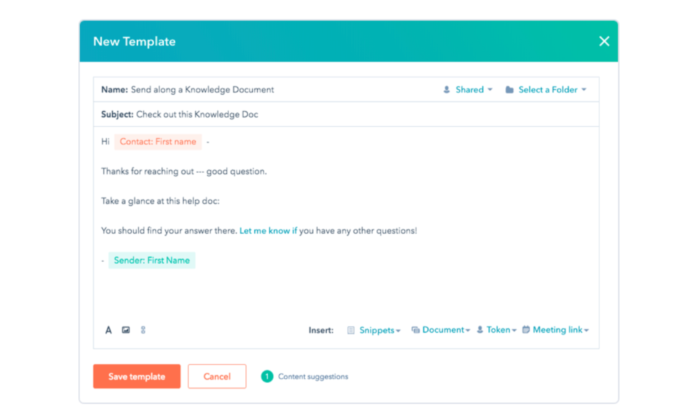
Need to monitor when contacts open your emails so you can optimize your open rates? No problem. Maybe you want to see how a contact behaves on your website. With Hubspot, it’s easy. 

Furthermore, they offer a wide variety of solutions, depending on your role within your company. 

These position-specific solutions include sales, marketing, customer service, operations, and owners. 

The free CRM plan includes a robust set of features, including:

  • Contact management
  • Email scheduling
  • Deal pipelines
  • Meeting scheduler
  • 1-1 live chat
  • Contact website activity
  • Store, track, and manage tasks
  • Document sharing
  • VoIP calling

These features are hard to beat on any other free plans on this list. However, Hubspot’s paid plans are well worth their price as well. 

The Starter Plan starts at $40 per month, paid annually. However, if you want to bundle all of Hubspot’s CRM software, you can get starter access to all four for $50 per month if you commit to a 12-month contract. 

So, for $10 extra dollars a month, you also get software specialized for marketing, sales, and customer service.  

However, keep in mind these prices are based on 1,000 contacts. The price increases for every additional 1,000 contacts you have. 

Sign up for a free plan to get started with Hubspot today.

#2 – Salesforce Review — The Best CRM Software for Versatility

Whether you’re a small business owner or a sales, marketing, IT, or customer support team, Salesforce has the perfect CRM solution. Known for its versatility, they offer specialized software that adapts to meet your needs. 

More than 150,000 businesses, including T Mobile, Adidas, and Yeti, rely on Salesforce to help them build strong relationships with their customers. 

They also offer specialized solutions for 14 different industries, including:

  • Financial services
  • Healthcare
  • Manufacturing
  • Consumer goods
  • Energy
  • Communications
  • Nonprofits

The system is so versatile because you can pick and choose which apps you need to build a complete CRM solution customized to match your business. 

From marketing automation and ecommerce sales to call-center software and self-service portals, Salesforce is dedicated to providing everything you need for unprecedented customer relationships. 

Their business plans include:

  1. Essentials — $25/user per month (basic sales and support)
  2. Sales Professional — $75/user per month (complete sales solution)
  3. Support Professional — $75/user per month (complete service solution)
  4. Pardot Growth — $1,250 per month for up to 10,000 contacts (marketing automation)

However, you can add additional features and applications depending on what you need. They also offer other plans for sales, customer service, commerce, and marketing CRM packages with varying features. 

Start your free trial to take Salesforce for a test drive today.

#3 – Zoho CRM Review — The Best for Small to Midsize Businesses

Unlike the other options on this list, Zoho CRM is an all-in-one solution. There aren’t additional modules to look through for different departments or anything like that. This makes it an excellent option for small to midsize businesses.

They also have an extensive network of 40 other business tools. So, if you’re using Zoho software already, integration with Zoho CRM is seamless. 
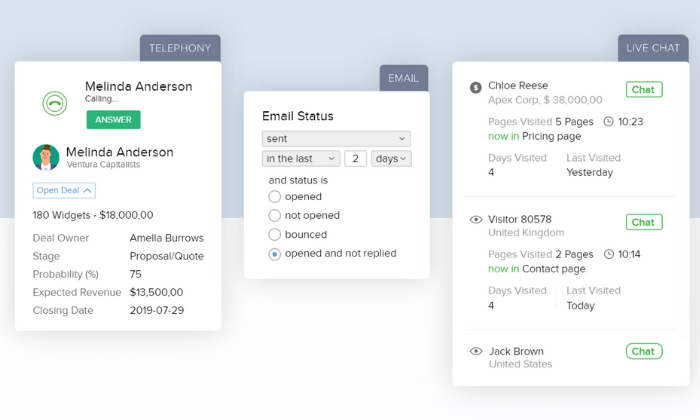
Plus, they have a worldwide network of over 150,000+ customers (including Netflix and Bose) in 180 countries, so you know you’re in good hands. 

Furthermore, Zoho offers a free forever plan with up to three users. It includes essential features like lead management, document sharing, task management, workflow rules, and a mobile application. 

However, their paid plans are affordable as well, and they include advanced CRM features like:

  • Real-time sales signals and customer notifications
  • Blueprint business management for both on and offline processes
  • Prospect scoring capabilities
  • Unique sales pipelines
  • Mass emails
  • Inventory management
  • An AI assistant
  • Advanced customizations

The cheapest paid plan starts at $12 per user per month, making it extremely affordable for small businesses. 

Sign up for a free 15-day trial to see if Zoho CRM is right for you. 

Note: Zoho also recently launched a sales-centric CRM specifically for small businesses. It’s called Bigin, and it includes a robust free plan if you’d like to try it out. Bigin’s paid plans are $7 per user per month. 

#4 – Freshsales Review — The Best CRM for Sales Teams

Unlike the other options on this list, Freshsales is specifically built for sales teams and lead management. From cold leads to customers, Freshsales helps you make better relationships while saving time with automation. 

Furthermore, this CRM helps you find the best leads, get in touch with them via their preferred method, and close the sale. 
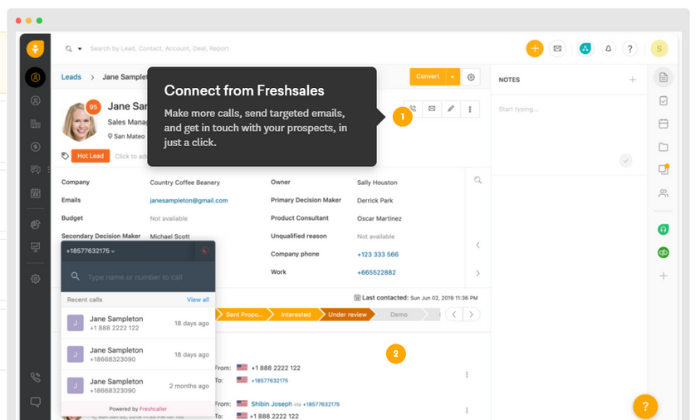
And Freshworks includes a built-in email and phone system to help simplify the process. 

They have a customer base of over 40,000 businesses, including some big names like Dyson and Best Western. So, despite being newer to the industry, they’re not inexperienced by any means. 

With Freshworks, you get powerful sales-based features, including:

  • Lead, contact, account, and deal management
  • Tasks and appointment management
  • Merge or clone records
  • Advanced conversation views
  • Lead scoring
  • Time-based workflows
  • Sales pipelines
  • Team inboxes and email forwarding
  • Email scheduling, templates, and alerts
  • Website visitor tracking
  • iOS and Android mobile apps

Aside from an impressive set of features, they also offer industry-specific solutions for 15 different industries, including retail, ecommerce, manufacturing, logistics, healthcare, and more. 

Their free forever plan includes access for an unlimited number of users with limited features. However, it’s a great way to try it out before investing. 

Freshsales’ paid plans are more robust, yet still affordable for businesses of all sizes. Their premium plans include:

  1. Blossom — $12/user per month (for small teams)
  2. Garden — $25/user per month (for growing teams)
  3. Estate — $45/user per month (for large teams)
  4. Forest — $79/user per month (for enterprises)

Sign up for a free 21-day trial to see if Freshsales is right for you and your sales team today.

#5 – Creatio Review — The Best Enterprise-grade CRM Software

While some of the other CRM software on this list includes an enterprise plan, you may find them limiting if you’re managing a large operation. However, Creatio is an enterprise-grade CRM software built with businesses like yours in mind. 

They offer specific CRM solutions for sales, marketing, and customer service teams.
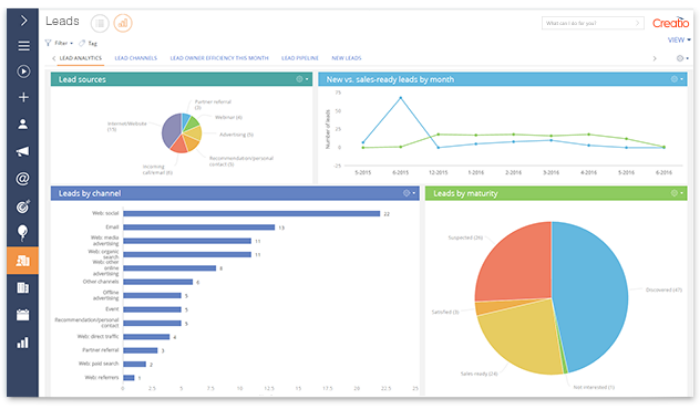
Marketing Creatio gives enterprise businesses everything they need to streamline their multichannel marketing campaigns and manage incoming leads. It includes features like:

  • Visual campaign designer
  • Website behavior tracking and segmentation
  • Advanced trigger campaigns
  • Personalized email marketing
  • Event tracking and response management

Pricing depends on the number of contacts and the number of emails per contact. 

Sales Creatio is perfect for large sales teams taking over after marketing hands them over. It’s an end-to-end sales management platform built to simplify the process and save you time. 

It includes a wide range of features, including:

  • Opportunity management
  • Customer profiles and buying behavior insight
  • Field sales management
  • Performance and operations

Pricing starts at $30 per user per month. 

Lastly, Service Creatio is for customer service teams interested in streamlining their processes and creating excellent customer experiences from start to finish. It includes features, like:

  • Account and contact management
  • Case and knowledge management
  • Omnichannel communications
  • Service catalog
  • Contact center

Pricing starts at $45 per user per month. 

You can bundle all three CRM solutions if you need to. And you can use their online pricing calculator to estimate the total cost. 

Get started with a free trial to see if Creatio is right for you. 

Summary

Hubspot, Salesforce, and Freshsales are my top recommendations for most businesses. Each one offers a wide range of features suitable for teams from all departments, including sales, marketing, and customer service. 

Furthermore, they’re all affordable, easy to set up, and easy to use.

However, the best CRM software for you depends on your business’s size and the features you need. So, use the criteria we talked about above as you go through the process of making your final decision. 

Which CRM software do you use?

The post The Best CRM Software (In-Depth Review) appeared first on Neil Patel.


from Blog – Neil Patel https://ift.tt/2Rt9lS2
via IFTTT

How to Use Instagram Shopping to Drive Product Sales

How to Use Instagram Shopping to Drive Product Sales

Have you used shops on Instagram? With over a billion active users and growing, Instagram may already be one of your favorite places to promote your e-commerce store. However, lots of opportunities exist for marketing on the channel, so it can be a great place to build a follower base and get the word out about your products and brand.

What if you could take passive interaction to the next level and actually buy and sell directly from the platform? That’s possible with Instagram shopping. This can be enticing for Instagram users and e-commerce shops who want to keep their interaction, from discovery to sale, right there on Instagram itself.

What Is an Instagram Shop?

Instagram shops are an option for Instagram account holders who have e-commerce brands to sell directly from the Instagram platform.

They provide a way for Instagram users to interact and shop with brands they love, find new brands they might like, and purchase through the Instagram app.

An Instagram shop exists like a mini e-commerce store, within Instagram, as an extension of your brand’s page. As a brand owner, you can build collections that are customizable and reflective of your style and perspective.

Shops can choose to allow purchasing directly from the app, using Facebook Pay, or they use their Instagram shop to point to an off-site e-commerce store. Either way, they can build a more interactive shopping experience for their users.

How Does Instagram Shopping Work?

Instagram Shopping is a pretty simple process for Instagram users. The whole idea of this feature is to make things more enticing, so users spend more time on the app, checking out the shops they love, as well as discovering new brands.

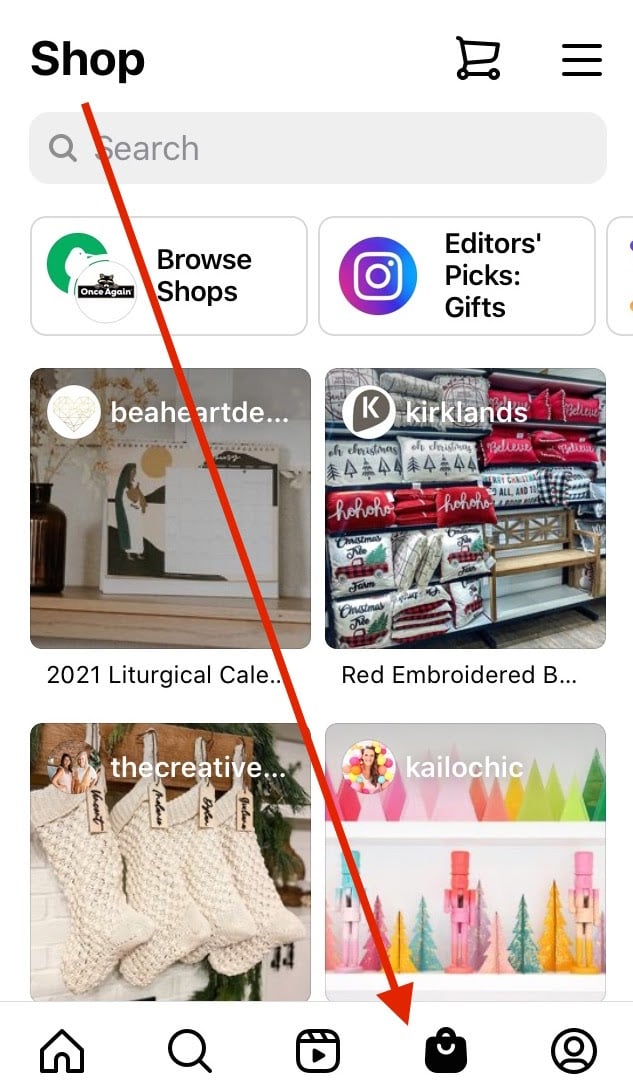
To find shops you want to explore or buy from, go to the little shopping icon that looks like a shopping bag on the app: 

How to Shop Shops on Instagram

From there, you will see shops from brands you already follow, as well as some that are recommended based on your interactions on Instagram. You can also check out “Editor’s Picks” to see different categories, such as Gift Guides, and to explore collections and other recommendations.

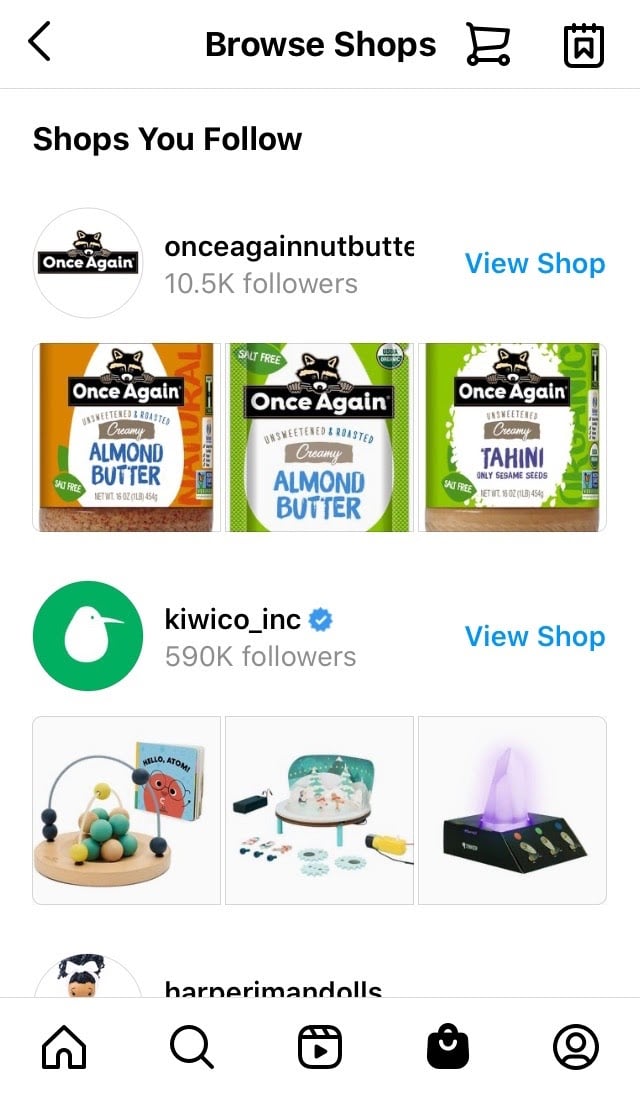
If you click “Browse Shops,” you’ll see a listing of brands you already follow who have shops on Instagram. This can be a great place to start when you’re exploring because you probably already have an interest in the products and may have even purchased from them in the past.

How to Browse Shops on Instagram

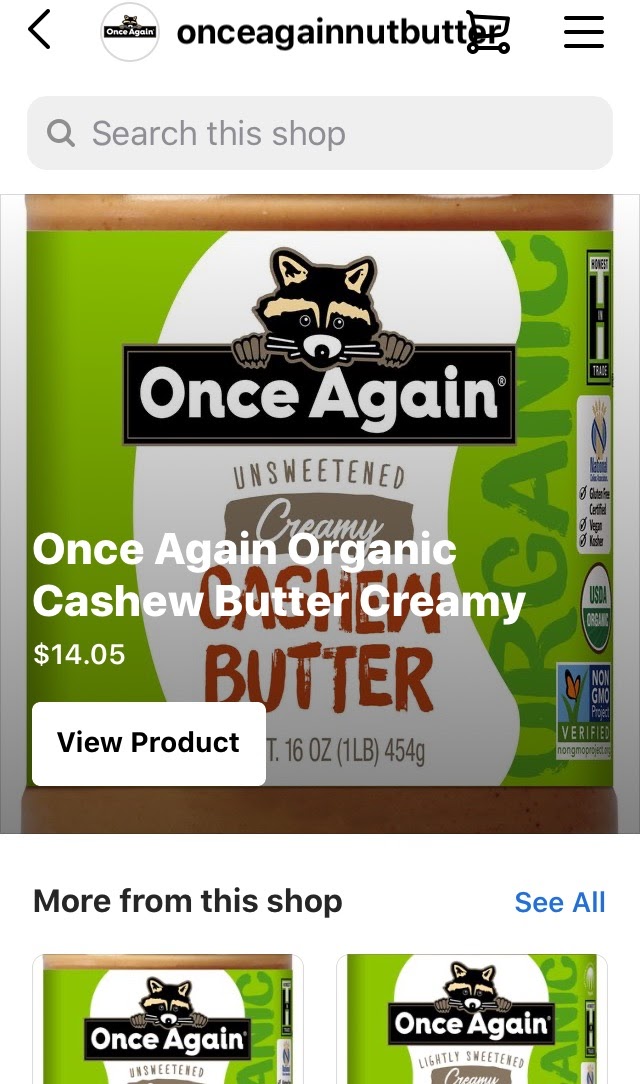
Once you click on a shop, you’ll see the products and collections they have available.

Instagram shopping example

From there, you can learn more or choose to buy, just like you would at an e-commerce site.

How to Set Up an Instagram Shop

To set up a shop on Instagram for your brand, you must have an Instagram Business account, and you must be eligible. According to Instagram, eligibility includes but is not limited to:

  • Operating in a supported market (dependent on your location)
  • Having an e-commerce website from which you sell products

Remember, an Instagram shop is an extension of your e-commerce store, not necessarily a replacement for it.

You will then have to connect your Facebook account. More later on how those two are connected and why it matters for your Instagram Shopping account.

You then follow the steps to set up your account, load your product images, and “turn on shopping.”

Here are a few tips to keep in mind as you go through those technical steps:

  • Use high-quality, editorial images for your products and collections: Think of your Instagram shop as a type of interactive catalog. Be selective about the images you are using for your products. Make sure they stand out and show lots of detail.
  • Have all your product information on hand: Again, thinking about this as a catalog, you will need to enter all the descriptive information about each product, including prices, colors, sizes, flavors, types, etc. You’ll also need information about shipping and other details. Keep it all at the ready before you dive in.
  • Get ready to tag: After getting your Instagram shop set up, the last step Instagram recommends is to start tagging. When you upload an image, select “Tag Products” and type in the name of the product you want to tag to that post. You will be able to do this in Instagram Stories as well.

Benefits of Having an Instagram Shop

Why would brand managers want to take the time to set up shops on Instagram? First, let’s look at some numbers. According to Instagram, 60% of people interviewed said they discover new products on the app. Facebook says 70% of people referred to as shopping enthusiasts turn to Instagram to shop, and 36% of all Instagram users consider shopping to be a hobby of theirs.

The best reason to set up shops on Instagram is to tap into that enthusiasm. Think of Instagram Shopping as the trendiest mall from back in the day, with eager buyers walking around and window shopping. You want to be there with your brand too, right?

Here are some more benefits of having a shop on Instagram:

  • It’s free: Yes, you can set up your Instagram shop for free. The only fees associated would be a selling fee when customers place an order and the fee for any ads you use to promote your products or shop.
  • It’s another online storefront: Don’t put all your eggs in one basket, they say, and that applies to online shopping too. If a hiccup occurs with one platform, you’re already set up somewhere else.
  • It’s a mobile catalog: Instagram has designed these shops to be very clean and scannable. They are easy to peruse and to get an overall idea of a brand’s look, as well as to dig in and learn more about the products. For this reason, you can think of shops on Instagram as a kind of mobile catalog. You may even find yourself sending people there to get a feel for what you sell, just because it’s so easy to scroll through.
  • It’s a way to build your following: As we talked about earlier, people are going on Instagram looking to shop. Setting up your shop there is a prime way to draw buyers who are ready to make a purchase, as well as to build a following for your Instagram account (which probably supports your overall social media marketing strategy).

Instagram Shopping vs. Facebook Shops

You may be wondering how shops on Instagram compare with shops on Facebook. While they are different platforms, they are both under the Facebook umbrella.

Remember that corporate Facebook owns Instagram, which means Facebook powers Instagram Shopping. To set up your Instagram shop, you will need to link to your Facebook account, and, as mentioned, payment is processed through Facebook Pay.

Should you set up an Instagram shop and a Facebook shop? Here are a couple of considerations to help you decide:

  • Link easily: Because you need Facebook to launch the Instagram shop, it may be worth having products on both platforms. You can use the same products and collections on each if that makes sense for your target market and brand.
  • Consider demographics: Your target market may spend more time on Instagram than on Facebook. If that’s the case, you’ll want to make sure you set up an Instagram shop. If your target market straddles both the demographics of Facebook and Instagram, you may want to set up a shop on each.

Submitting and Receiving Payment for Instagram Shopping Products

How do you go about actually buying and selling with Instagram Shopping? A big part of this question is how money is exchanged.

Remember you can choose to have your products point to your e-commerce site. Buyers will then be directed to your website, in a browser within the Instagram app, rather than processing the purchase through the Instagram platform.

However, if you want to save buyers that step, you can set up payment options to allow the transaction through Instagram. When you set up your shop, you’ll need to link to Facebook Pay. We noted above the relationship between Facebook and Instagram. Facebook Pay is how you receive payments for purchases made.

When you purchase something from shops on Instagram, you’ll need to submit your credit card, debit card, or PayPal information to use Facebook Pay to finalize the transaction.

How to Promote Your Instagram Shop

Once you have an Instagram shop up and running, you’ll want to find ways to promote it and draw potential customers to your new location. Here are some tips for achieving that:

  • Launch timely collections: When you create collections or groupings of products to showcase in your shop, think about the browsing buyers first and what they are searching for right now. Instagram recommends thinking about seasons, holidays, or pop culture moments to create collections that connect with and attract buyers.
  • Make it easy for shoppers: When you create posts and stories, make sure to choose the “Tag Product” option to link directly to your shop products. Also, Facebook recommends adding calls-to-action in your captions to remind buyers of what to do. Another recommendation is to update your bio with shopping information.
  • Invest in ads: Want to reach even more people with your Instagram shop? You could consider launching an ad on Instagram with clickable tags that draw people to your shop.

Alternatives to Instagram Shopping

There could be a few reasons why a shop on Instagram is not the right platform for your brand, or maybe you want to explore other shop options to find a better fit. Some of those reasons may be:

  • It’s not the right demographic: Yes, Instagram is wildly popular, but not everyone is shopping there. If the target market of your brand is not tech-savvy, doesn’t tend to use Instagram, or prefers not to shop on new platforms, you may not want to set up an Instagram shop.
  • There aren’t enough products: Shops on Instagram showcase collections of products well, allowing brands to launch or promote groups of products. If you are only selling one item, it may not be worth your time to set up a shop. However, even one product, if photographed and promoted well, could be popular there.
  • They aren’t physical products: You do need to sell a physical product. Digital products or services are not sellable with the app.
  • It’s not in the right location: As mentioned earlier, you do need to operate in a location where Instagram Shopping is available. If you don’t, you’ll need to find an alternative.

In these cases, or if you’re just looking for more customization or wider tools, you may want to choose an alternative to Instagram Shopping. Examples may include:

  • Like2Buy: With Like2Buy, you can build shoppable solutions, as well as create other calls-to-action, such as requesting email addresses of potential customers.
  • Yotpo: In addition to several e-commerce marketing tools, Yotpo offers an Instagram integration tool.
  • FourSixty: Advertising a design-centric aesthetic, FourSixty provides Instagram marketing tools, including shoppable galleries and scheduling.

Conclusion

Shops on Instagram allow you to interact with your followers (and new buyers!), in a seamless way. You can create collections just in time for a season or holiday and promote your products to an audience that is eager to buy.

This feature allows brand owners to sell on Instagram dynamically. While it may not be the only solution you need, it can be a great addition to your Instagram sales strategy.

Will you be shopping and selling directly on the Instagram app? Or do you prefer a more traditional e-commerce platform?

The post How to Use Instagram Shopping to Drive Product Sales appeared first on Neil Patel.


from Blog – Neil Patel https://ift.tt/357wC3m
via IFTTT

5 Marketing Automation Pro Tips to Drive More Leads and Conversions

Marketing automation provides time and cost savings. However, every company that uses this technology may not be getting as much out of it as they should, especially when it comes to driving more leads and conversions. Here are some ways to make marketing automation work for you.

  1. Create a map for the lead journey

Although marketing automation solutions do most of the work nowadays, you still should provide some direction and assistance to help the software deliver optimized results. It’s important to create a visual of how your leads move through various stages on their journey toward conversion. Doing so will help you identify the steps and also help you understand where leads get stuck along the way so you can address that in the marketing program design. 

There are many lead stages throughout a journey that may be relevant to your automated program design planning. For example, there are leads that remain anonymous while others are known and/or engaged. Other leads may have already been qualified through your marketing campaigns or sales team. 

Have a plan for each lead stage so you can use your marketing automation to address the behavior at that stage to keep every lead moving toward conversion.

  1. Use an automatic qualification process to speed up lead movement

Having the ability to move leads through the pipeline at a faster rate can drive more leads and conversions. Pushing promising leads along toward conversion opens more room in the pipeline to funnel more new leads. 

Your automatic qualification process can involve assigning score values to actions like the lead signing up for a demo or free account. This action may indicate an interest in a specific product or service. Taking the time to assign the right values to how leads interact with your brand will enable you to capture the lead faster and automate the next best action that pushes the lead to sales faster. Faster speed to lead means your prospects are getting the information and interactions they find relevant faster, and allows your team to know when the prospect is ready to engage with sales.

Marketing automation software can be used to assign a lead score that reflects each action taken by the prospect and to determine if and when that lead meets your scoring qualification. From there, automated triggers can be set up for engagement with sales or for placement into another campaign at any particular time.

  1. Activate personalization and segmentation across marketing activities

Bringing all your data into a marketing automation platform enables you to get more insights from the extensive prospect data that you receive across all digital channels. Incorporating artificial intelligence into an automation platform, you can use data from your prospect’s digital footprint to inform segmentation and deliver relevant personalization in both marketing and sales engagement. 

This facilitates the ability to bring scaled efficiencies to personalized emails and other engagements with leads. In doing so, it’s easier to show these prospects that you understand who they are as individuals and that you can address their pain points.   

  1. Implement multi-channel campaigns

The more channels that you can engage with prospects on, the greater likelihood you have of reaching more of your target audience. Put marketing automation to work in accomplishing this, including scheduling and sending campaigns for email, social media, SMS text messaging, videos, and more. 

You can set days and times to space publication of these campaigns to maximize the number of audience members that can see it. And, thanks to artificial intelligence, optimized days and times are often recommended by the marketing automation platform to increase your reach and response rates. 

5. Use automation for increasing your social listening and monitoring capabilities

Responsiveness can also be a deciding factor for a lead. Typically, however, it can be difficult to stay on top of all the online comments—positive and negative—that appear let alone respond to them in a timely manner. That’s why you should look for a marketing automation solution that includes social listening and monitoring capabilities. 

Receive notification when your brand is mentioned on social media so you can jump on and join the discussion, respond to feedback about a customer experience, or answer questions. It delivers the ability to be more personal and connected with your audience. All those that have viewed that conversation will see your level of care and concern, potentially winning them over. 

Marketing automation drives customer growth

Your marketing and sales teams may be stellar in their ability to collect leads and convert them. However, their efforts can be enhanced by marketing automation solutions that help improve personalization, speed qualification, and amplify conversations. These capabilities can open the pipeline to more leads and facilitate a stronger relationship between your customer and your brand.


For more information about marketing automation, please read: Also, check out:  


from Oracle Blogs | Oracle Marketing Cloud https://ift.tt/2Mqazy9
via IFTTT

Saturday, 2 January 2021

The 5 Best Marketing Automation Companies of 2021

You could get a marketing automation tool and try to figure it out yourself.

Or you could get a marketing automation company to do everything.

Look, marketing automation gets crazy complicated.

Lead routing, lead tracking, campaign measurement, all the emails and landing pages, lead nurturing, dozens of segmentation lists, it goes on and on.

Not to mention a deep integration with your CRM which has to work flawlessly.

Your entire marketing program depends on getting marketing automation right.

The best sales teams already work with top Salesforce partners to get everything set up from the beginning.

It’s about time that marketing teams followed their example.

Don’t just look for a marketing automation tool, find a marketing automation company (agency) that can help you with everything.

The 5 Best Marketing Automation Companies

Some of us in that marketing automation companies are: 

  1. Neil Patel Digital – Best for Content Marketing Automation
  2. LeadMD – Best for Tech Stack Integration
  3. CS2 Marketing – Best for On-call Marketing Operations
  4. Bluewolf – Best for Salesforce Automation
  5. Perkuto – Best for Marketo Automation

Let’s dive into each.

#1 Neil Patel Digital – Best for Content Marketing Automation

If there’s one digital advertising channel that cuts across all others, including automation, it has to be content marketing. 

I’m not here to remind you that content is king. You already know! 

Even with marketing automation, content marketing drives everything. You need the right content in the right emails to keep leads moving down the funnel.

Tons of billion dollar startups have built their sales and marketing process around content. And it works beautifully.

And it’s an area my team at Neil Patel Digital shines the brightest. 

How? 

We’ve rolled out content programs for the entire sales cycle across many Fortune 500 brands.

I truly believe we’re one of the best companies at content, period.

If you’d like content marketing and marketing automation working together seamlessly, we should chat. 

#2 LeadMD – Best for Tech Stack Integration

Marketing automation frees you (and relevant people on your team) from mundane tasks. 

For example, say someone signs up to download a whitepaper on your landing page. 

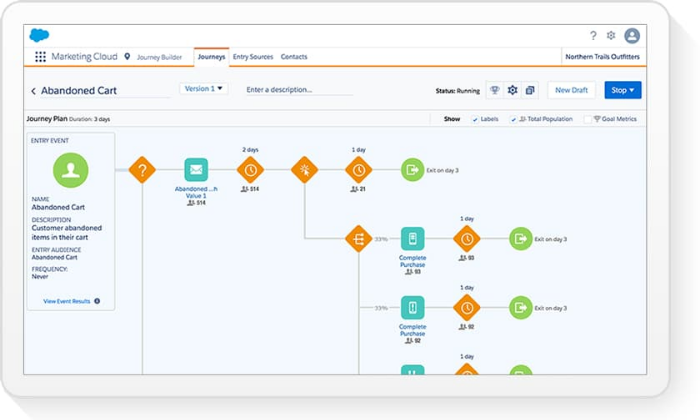
They fill out the form fields, your CRM collects this data, creates tags based on the info provided, and segments them into relevant email lists. 

That email sequence could include 180 days or branching email logic based on their actions and sales stage.

For this to work well, you’ll need tight integrations between your:

  • Marketing automation tool
  • CRM tool
  • Landing page tool
  • Software trials and accounts
  • Ecommerce accounts
  • Subscription settings
  • Customer support tools
  • Deduplication tools

And dozens of small tools that impact your users.

If that sounds like a lot, that’s because it is.

These systems get extremely complicated very quickly.

You’ll need a team that knows how to get everything working together. One broken link in the chain could dump thousands of leads by accident, costing you hundreds of thousands of dollars. I’ve seen it happen countless times.

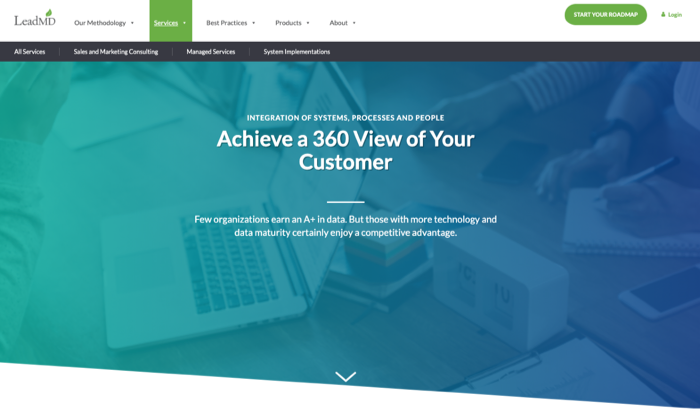
LeadMD specializes in setting up these types of integrations:

LeadMD is the go-to marketing automation company for integrating your tech stack. 

If you feel really good about the rest of your marketing strategy and just need help with getting all the infrastructure working correctly, reach out to them.

#3 CS2 Marketing – Best for On-call Marketing Operations

Once you get your marketing automation fully implemented, that’s not the end.

New marketing operations projects come up all the time.

A hot new campaign needs to get added to your automation. Sales wants to tweak the lead scoring or MQL definition. IT changes one of your tools and you need to re-implement that part of the stack.

Lots of projects (large and small) will come up.

One option is to hire a full-time marketing operations person. That’ll easily cost $100K fully loaded with benefits, taxes, and marketing rate compensation.

Or you can find a marketing automation company that specializes in scaling up and down as you need them.

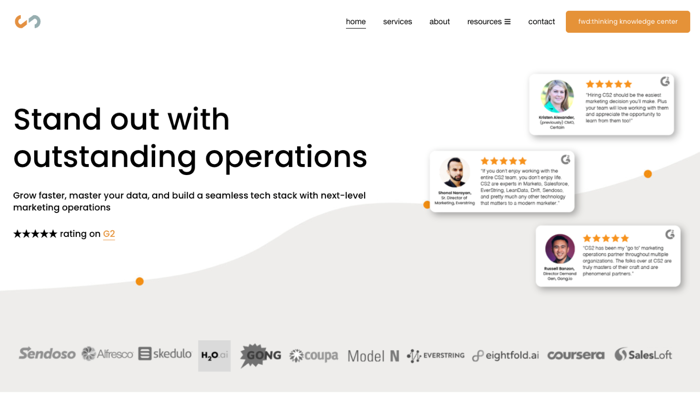
That’s exactly what Cs2 Marketing does.

First, you can sign up for a contract to get ongoing consulting. This is super valuable to make sure you’re not accidentally lighting your whole marketing stack on fire.

Then, when you have a project some up, they have a whole team that can execute it for you.

This is perfect for mid-size companies that need to keep every dollar focused on customer acquisition for as long as possible.

#4 Bluewolf – Best for Salesforce Automation

I’m going to say something controversial.

Oftentimes, how your marketing automation tool integrates with Salesforce is more important than the marketing tool itself.

After all, your business lives and dies on your CRM, which is usually Salesforce.

One way to get everything working right is to work backwards. Get your CRM dialed, then force your marketing automation tool to work the same way.

So before jumping into a deep marketing automation tool implementation, consider getting a top CRM agency to help with Salesforce.

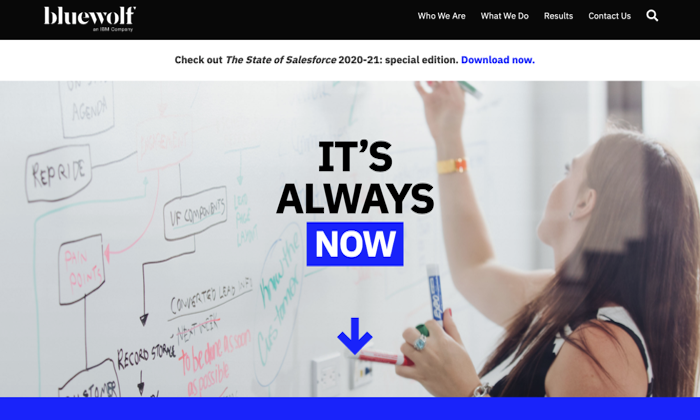
For this, check out Bluewolf.

Bluewolf is an IBM company, and that alone speaks volumes about this agency’s reputation. They mostly serve enterprise brands and are prepared to handle anything that you can throw at them.

Bluewolf is also global. They have about 24 offices spread across different continents. 

#5 Perkuto – Best for Marketo Automation

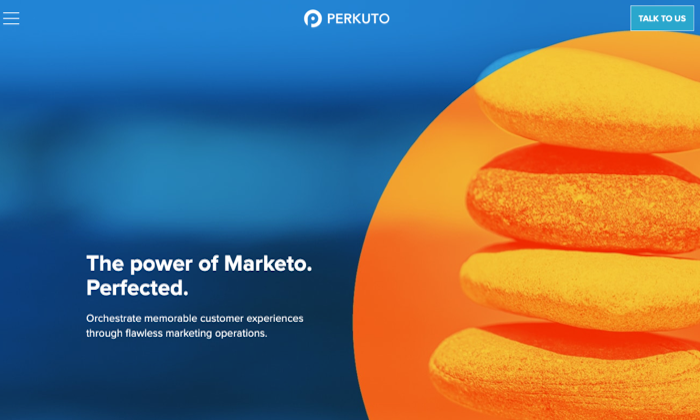
Marketo is a one powerful tool. If you’re already using it and want to go really deep with your implementation, check out Perkuto

You could say that Perkuto is THE top-most Marketo expert, having achieved the “Marketo Engage” status and works with a team of over 50 marketing automation strategists and hardcore engineers.

If it can be done in Marketro, Perkuto can make it happen.

I’d definitely reach out to them if you have a Marketo implementation that’s gone haywire and you need serious expertise to fix it all. In those cases, you want a top expert to get you back on track. They’re worth every penny.

5 Characteristics That Make a Great Marketing Automation Company

When looking at marketing automation companies, what should you prioritize?

What are the red flags?

What signs tell you that someone is one of the best?

I start by looking for these characteristics.

1. ROI Before Tech

Some engineers and infrastructure folks love tech for tech’s sake.

Not all, but some do.

In marketing, that’s super dangerous.

You need a marketing automation implementation that generates real ROI. You spend $X. It needs to generate more than $X. That’s the whole point of marketing.

Otherwise, it’s just a waste of time.

When looking at marketing automation companies, they should have an extreme focus on driving ROI. It should be the lens that they filter every recommendation through.

Even better, they should talk about revenue growth and ROI naturally. You shouldn’t feel like you have to push them here.

2. Experience With Companies Bigger Than You

When working with any marketing automation company, make sure you’re not the biggest customer.

The last thing you want is for a vendor to patch your implementation together because it’s the first time they’re handled your complex use-case.

You don’t want the marketing automation company to learn on your dime. Your implementation will suffer. Tech debt will pile up and you’ll end up paying to fix it later.

Ask the company for case studies and a list of clients in a similar industry as you. Many of them should be larger. If not, treat it as a red flag. 

3. Deep Experience With Your Marketing Tech Stack

In any marketing automation tool, there are dozens of different ways to set up any workflow or feature.

You don’t want it to just work, You want it set up so it has that perfect balance between scalability and flexibility.

That’s not easy to do.

To know what option is best, it takes a lot of trial and error with every tool. And experience across dozens of clients and implementations.

So even if a marketing automation company has a ton of experience, make sure they have experience with your marketing tech stack.

Otherwise, keep looking.

4. Expensive

A marketing automation (and CRM) implementation is one area you do not want to cut corners.

We’re talking about foundational infrastructure that routes every lead of your business.

Any leaks means you’ll lose serious money.

And sense these systems get extremely complicated, it’s easy for stuff to fall through the cracks.

So when you’re shopping around with different companies, look at low prices as a red flag. The experienced folks will know their value and charge accordingly.

Spend the money to get your marketing automation set up correctly. It’ll instantly pay for itself.

5. A Desire to Coach

As you start talking with companies, the best ones will have an innate desire to coach you and your team.

Even if they handle 100% of the initial implementation, they know that your team needs to manage and operate it all.

Communicating best practices, guiding your team, and empathetic coaching will make sure that your implementation stays clean for years to come.

On any given call, you should feel like you’re learning. That’s a good sign they’ll continue to coach your team throughout the entire implementation.

What to Expect from a Great Marketing Automation Company

Once you start to reach out to marketing automation companies, expect to go through these steps.

1. Filling out the contact form

Since marketing automation projects are major rollouts, expect an in-depth sales process before getting started.

The marketing automation also needs to do a deep dive on your needs before being able to come up with even a general price range.

Look for the contact form of their website and use that to get started.

2. The discovery call

After filing out the contact form, you should receive a reply pretty quickly.

Any great team will be crazy responsive to any new prospects. Expect a reply within 24 hours.

If you don’t get a reply, that might be a sign that you’re a poor fit for that company. For example, the companies that specialize in enterprise clients will probably ignore smaller startups that need a basic implementation for a marketing team of 2-3 people. It’s just too small for them. In these cases, they typically don’t respond at all.

So if you don’t get a response and you’re a smaller company, look for folks that feature clients on their site that are closer to your size.

Once you get a reply, you’ll usually get asked to jump on a discovery call. There won’t be much pitching on this call. Instead, the marketing automation company will want to learn as much about you as possible. They’ll ask you things like:

  • Budget
  • Timelines
  • Your marketing tech stack
  • Company size
  • Key stakeholders
  • Hard requirements for the project

I recommend that you sit down and come up with clear answers to these items before the discovery call. That will keep the process moving quickly.

The clearer you can be with the partner, the more likely they’ll be able to deliver what you want.

3. The Proposal

Depending on the complexity of your implementation, you might have several calls to scope out the full project.

Once everything has been clarified, expect to get a proposal that breaks down the full cost, timelines, and deliverables of the project.

If you wince at the price, it’s probably in the right range. Implementation fees for CRMs and marketing automation tools are pretty high.

One other thing, really double and triple check all the requirements with your team. Look for holes and items that you missed in the spec. Changing requirements later will get really difficult. Best to get any changes added to the proposal now.

Also ask the company how they handle mid-project scope changes in the event that it happens. Usually, they’ll have an hourly rate that they charge for any additional work.

4. Sign and get started

Once you’re ready, sign the proposals and get the project going.

After everything is signed, the marketing automation company usually takes the lead. As long as you’re responsive on your side, things usually stay moving without you having to push on them.

The initial process usually starts with:

  • Introductions to the whole implementation team
  • A kick-off call
  • Scheduling for regular check-ins
  • Calls with internal experts to go through all details

Are the Top Marketing Automation Companies Worth it?

I believe so.

Any serious marketing team will need a fully operational marketing automation tool.

And marketing automation tools have gotten so complicated that it’s unwise to muddle through them yourself.

You want an experienced team to roll out your tool the right way. It costs a lot more upfront but it’ll save you a ton of money in the long run.

I was speaking to a VP of Marketing the other day. He worked at a top-tier marketing team, managing hundreds of thousands of leads. He turned to me and said “You know, the other day, we discovered 100,000 leads that got lost in our marketing automation tool. They were just sitting there. For like a year.”

That’s nuts! Think of all the lost revenue.

And it happens all the time.

Look around, reach out to a few experts in this space, and get it done right.

The post The 5 Best Marketing Automation Companies of 2021 appeared first on Neil Patel.


from Blog – Neil Patel https://ift.tt/388X4eA
via IFTTT

Friday, 1 January 2021

Best EMR Systems

Disclosure: This content is reader-supported, which means if you click on some of our links that we may earn a commission.

In the fight to stay organized, healthcare professionals have an uphill battle.

Billing is more complicated than the human genome.

Government regulations add extra steps to every task.

Decisions are time-sensitive.

Small mistakes can have serious consequences.

On top of all of this, everyone’s busy. There’s no extra time to search for a patient record or reorder an incorrect prescription.

The best electronic medical records (EMR) systems can simplify a lot of the complex challenges today’s providers face.

They are not a silver bullet by any means, but finding a product that works for your practice will make you more efficient today and better prepared for tomorrow.

Here are the top EMR systems that are helping practices improve care, reduce burnout, and make every day less stressful for everyone who walks in the door.

The Top Four Options for EMR Systems

  1. CareCloud – Best for growing specialty practices
  2. athenahealth – Best for switching to a new system
  3. SimplePractice – Best for health and wellness providers
  4. Kareo – Best for independent practices

The Different Types of EMR Systems

Not so long ago, EMR systems were the tool for turning paper charts into digital resources. They made patient data easier to access and track.

People still need these functions, but today you are going to see very few standalone EMR systems. Instead, you will find EMR systems will come as part of a larger electronic health records (EHR) system.

EMR vs EHR Systems

Here’s the key difference between the two:

  • Electronic medical records are a digitized version of a patient’s chart.
  • Electronic health records include information from all doctors involved with a patient’s care.

With EMR systems, people within the organization could access a patient’s chart. With EHR systems, on the other hand, medical records can be shared between multiple providers, labs, and insurers.

This ability to share complete EHRs is critical in today’s healthcare environment. 

You may already know the reasons why EMR systems are being phased out in favor of EHRs. I’m not going to go in-depth here, though you can certainly read about it if digging into healthcare legislation blows your hair back (see specifically the HITECH Act).

Suffice it to say, new laws and changes in technology have made EHR systems essential.

This can be confusing though. 

Many providers still need to digitize and organize the work of their office. EMR systems are perfect for that, and so there’s still a lot of online search for the term.

And because people are asking the internet for EMR systems, you’ll see vendors offering “EMR systems” and directing you to their EHR, or calling their products EMR/EHR solutions.

Some vendors seem to use EHR and EMR interchangeably. Likely, they will continue to do so as long as people are searching for EMRs.

For all the haziness and craziness of the situation, providers who need an EMR system today are really just looking at two major product categories:

  1. EHR systems
  2. Practice management suites

Let’s go through both of these so you can figure out which one is going to help you get your practice to where it needs to be.

I’m still going to talk about EMR systems, but just know that it is going to come as part of a solution with a different name.

Electronic Health Records Systems

EHR systems include everything providers need from traditional EMR systems to take their practice online. They can digitize charts, connect them to schedules, and keep each patient visit as efficient as possible.

For practices looking to go paperless, these products can be extremely helpful. They will help you turn file cabinets into searchable digital drives. This saves so much time for doctors, nurses, and staff who can quickly access everything they need from any device.

In addition to tracking patient records, EHR systems help with:

  • Billing
  • Insurance
  • E-prescribing
  • Lab work and tests

In this sense, an EHR “follows the patient,” giving all parties involved with a patient’s care the information they need to keep the process moving forward.

Most often, you will find EHR software offered as one part of a complete array of tools for managing a practice. Vendors like Kareo and athenahealth offer stand-alone EHR systems, which can be a great starting point for making the transition online.

Practice Management Suites

A practice management suite is designed to centralize all of the administrative, clinical, financial, and legal processes within a single platform.

In addition to EMR/EHR capabilities, they include:

  • Advanced reporting
  • Patient engagement
  • Revenue cycle management
  • Telehealth

As robust as these solutions are, they are not just for large organizations. In fact, these products work really well in the small practice setting. 

With limited staff, solo providers simply don’t have the time to manage 7 or 8 different tools to interact with each patient. Practice management suites are highly customizable, allowing providers to unify and trim down their workflow to its essential elements.

Small practices also benefit from the rich reporting features. 

Dashboards and data visualization tools help providers understand trends in clinical data. This can help practices decrease wait times, improve patient engagement, hit regulatory goals, and better manage risk.

How to Choose the Best EMR System for You

The right EMR system provides support for overburdened staff by streamlining critical administrative tasks.

The wrong EMR system can make things worse.

According to a study from the American Medical Association, the average family physician spends 86 minutes per day doing administrative tasks after they leave work.

This so-called “pajama time” has become an awful reality for every physician stuck using a well-intentioned but poorly-performing EMR system. 

And it’s not just doctors who are affected by this. Nurses, staff, pharmacists, and—most of all—patients suffer the consequences of inefficient systems.

Just knowing which solutions are popular is not enough. Sometimes a good system is implemented poorly or deployed in a place where it doesn’t fit.

So, how do you pick an EMR system that actually benefits employees and patients?

There’s no easy answer, but by following these three steps you can start to hone in on the right product.

Understand the features you really need

There are an astonishing number of features included with every EMR solution. Most individuals will never use the majority of them.

It’s not surprising, given that these systems are built to work for different types of doctors in a wide variety of clinical settings.

Go into your search with a list of must-have features and functionality. Every product is going to come with digitized charts and patient tracking, but what does that mean for your practice?

In other words, which system has the features that will help receptionists, nurses, doctors, and patients get from A to B? How will each set of features map to your actual patient flows?

A to B is an over-simplification, but also not. One of the most common complaints about EMR systems is that they take too long to accomplish routine tasks.

Ordering a prescription or procedure shouldn’t require scrolling through hundreds of irrelevant options. If a solution includes e-prescribing, ensure that it can be customized to actually save time.

The more A to B tasks your EMR system streamlines, the more time all staff have to spend engaging with patients.

Consider a specialty option

A welcome trend is the growing number of EMR systems tailor-made for specialty practices.

I like these because they solve two problems associated with traditional, general-use EMRs. 

One, providers get exactly the tools they need instead of a platform freighted with unnecessary features.

Two, each feature has the appropriate depth for the specialty in question. Laser settings are automatically recorded on charts for dermatologists. Orthopedic surgeons can share large-file imaging results with ease.

Instead of workflows and templates designed for the “textbook clinic,” these products meet the specific needs of today’s specialists.

Prepare for integration and implementation

It’s much easier to deploy an EMR system that integrates with the billing, imaging, and other platforms you use.

Some EMRs centralize those responsibilities within a single platform. If that’s the route you go, what’s it going to be like to move everything from multiple platforms?

The transition from paper to EMR or from one EMR to another is taxing under any circumstances. If the pieces of the puzzle don’t fit together, it can be even worse.

To make the best of a difficult challenge, find a vendor who is willing to help bring data from your existing platform to theirs as part of the deployment.

I definitely recommend reading reviews from actual customers about the kind of service they receive during and after implementation. If you are supposed to get a dedicated service rep, how dedicated are they?

It’s also not 100% on the vendor. What kind of in-house IT support will make everyone’s life easier? Under-budget for this at your own risk.

Upskilling a few “super-user” staff members who can fix issues on the spot will go a long way towards smoothing out the daily frustrations of moving to a new system.

#1 – CareCloud — Best for Growing Specialty Practices

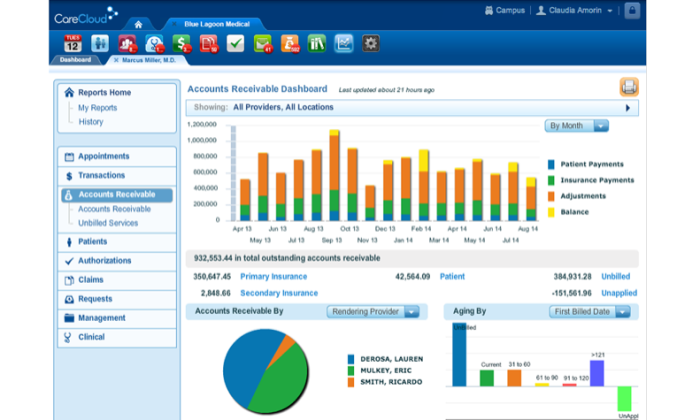
CareCloud is a practice management suite that gives doctors more time to spend with their patients and more resources to invest in their practice. 

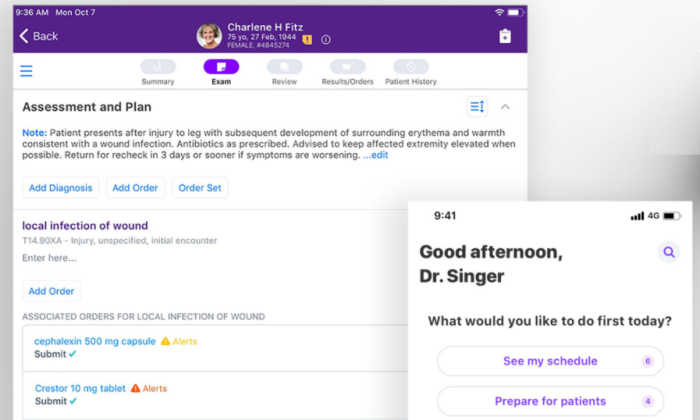
It unifies the tools providers need to manage every step of the patient relationship in their specific setting. Users can customize charts, reuse order sets, and share content with their colleagues.

The decision support features are quite advanced. This cuts down on the potential for medical errors by immediately flagging issues like dangerous drug combinations and dietary restrictions.

In addition to delivering real-time information at the point of care, quality chart data translates into rich reporting in CareCloud. 

Track the performance indicators that matter most, get an instant snapshot of where things stand, and keep an eye on how they evolve.

The EMR and revenue cycle management features work really well together. Providers can use what they discover to improve the quality of patient care and better steward a small practice over financial and regulatory hurdles.

One of the reasons CareCloud works so well is that they offer 24 specialty specific solutions. These deliver tremendous out-of-the-box functionality to providers who would otherwise be stuck configuring their system.

For pain management, physical therapy, podiatry, proctology, pulmonology—and that’s just the p’s—clinicians and physicians can get to work on CareCloud right away.

Some of the highlights of CareCloud include:

  • E-prescribing
  • Real-time patient flows
  • Patient portal
  • Drag-and-drop scheduling
  • Quality initiative reporting
  • Mobile app

In addition, they make a lot of additional tools available to speciality practices through their Content Store. Find solutions for insurance, billing, scheduling, and record-keeping that are built by other providers in your specific field.

You’ll have to get in touch with CareCloud for pricing, whether you want to use Charts—their EHR module—or the entire practice management platform.

It’s a great option for speciality practices that are looking to grow. CareCloud will streamline every process—from insurance to patient handoffs—because it has everything a specialist needs with none of the bloat.

#2 – athenahealth — Best for Switching to a New System

athenahealth consistently develops trusted healthcare software for hospital systems, small private practices, and everything in between. 

They offer a full practice management suite, athenaOne, which provides EHR, billing, patient engagement, population health, care coordination, and epocrates, a best-in-class mobile app.

Alternatively, providers can use athenaClinicals, the EHR component of athenaOne. Their products work well with many other options on the market, so practices don’t have to migrate all their systems at once.

This makes it a great option for practices that see EMR/EHR a key step in the gradual process of future-proofing their entire practice.

One of the biggest draws of athenaClinicals is how easy it is to navigate. It’s a really intelligent platform that is continually auto populating patient data and prioritizing important information. 

A lot of the platform’s recommendations come from trends it picks up on in your network, like routine processes and orders. If patients being seen for one treatment are often prescribed a certain medication, it will be right there without any search required.

Stop struggling with ever-changing procedure codes and insurance protocols. athenahealth monitors federal quality programs and makes best practices available immediately.

Some of the other standout features include:

  • Secure voice, text, and email reminders
  • Patient portal
  • Decision support
  • Rich reporting
  • Mobile app
  • App marketplace

Even though the user interface is great, there is a learning curve because the platform is so deep. In other words, the control that makes athenahealth such a great long-term solution requires a little getting used to in the short term.

I think it’s worth it, because it’s the last tool staff will ever have to learn.

The platform has proven itself capable of handling the most challenging healthcare IT environments.

Never switch again.

The cost of athenahealth’s integrated suite is based on a percentage of monthly collections. The idea is that they partner with your practice instead of locking you in a contract and charging for upgrades. 

They do well if you do well. Many companies report that the increased efficiency with billing and collections offsets the costs almost entirely, to say nothing of its impact across the practice.

athena’s customer support has a solid reputation and they have a lot of experience helping clients move their data over securely.

If you are stuck on paper or with a system that’s not getting it done, athenahealth will do what it takes to make you their next satisfied member.

#3 – SimplePractice — Best for Health and Wellness Providers

SimplePractice is an affordable practice management suite that’s delivering value to therapists, dieticians, social workers, and other providers in the mental health and wellness space.

It’s a great price for small clinics and private practices that want to centralize charts, notes, appointments, insurance, and billing in one intuitive platform.

There’s a patient portal, so both sides benefit from the accessibility. Clients can upload documents and even book their own appointments (on your terms, of course). 

Speaking of accessible, SimplePractice empowers providers to meet with their clients, regardless of where they are coming from, or ability to come in.

Every consultation can be managed securely online, thanks to features like paperless intakes, online booking, and HIPAA-compliant telehealth solutions.  

Not every community has the local resources in place to serve those who need care. And even when patients have a nearby office, taking time to come in for appointments can still pose problems.

SimplePractice can help providers stay in touch with clients, no matter how busy or far away they are.

It’s great for an entire practice, but focusing in on the EMR features, SimplePractice comes with:

  • Template library
  • Diagnosis and treatment plans
  • Searchable ICD-10 codes
  • Secure text messaging
  • Appointment reminders
  • Superbills
  • Mobile App

There’s also customizable patient intake forms and surveys, which allow providers to ask questions in the right way. They can be sensitive, specific, and leave enough room for people to share their thoughts.

They offer plans for solo practices starting at $39/month. 

Group practice rates start at $98/month for 2 clinicians. Each additional user costs $39/month.

Features like telehealth and billing are extra charges, as they are with other platforms. On SimplePractice, however, the added costs are transparent—$10/month per user for telehealth and electronic claim filing starts at 25¢ per claim.

Practices that don’t need these features, or use something else, aren’t stuck paying, and those that need them have a predictable cost at the end of the month. 

Predictable, affordable, and complete. That’s SimplePractice. Try it free for 30 days.

Their Switching Team will help you import everything and live support is included with every plan.

#4 – Kareo — Best for Independent Practices

Kareo is an all-in-one solution for practice management that’s designed to meet the particular needs of an independent practice. 

This is their focus. You never have to worry about competing with massive hospitals for their attention.

Kareo isn’t hospital software that’s been pared down. The platform is a simple set of three integrated modules: Clinical, Billing, and Engage. 

There aren’t a million components to get the complete system and, more importantly, each part works fine on its own. 

If a company just needs a dependable EHR, for example, Kareo Clinical has everything they need.

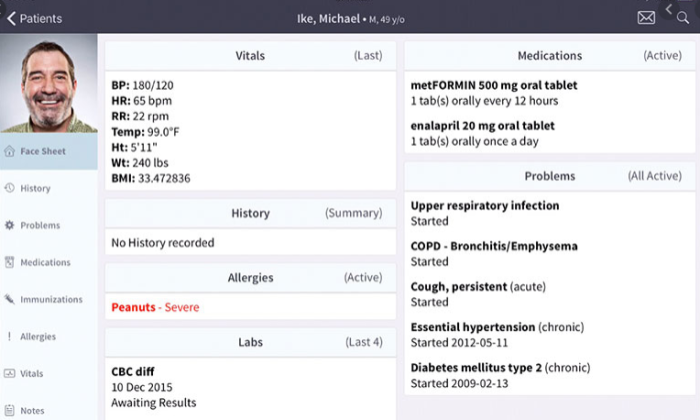
Charts are easy to read with space for notes. They feel simple, despite the wealth of information you can add. Kareo is optimized for all screen sizes, letting providers prescribe a medication or create a bill in minutes from any device.

The e-prescribing features save providers time and patients money. With Kareo’s integrated prescription discounts, doctors can compare prices and find savings for their patients.

They have a lot of great templates and forms that can be customized quickly, plus “same-as-last-time” features that streamline routine documentation. 

Other helpful tools include:

  • Patient portal
  • Customizable dashboards
  • Secure messaging
  • Decision support
  • Rich reporting
  • App marketplace

Kareo flowsheets are one of the most useful reporting features, showing doctors a patient’s key vitals and lab results over time. This makes it easier to analyze progress and track several aspects of a patient’s health at once.

None of these great features take long to master. There are self-service online resources like Kareo University, which many users find helpful.

But you are not on your own. After you sign up, they provide a free Kareo success coach for the first 60 days who will help with transferring and digitizing files. 

Their customer support is available via phone, email, and chat to answer all those insurance billing questions.

For independent practices that want an efficient, simple way to manage medical records, Kareo Clinical is going to overperform. 

Summary

Providing quality care is hard. 

That’s the root of the problem when it comes to finding a workable EMR system. Often, people put off switching to a better system because it’s such a pain.

Kareo and athenahealth do a lot to make the process easier. Independent practices should opt for Kareo because it’s built to fit their needs. For everyone else, athenahealth is a dependable long-term solution no matter how their practice evolves over time.

Looking at speciality practices, CareCloud is going to be the easiest to get up and running. So much of the backend organization has been done already. Templates and forms are ready to go and you don’t have to sort through irrelevant options.

For those working in the health and wellness space, SimplePractice is a perfect platform. It’s got competitive, predictable pricing and a rich set of features designed to nurture the most sensitive patient relationships.

The post Best EMR Systems appeared first on Neil Patel.


from Blog – Neil Patel https://ift.tt/2X01TAT
via IFTTT