Believe it or not, I’ve been working on Ubersuggest for almost 3 years now.
I bought it on February 13, 2017, for $120,000 dollars as a test to see if I could get more traffic from a tool than traditional content marketing or SEO.
Since then the tool has come a long way, in which I’ve added tons of features that competitors charge $100 a month or even more for.
But I’ve finally got Ubersuggest to a point where I can start releasing features that my competition don’t even have.
So before, you head on over to Ubersuggest to work on your SEO, make sure you read everything below because I’ve just changed up how you are going do keyword research (in a good way).
On top of that, I’ve also released a few other features as well related to link data and traffic estimations.
Here’s what’s new:
More keyword data
The biggest problem I had with keyword research was how to find the right keyword.
Sure, there are metrics like CPC data, SEO difficulty, or even search volume, but assuming you find keywords with a high CPC, low SEO difficulty, and high search volume, it still doesn’t mean it is a good keyword to go after.
And there are a few reasons why…
Mobile searches aren’t worth as much – first off, if the keyword mainly gets searched from on mobile devices the conversion rate will be lower. It doesn’t mean mobile traffic is useless, it just typically means the keyword won’t be as valuable.
High search volume doesn’t guarantee lots of organic clicks – what happens if the keyword gets a ton of searches but no clicks? This sounds crazy, but it actually happens a lot. For example, when people search for “weather” in the United States, roughly 60% of the people don’t click any results.
Not all searchers are worth the same – some keywords get searched heavily by teenagers. Some keywords get searched heavily by people who are in their 30s or 40s. If the majority of the searches for a given keyword happen by a really young audience, chances are they won’t have a credit card and they won’t convert into a customer.
Because of all of this, I decided to change how the industry does keyword research.
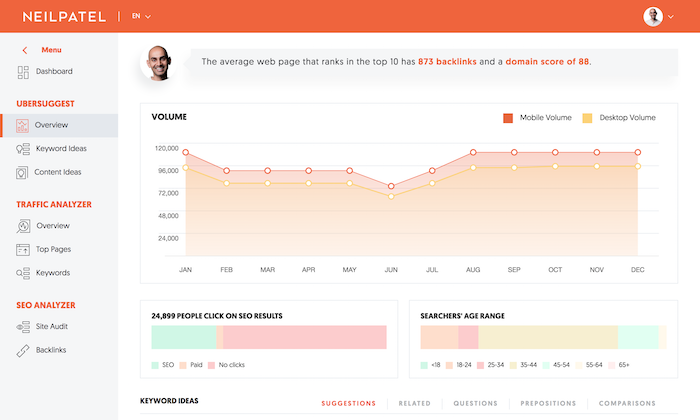
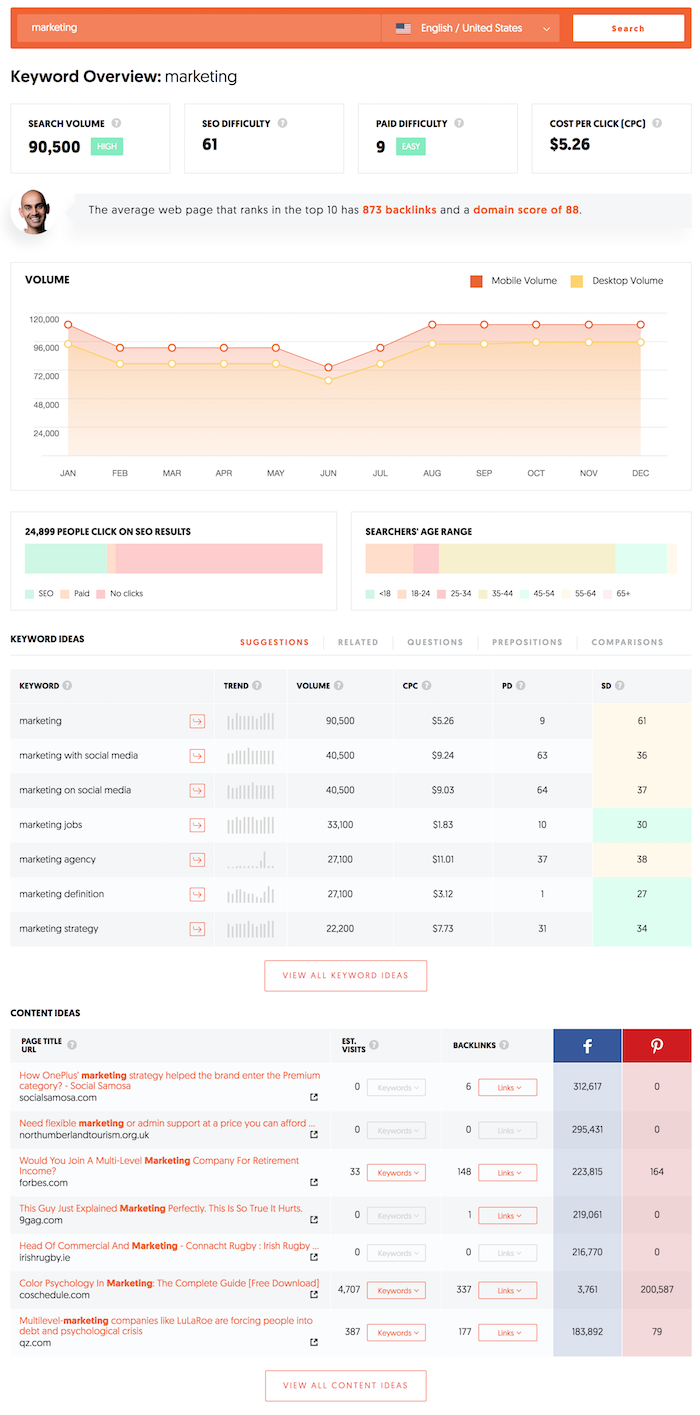
Now when you type in a keyword like “marketing” into Ubersuggest, you’ll see this:
If you have been using Ubersuggest for the last year or so you may notice some differences… but if you haven’t let me break down what’s new.
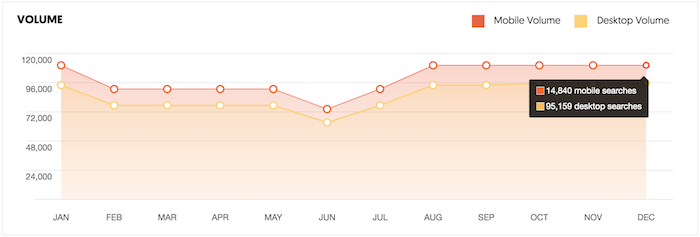
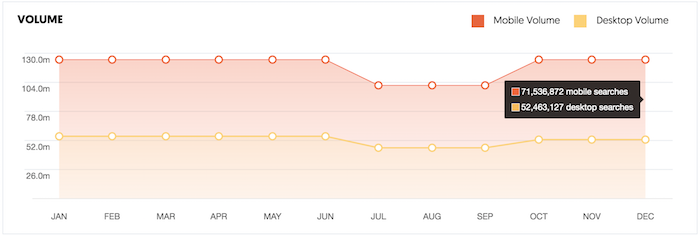
First off, for any given keyword you will see what percentage of the searches are taking place from mobile devices or desktop devices.
For example, with the term “marketing” you can see that the majority of the searches are coming from desktop devices.
On the flip side, if you use Ubersuggest to look at the term “weather” you’ll notice that the majority of the searches happen on mobile devices.
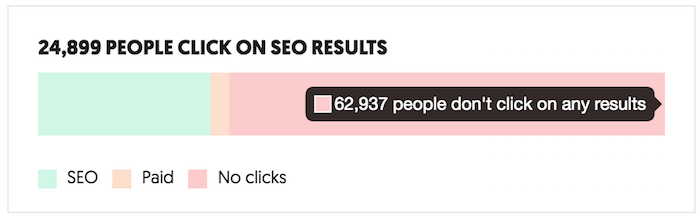
And with any given keyword you can also see what percentage of the people even click on the SEO or paid results.
I love this bar chart because it tells me if I should even go after a specific keyword. Just because a term has tons of searches doesn’t mean you are going to get tons of clicks, even if you rank at the number 1 spot.
If you leverage paid ads, this bar chart is also helpful because it will give you a sense of how many people click on the paid ads as well.
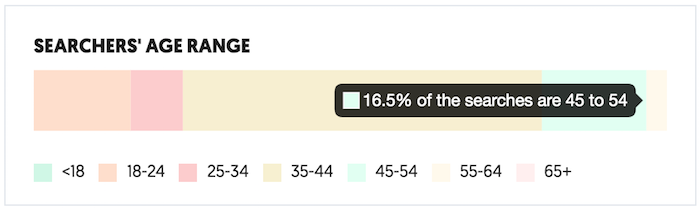
Another chart that I’ve added is one that breaks down the age range of each searcher.
As you can see from the above image, Ubersuggest now shows what percentage of the searches take place between each age range.
This is really important if you know the persona of your ideal customer, as you only want to target keywords that your ideal buyer is searching for.
What’s also cool is this data is available for all countries within Ubersuggest and for almost all of the keywords within our database.
Now before you head off to Ubersuggest and test it out, there are a few more features that I’ve just released.
More backlink data
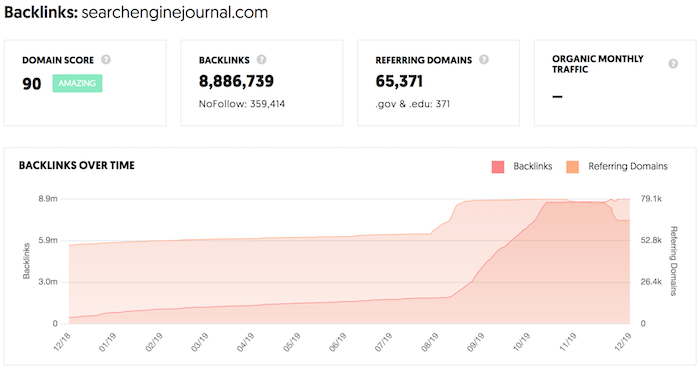
Over the last few months, I’ve gotten feedback that our link database isn’t as big as you would like, so we have been working on fixing this.
This chart will quickly show you if a site is growing in backlink and referring domain count over time or if they are declining.
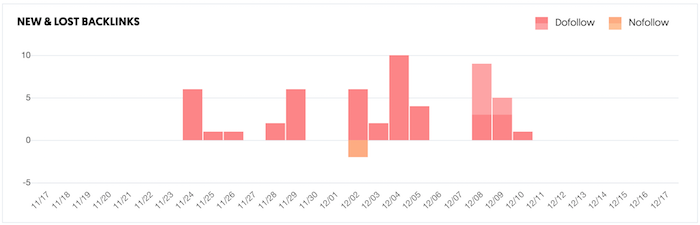
On top of that, we are even showing the daily new and lost link count for a given site.
I know the new and lost link count chart looks a bit off, but keep in mind we started having Ubersuggest crawl more pages around the web faster and more frequently. Hence you are seeing a big spike in new and lost links.
But over the next 4 weeks, it should normalize, and you’ll see an accurate representation of new and lost links.
This will help you identify new link opportunities more easily. Especially because you can now clearly see where your competitors are focusing their link building efforts.
Better traffic estimations
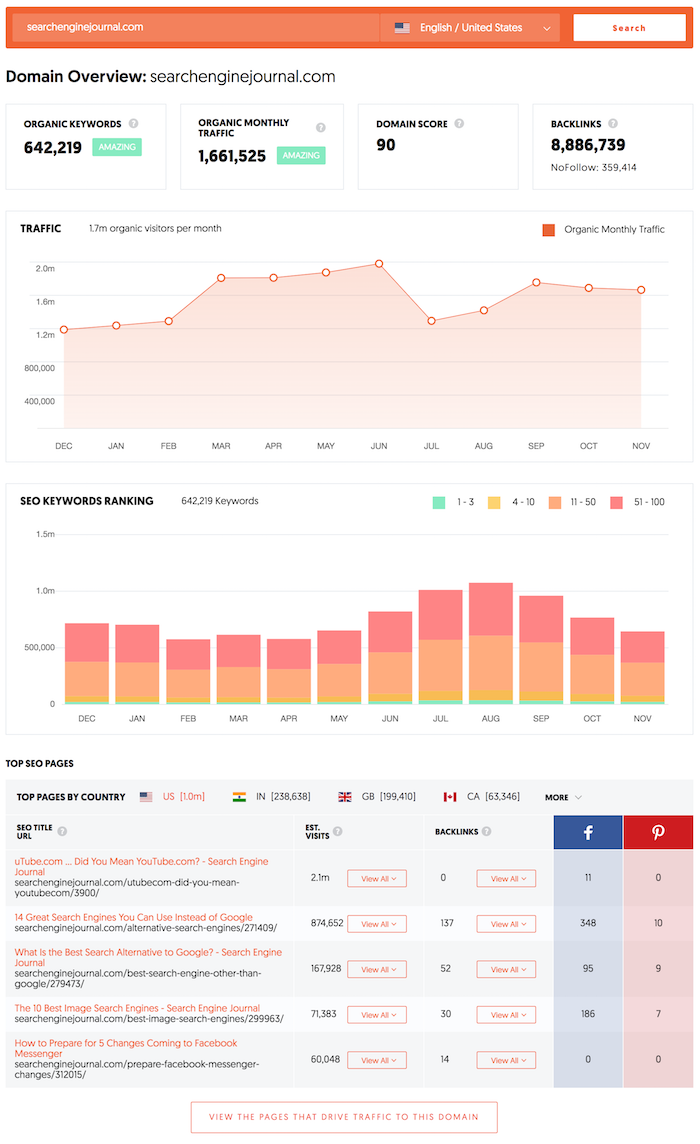
Lastly in Ubersuggest, you can also enter in a URL and get data on any given domain.
From its estimated monthly search traffic to the number of keywords a domain ranks for to even its top pages based on link and traffic count.
We haven’t fully finished creating our new algorithm when it comes to traffic estimations, but the chart you’ll see now is much more accurate than the older one.
Even though this is a big improvement from our older charts, give it another 3 months and it should be extremely accurate.
When you are using the traffic analyzer report in Ubersuggest, keep in mind that this will give you a directional guide on how you are doing versus your competition.
I’ve made them in order to give you a leg up on your competition as the data in the tool is now something that most of you have never seen before.
And over the next two months, you’ll see some big launches in Ubersuggest. From a chrome extension to even more accurate traffic estimations to even an Alert system that will notify you when things are wrong with your site.
So, go to Ubersuggest and try out the new keyword features as well as traffic estimation and backlink features.
The world of influencer marketing is getting more controversial by the day. According to a recent study conducted by a professor at the University of Baltimore, influencer marketing fraud will cost brands up to $1.3 billion in 2019. In fact, as much as 15% of all advertiser spending on influencer marketing will be wasted, as brands pay for followers and fans that don’t really exist.
The bottom line here is that it’s far too easy to buy fans and followers, and that’s something even the big A-list influencers are guilty of doing. As a result, even when dealing with celebrity influencers, brands may think they are reaching hundreds of thousands of people with their ads, but the reality may be far bleaker. It’s safe to assume that 90% of an influencer’s audience will never see the sponsored post they were supposed to see.
Reasons behind poor performance of influencer marketing
One reason, of course, has to do with the algorithms. Even if you sign up to follow a certain influencer, there’s no guarantee that the big social media platforms will actually show you all of that person’s content. Take the Facebook algorithm, for example. If you have demonstrated in the past that you never, ever interact with a certainbrand’s content, you will likely never see content from that brand. And if certain influencers never get their content to“pop” on social media, then Facebook is not going to reward them just because they claim to have a lot of followers and fans.
And another reason has to do with followers of the influencers who have exited the platform entirely or moved on to bigger and better things. In other words, it might have seemed like a good idea a few years ago to follow a certain influencer, but hey, tastes change, and maybe you’ve embraced someone new. It happens all the time in real life, right?
Key signs to watch for brands
So before you decide to allocate a huge chunk of your digital advertising spend to influencer marketing, it’s worth doing some initial due diligence. For example, check to see how long the influencer has been active on a certain platform. New accounts created within the past 12-18 months may be from fake influencers trying to scoop up some of the digital ad dollars that the big brands are throwing around.
And, more importantly, check to see what kind of engagement each post from that influencer is getting. If a mega-influencer claims to have 100,000 followers, but each new photo on Instagram is only picking up 100 likes, then there’s likely a problem with ghost followers. You can’t expect every follower to like everything you do, but you can certainly assume a certain level of engagement. Otherwise, you’re just wasting your money.
Not the end of influencer marketing
While paying for eyeballs that don’t really exist may be an ongoing problem for brands, that’s not to say that the shine if entirely off influencer marketing. By just about any metric, influencer marketing works better than just about any other form of social media advertising. Because, let’s face facts, who really buys something based on a random Facebook ad from an unknown brand? According to digital agency Edelman, 63% of consumers still trust influencers more than brands’ own advertising. And, according to one metric tracked by Edelman, real influencers (not the “fake” influencers with paid-for followers) are six times more powerful than celebrities in driving the purchase decision.
The big takeaway from the latest figures on influencer marketing fraud is that getting lots of new followers is easy on social media, but actually getting engagement from those followers is hard. With that in mind, brands should always be willing to pay up for influencers who can demonstrate engagement and the ability to convert followers into buyers.
Find out more about influencer marketing and how it can help with “Influencer Marketing: How to Engage and Convert.”
Welcome to episode 16 of On the Fly, our new video series with small bites (two mins or less) of marketing advice and training from marketing experts, delivered while they are on the road, at the airport, or traveling somewhere.
“You don’t need more content marketing”, says Gini Dietrich, our expert On the Fly this week. Gini is the founder and author of Spin Sucks. She is an award-winning blogger, marketer, and communications professional. Coming from someone who lives and breathes content marketing, this might seem like a bold statement but, what she means is we don’t need more, we need better. We need to create quality content that does not require us to do more content marketing. How?
Build just one piece of content but make that the very best content for that topic on the internet. Then focus on making it evergreen. Repurpose that content in different formats to drive leads from various channels. She gives us an example in her video.
A company’s success depends upon marketing and sales working hand in hand. Marketing essentially helps sales close more deals faster. This requires proper communication and sharing of both data and leads. In fact, lead management is essential to both marketing and sales. If your lead management is efficient and both your marketing and sales teams are working together and communicating well, then your salespeople can focus more on selling products to qualified customers rather than nurturing potential customers. They can leave that to marketing.
Relationship One spoke to Sarah Smith, Marketing Operations Manager at Thomson Reuters, on the Inspired Marketing Podcast about how marketing automation can clean up and enhance your lead management system. For 15 years, Smith has worked to improve in-house marketing process and the customer experience at Thomson Reuters via enterprise systems and technologies. Her current role sees her using Oracle Eloqua to help marketing and sales streamline how they qualify and communicate with prospects through the funnel.
Previously, her organization had adopted a format that created a new lead every single time someone submitted some type of form on their website. However, the same person could submit multiple different forms over the course of a single day or month. These forms could cross different product lines, which would create a disjointed customer experience, as these people might then get calls from multiple salespeople unaware of the other leads generated for the same person in the system.
One Lead Per Contact
In late 2017, her organization started moving to a more centralized demand center, so they thought it was a good idea to adopt a one-lead-per-contact format. By bringing everything together like that, they would have a sales workflow in place better able to:
Support cold calling
Build up a pipeline of leads for sales
Handle inbound marketing communications, which qualify leads, so sales would only have to deal with prospects ready and willing to get on a call with them
Today, as a result, 90-95 % of all their leads go through their sales and business development teams, which has created a much cleaner customer experience, with customers only having one point of contact who reaches out to them. Even if someone has qualified for multiple products and multiple salespeople have become involved, they still only have one person as their contact.
Along with switching to this new format, they now make sure sales representatives can see people’s records as customers for Thomson Reuters. So, even with the format change, sales can still see if and when prospects submitted forms or did business with them before. They utilize tools such as Oracle Eloqua Profiler to do this. It is a sales tool designed to take the rich data captured by marketing and share it directly with sales.
With Oracle Eloqua Profiler showing previously submitted forms and proving valuable context and customer data, marketing can streamline and automate the process of reaching back out to customers with emails and call scripting. For Smith’s organization, with this already in place, the next phase will involve the marketing team taking that data and using it to help qualify leads and inform sales in how to engage with that person.
Checks and Balances
Her organization will also be building a system of checks and balances so that the same people aren’t contacted too many times in a certain time frame if they aren’t ready to move forward by talking to sales yet. This system will seek to strike a balance between giving them a breather period before calling them again but also trying to remind top of mind for them.
If they could do it all over again, Smith’s organization thinks they would:
Get the groups with larger accounts on board earlier
Look at more exceptions and determine if they are really worthy exceptions
Results
The overall benefits to moving to a one-lead-per-contact format included:
Clearing up timing issues, as to when lead records get updated and being able to see what the true lead count is and track marketing-attributed sales
Moving to multitouch attribution to track all touchpoints that could have influenced someone’s conversion in the funnel from the beginning to the end of their buyer’s journey
A streamlined and more effective lead management system
A cleaner and more satisfying customer experience
For organizations looking to make a similar move, Smith’s organization suggests:
Having executive leadership buy in right away
Figuring how to adjust as other groups came on
Making a point to have extra points to help support reporting for all this, as to easily track their results and know what is going on with the funnel
Proper lead nurturing does not mean sending out email blast after email blast. The modern marketer can show more finesse and skill. See what tools and tips you can bring to bear in “Leading Nurturing for the Modern Marketer.”