As a small business, ranking for keyword terms can be difficult. With larger, more resourced businesses targeting those same terms, it can seem impossible to nudge your way to the top of the search engine results pages (SERPs).
How are small businesses expected to rank highly on SERPs? Fortunately, with the use of local SEO, there’s more than a good chance.
If there’s one thing that’s certain, it’s that local SEO has never been more important for small businesses than it is now. Just consider that “where to buy” + “near me” mobile queries havegrown by over 200 percentfrom 2017 to 2019.
This guide will introduce local SEO for small businesses. We’ll then cover 12 local SEO tips and the tools you need to begin your journey.
What Is Local SEO for Small Business?
Search engine optimization (SEO) is the process of improving your website to increase the chances of it being seen when people search terms related to your business. Local SEO is a similar venture but with a particular focus on local keyword terms.
With more people relying on online information to make offline purchases, local SEO for small businesses has never been more important. In fact, one study found 78 percent of local searcheson mobile result in an offline purchase. You can’t argue with those results!
Other reasons to optimize your website for local SEO include the opportunity to build your website up as an authority and educate your target audience on your products and services.
Your local SEO efforts don’t have to center around increasing sales. You can also use local SEO strategies to drive traffic to your website for the purpose of informing or educating.
12 Local SEO Tips for Small Businesses
Many local SEO tips can be implemented within minutes, while others take considerably more time. However, each of the tips below can greatly benefit your local business, both online and offline.
1. Optimize for Google My Business
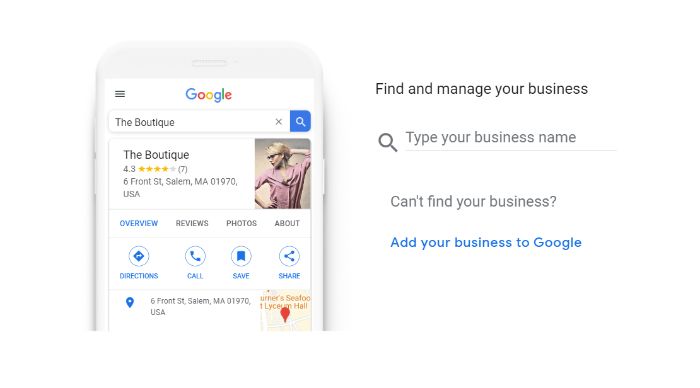
Google My Business is a business directory owned and operated by Google. The goal of the platform is to provide the most accurate business information for local businesses to searchers.
With this in mind, most businesses will have a Google My Business listing within a year or so of starting their business. This is done automatically as Google learns of your business through its website crawl bots.
The problem with an automated listing, though, is that information may not be complete or accurate. Only when you claim your listing can you ensure you’re getting the most from the platform.
If you need even more reason to claim or create your own listing, then consider that businesses with 4 or more stars on Google My Business outrank those with less than 4 starsby about 11 percent. As a small business, you can’t afford to lose out on that edge.
Add photos and videos of your business and offerings to your profile.
Respond to ratings and reviews in a professional and timely manner.
It’s important that your business information is accurate and updated. You should ensure updates are made at least monthly, though weekly monitoring of your listing is important to success.
2. Claim All Business Directories
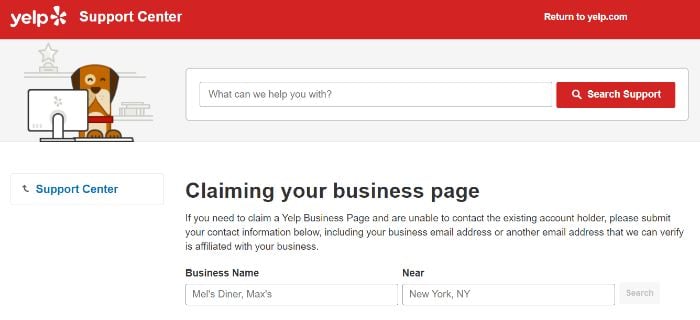
Speaking of business directories, you must be sure to stake your claim in all business directories. The most popular include Google My Business mentioned above and Yelp.
You may think that a Google Business Profile is sufficient to bring in traffic, both online and in-store. However, consider that a Yelp page is present in the top 5 results for 92 percent of search queries that contain a city and business category.
What difference does it make for your listing to be in the top 5 results on Google? The top 5 results on the SERPsaccount for 80 percent of click-throughson the first page of Google.The first organic result alone accounts for almost 40 percent.
All of this to say, you can’t afford to not claim your business on all directories wherever possible.
While Google and Yelp are the big dogs, other business directories to consider are Facebook, Bing, Yahoo, and Yellow Pages.
3. Perform a Local SEO Audit
Now that you’re established on business directories, it’s time to understand the landscape. This enables you to see what your competitors are doing so you, too, can make the same improvements (and better) on your website.
Results on the first page of SERPs provide the most insight and inspiration. After all, the first three positions aloneaccount for 66.5 percentof the click-throughs on the SERPs!
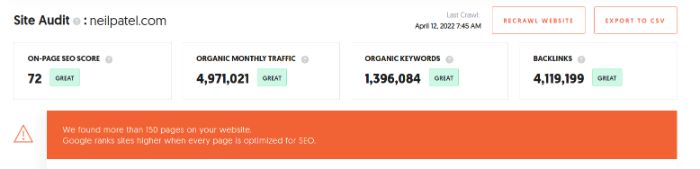
As you begin your audit, first consider free tools and analyzers like the SEO Analyzer. These tools give you a detailed overview of your website’s current status and what you can do to optimize.
Next, use your target keywords (which you’ll work out in the next section), and compare your website to the top five of each SERP. Consider types of content, website structure, page elements, and keyword density.
I would recommend keeping a spreadsheet of your findings to easily track and implement your changes.
4. Target Local Keywords
As a small business, keyword targeting can be daunting. You know you’ll be lost in the sea when you target high-volume keywords, but lower-volume keywords tend to yield little return.
As a local business, you actually have an edge when it comes to keyword targeting. “Near me” search term variations increased as little as 150 percent (e.g. “near me now”) to as much as 900 percent (e.g. “near me today/tonight”) in just a few years. This means that targeting a combination of high volume and local keywords can work in your favor.
What do I mean in practice?
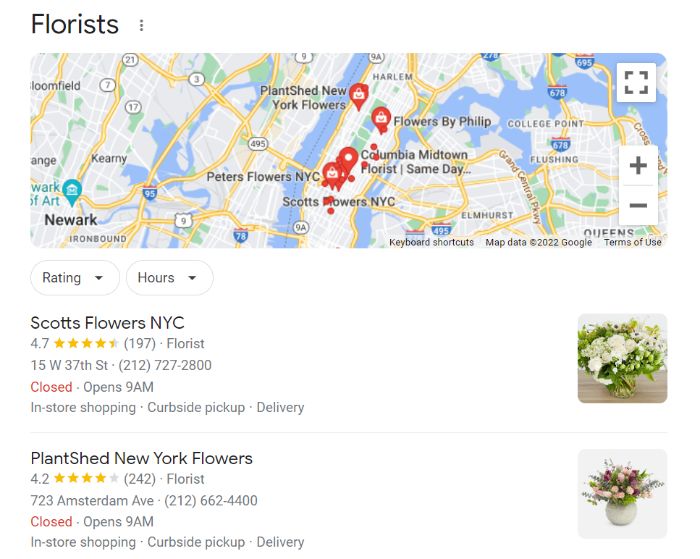
Let’s say you own a local flower shop. Your website naturally contains many high-volume keywords, such as “florist,” “flower shop,” and “flowers for sale.” The fact is you’re unlikely to beat out national flower providers, like 1-800-Flowers and Sam’s Club, with those keywords.
The goal should be to optimize your website with local keywords.
For example, search your website for every instance of “flowers for sale.” You’ll want to be wary of keyword stuffing, but take care to change most of these instances to more specific, local terms, such as:
“flowers for sale in [city or zip code]”
“[city or zip code] flowers for sale”
“flowers for sale [city or zip code]”
You don’t have to target only your specific town and zip code, though. Consider areas within 10 or 15 miles of your business and target those local keywords, too. This is especially good practice if you live in a smaller town outside of a larger city or metro area.
5. Encourage (and Reward) Customer Reviews
When was the last time you visited a restaurant or purchased an item without researching ratings and reviews? If you’re like 82 percent of consumersperforming an online local search, then the answer is never.
Customer reviews are the lifeblood of your business. This is particularly true for new and small businesses.
How can you obtain online customer reviews?
First, ensure there is a place for customers to leave reviews. If you’ve claimed your Google My Business profile and Yelp business listing, then you’re off to a great start.
Second, offer an incentive to customers who leave reviews. Whether by word of mouth or marked on in-store receipts, let customers know they will receive a discount or a complimentary item for their rating and review.
The work doesn’t stop there, though. You must respond to all reviews, negative and positive. This gives you an opportunity to engage with your customers, and it can also instill faith in your brand by those who have yet to purchase.
6. Create Local Content
Above we talked about targeting local keywords while avoiding keyword stuffing. The best way to do this is to create local content for your website or website’s blog.
Local content can be a blog post, a news release, or a static web page. You can use these various content types to highlight local events (past and upcoming), local offerings, local business roundups (e.g., local businesses that complement but don’t compete with yours), or even to educate the public on your product or service.
The more natural content you have on your website, the more easily you can target local keywords. It can also help to establish you as an expert in the field, which is crucial for small business owners competing against larger businesses.
Continuing with the example of a flower shop, here are a few content ideas that will naturally target both the audience and the keywords:
Blog post: #X [your state] Flowers for Year-Round Decorating
Static web page: Our Local [your state] Flower Offerings
Static web page: [your state] Garden Flower Offerings
Blog post: [your state] Flower Events for [season/year]
7. Implement a Local Backlink Strategy
A backlink is a link to your website from another site. Depending on the quality of the third-party websites and the number of links to your website, this can have a considerable impact on your website’s authority.
Authority is a critical piece in determining how high your website ranks on the SERPs. How do we know this? Consider that the #1 result in Google has an average of3.8x more backlinksthan positions #2 to #10.
How can a small business website begin to build its backlink profile? A few things to consider are:
writing guest posts for relevant, high-quality websites in your industry
The hard work isn’t getting traffic to your site, but instead keeping it there once it arrives. If your site isn’t mobile-friendly, then local searchers will quickly leave your site and consider a competitor instead.
What is a mobile-friendly site? The four basic elements that every mobile-friendly site should contain include:
responsive page display
readable fonts
proper text formatting
optimized media display
Beyond a mobile-friendly website, you must also produce mobile-friendly content. The good news about mobile-friendly content is that it’s also viewable for desktop readers.
What does such content consist of?
short paragraphs
white space
subheadings
a summary
images
lists
styling (e.g., bold, italics)
If you’re not a web developer, the idea of creating a mobile-friendly website can be daunting. The good news is that most website platforms incorporate mobile-friendly elements into their themes and overlays. Keep an eye out for “responsive” as an indicator of such options.
9. Optimize Page Structure
Local SEO for business goes beyond business listings and content. An often-overlooked element is page structure.
Page structure includes title tags, headers, meta description, and URL. When used correctly, these can further enhance your content and improve your rankings on SERPs.
Perhaps you’re wondering just how much of an impact these elements can have on your rankings. Here’s the deal: To employ elements that your competitors may not be, you can get ahead.
Which page structure elements are most overlooked by small businesses? From greatest to least, here is what percentage of small business owners use the following key SEO features:
Title tag: 99 percent
Robots.txt: 88 percent
Sitemap.xml: 73 percent
Meta description: 72 percent
H1: 68 percent
Schema.org: 44 percent
You can address the title tag, meta description, and H1 most easily. However, robots.txt, sitemap.xml, and schema.org also have their place on a well-structured website.
10. Get Involved on Social Media
Social media isn’t just for big brands and influencers. A local business page can benefit from social media usage, too.
More specifically, a local business page can be a great place to keep customers up-to-date on the latest sales, events, and changes (e.g., hours of operation). That’s because even with a website, a social media profile is more like a “living” version of your business.
Perhaps Facebook users benefit most from local business pages. After all, ⅔ of Facebook usersacross all countries surveyed say they visit the Page of a local business at least once a week. However, other social media platforms like Instagram and TikTok can also offer your business an edge.
Make it easy for customers to purchase your products and services online.
Depending on your business and target audience, social media may or may not make up a large percentage of your sales and traffic. However, either way, a strong social media presence is a must for small businesses.
11. Participate in Local Business Events
Would you be surprised to learn you can do a lot offline to improve your website’s local SEO? 48 percent of marketers invest at least 20 percent of theirmarketing budget in live events.
Participating in local business events, especially those with a strong social media presence, can help grow your business in a few ways. They’re an opportunity to market your business but also are an easy way to get to know your audience and the community you serve. There’s likely to be a return on such events, too.
As a small business, you have the versatility to host your own event or sponsor and join with larger community events. An event you host yourself would likely yield a larger return, but a community event may be ideal for smaller budgets.
12. Invest in Google Ads With Local Keywords
Small business usually means small budget. It’s important that you invest wisely in the growth of your business online. Where should you hedge your bets? For most businesses, Google Ads is a good place to start.
Google Ads is a paid advertising platform that enables you to appear in prominent places on the SERPs.
You may think that you could never compete against big businesses. One way around this is to highlight your local status by targeting local keywords and local audiences. For example, instead of targeting “flowers for sale,” target “flowers for sale in [your city or zip code].”
How can we know this will be successful? According to Think with Google, 72 percent of computer or tablet users and 67 percent of smartphone users want ads that are customized to their city or zip code. Users want to find the options most local to them, so give them what they want.
It’s true that starting with Google Ads can be daunting, but fortunately, you have the option to invest in an advertising agency to help you set up and manage your account and keywords. If you want to go it alone, though, follow these essential steps:
Conductkeyword research: This will include keywords you want to target but also keywords you want to exclude from your campaigns (negative keywords).
Decide how your ad groups will be structured: Ad groups are ad campaigns grouped by a common element, like target audience, target keyword, or even location. Decide how your groups will break down so you can begin to create your campaigns.
Create your first campaign: A campaign is a step above ad groups in that it encompasses a larger target audience. For example, you can have a “Wedding Flowers” campaign that includes ad groups like “Wedding Flowers in Queens” and “Wedding Flowers in Brooklyn.” This is where you will set campaign-level goals and settings.
Create your first ad: Google Ads has multiple ad types. A text ad is a good place to begin, though your ad groups can contain multiple ad types, and it’s important to experiment with what works for your audience.
Continuous monitoring and tweaking of your campaigns are necessary for success.
Local SEO Tips for Small Businesses Frequently Asked Questions
As a small business, should I get an agency to help with my local SEO?
As a small business, budget can be a constraint. While you can make many changes yourself, a consulting agency can offer invaluable advice and resources.
How does local SEO help small businesses grow?
With local search intent being what it is, local SEO can be a boon to small businesses. It can put you on the map (or SERPs, as it happens) for keywords you may not have ever ranked for on a larger scale.
How much should a small business pay for local SEO?
The amount you invest will vary depending on what you find to be meaningful and valuable to your business. If you must invest, I recommend you do so in two places: 1) in an SEO consulting agency, and 2) in paid advertising.
What kind of small businesses need local SEO?
Local SEO can benefit small businesses of all kinds. If you provide products or services in a specific area (or multiple areas), then you can benefit from its use.
Conclusion: Local SEO for Small Business
As a small business owner, you know that hard work and dedication is needed to grow your sales. Much the same can be said for local SEO. While SEO can take time and patience, it can pay off in the long run.
With the 12 local SEO tips outlined above, even the smallest businesses can benefit. From keyword research to social media marketing to paid advertising, you can begin to make changes today to see benefits in the future.
Which of these local SEO tips for small businesses will you implement first?
from Neil Patel's Digital Marketing Blog https://ift.tt/B1Lajed
via IFTTT
The internet has transformed the advertising industry. Traditionally hard-to-measure channels like TV, billboards, and sponsorships are being pushed to the wayside by cheap, trackable online advertising channels like social media ads, display, and paid search ads.
This shift is democratizing the industry. Even the smallest brands can compete on the same platform as multinationals if they have the right knowledge, ad creatives, and targeting. If you want to grow your business, online advertising should be the first place you start.
I’ll show you how you can do just that in this guide. You’ll learn why online advertising is so beneficial, the best online advertising channels to use and how to create an online advertising campaign from scratch.
Online advertising is a form of paid-for marketing that leverages internet-based channels to promote products and services. There are plenty of online advertising channels to choose from, including search engines like Google or Bing, social media platforms, and display ads, banner ads, and native ads.
Unlike traditional advertising mediums, the cost of online advertising is low. Small businesses can generate hundreds of new customers for just a couple hundred bucks a month. Online advertising is more measurable, too. Every channel can be tracked, measured, and optimized, so marketers squeeze as much ROI from their campaigns as possible.
Such are the benefits of online advertising, companies are increasingly dedicating more and more of their budget to digital channels.
As you can see in this infographic from Visual Capitalist, there have been sharp falls in newspaper and TV advertising spending, while search, social media, online video, and e-commerce spending has increased dramatically since the early 2000s.
Why Your Business Should Advertise Online
However big your business, online advertising is one of the best ways to build a brand, win new customers, and grow revenue. It has many advantages over traditional forms of advertising and other forms of online marketing, but there are four big benefits I want to highlight.
Immediate Results
When you advertise online, you don’t have to wait months, weeks, or even days to get rewarded for your efforts. Sales can happen as soon as your ads go live.
This is unlike virtually any other form of marketing—traditional or otherwise. With SEO, for instance, it takes an average of about three months for a page to rank well on Google. Social media accounts tend to grow between9.4 percent and 16 percentevery six months.
The speed at which you see results doesn’t just help you win customers and drive revenue faster, it also helps you optimize campaigns quicker. Because you get data so fast, however, you’re able to optimize your campaigns to maximize ROI much faster. What takes six months or more with SEO, takesjust three monthswith paid ads.
This is vital because optimizing PPC campaigns can double your ROI or more. Easton Sports, for example,doubled its ROIfrom 400 percent to 900 percent by working with e-commerce marketing agency The Good.
Better Targeting
Forget broad, mass-market ads that aim to please everyone. Online advertising lets you drill down into your target market and know with confidence that every dollar of your budget is being spent on them. That’s the kind of targeting traditional advertising can never compete with.
Most online advertising channels offer granular targeting, allowing you to focus your efforts on a small segment of their audience. Facebook lets you customize your target audience by dozens of criteria, including:
location
age
gender
education
job
interests
behavior
connections
As a result, you don’t have to worry about wasting your advertising budget on people who aren’t interested in your product. If you have strong buyer personas, you can target them with ease. Even if you don’t have buyer personas, granular targeting makes it easy to identify profitable segments of a large audience.
Better still, online advertising allows you to reach millions of people every day. Facebook has almostthree billionmonthly active users. Google processes around63,000 queriesevery second. No other advertising medium lets your average joe business reach audiences of this size.
Low Costs
You won’t be forking over millions in advertising fees to reach targeted audiences. Unlike traditional advertising—where it cancost over $100,000to run a 30-second TV advert—the cost of online advertising is incredibly low.
It costs, on average, just$3 to $10 to reach 1000 peoplewith online advertising, compared to $22 to reach 1000 people using traditional methods. While your mom and pop retailer can’t hope to afford a TV advert, they can run a successful online advertising campaign on Facebook, Google, or any other channel.
You can limit the cost of your online advertising, too. The vast majority of online ad platforms will let you set a limit on your total and budgets, so you don’t blow everything at once.
Loads of Data
The worst thing about traditional forms of advertising like print, TV, or radio is that it’s tough to work out how well your campaign performed. That’s not the case with online advertising, where most channels show you exactly how well your ads performed.
Typically, online advertising channels will show how many people saw and clicked your ad, how many sales your ad resulted in, and many, many more metrics.
This data is gold. First, it allows you to measure ROI to see whether your online advertising is delivering a return.
Second, you can use that data to optimize your campaigns and make them even more profitable. With it, you can understand why your ad performed well or poorly and what you can change to improve your ROI in the future.
Types of Online Advertising for Businesses
Below are the main types of online advertising you need to know
1. Paid Search
Paid search is one of the most important online advertising channels. The vast majority of all online interactions start with a search engine—which makes it one of the best places to target potential customers.
Google is the dominant force in paid search advertising, which is unsurprising given it currently enjoys an 85 percent global market share. Other search engines like Bing and DuckDuckGo also offer paid ad solutions.
Paid ads come in two models: pay per click and CPM. With pay per click, brands pay every time someone clicks on their ads. With CPM, brands pay a set cost per thousand views.
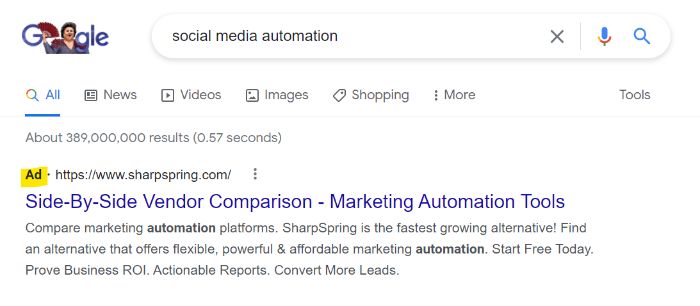
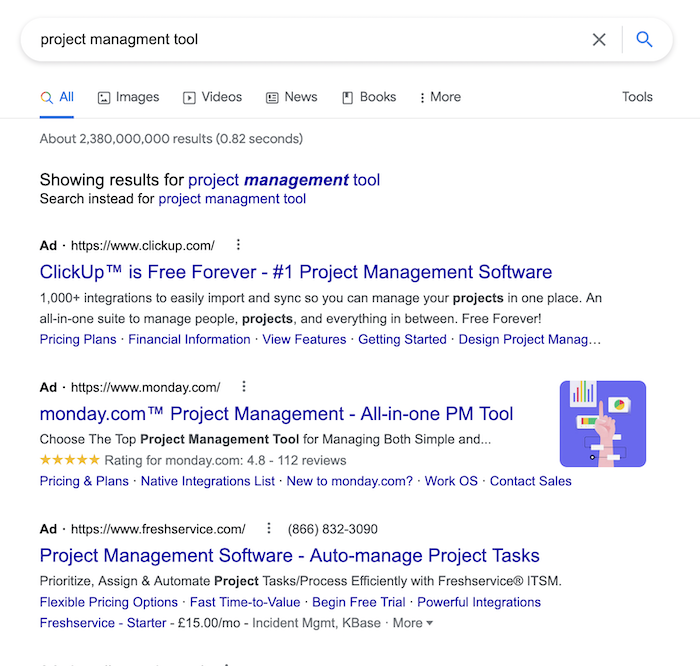
They are usually positioned at the top of search result pages, as you can see below. They may also feature at the bottom of result pages and in separate tabs, like the Shopping tab.
Paid search offers some of the best targeting available to online advertisers. Brands can target specific keywords, destinations, devices, and more. This allows them to create highly relevant ads that can return anaverage ROAS of 200 percent.
That comes at a cost, however. Paid search ads are some of the most expensive you can buy. The average CPC of Google Ads isbetween $1 and $2. Averages can rise much higher in some industries like law—where the average CPC is more than $6.
Pros:
huge reach
fantastic targeting
immediate results
high intent traffic
Cons:
can be expensive
not visual ads
highly competitive
2. Social Media Advertising
Social media advertising is huge. It is the second biggest digital advertising market withrevenues of $153.7 billionin 2021. That’s expected to grow to $252.6 billion in 2026.
Consumers are obsessed with social media, too. Over half of the world’s population use some form of social media and the average person uses it for2 hours and 27 minutesevery day.
Every major social media platform has an advertising offering, including:
Ad formats vary depending on the platform, but the vast majority will be a form of in-feed ad. Facebook, for example, has four main ad formats.
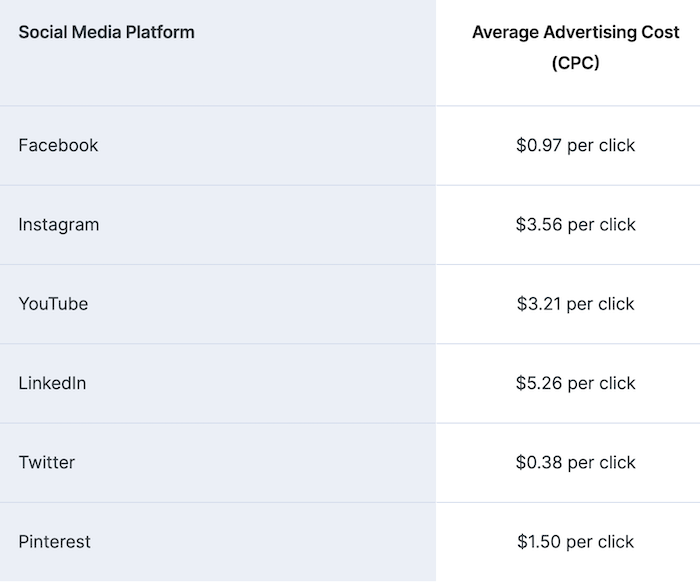
The cost of social media ads will also vary depending on the platform. As you can see in this table by WebFX, LinkedIn and Instagram are two of the most expensive platforms with average CPCs north of $3. Facebook and Twitter tend to be the cheapest.
Pros:
insane targeting
wide audience reach
effective for brand awareness and sales
some channels have low costs
Cons:
costs can be very high on popular channels
a lot of competition
can be hard to find the right platform
Apple tracking updates may cause issues
3. Native Ads
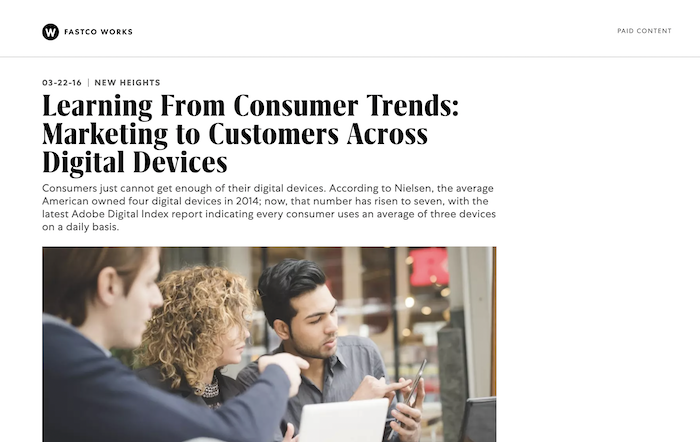
Native ads don’t feel like they’re ads at all. Brands partner with publishers to create sponsored content that provides a lot of value to the reader while subtly promoting your business. The content is published on the partner’s site and distributed as normal. The idea is that users read the content and get value from it without feeling like they’re being sold to. It’s a win-win.
Here’s an example of a typical native ad on Fast Company. Note the small “paid content” disclaimer in the top right-hand corner.
Native ads can be very effective.
It’s been shown the softer touch of native ads can result infive to ten times higher CTRsthan direct response ads. Native ads can be expensive, however. Major publications charge as much as$200,000 to get featured.
The vast majority of major publishers will offer some form of sponsored content or native ad package, making it easy for your brand to get featured in dozens of high-quality publications.
Pros:
build trust
appear authentic
Cons:
high effort required
typically smaller returns on investment
4. Display Ads
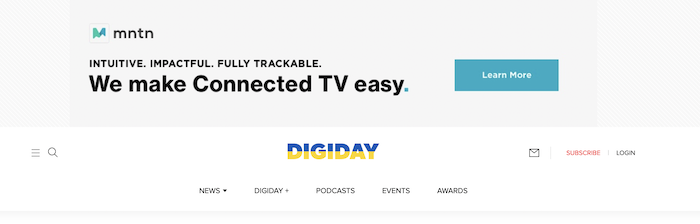
Display advertising is one of the most common forms of online advertising. In fact, it’s probably the one that came to mind when you saw the title of this article. Display ads come in many forms, including banner ads, in-content ads, side-bar ads, and popups.
Below you can see an example of a banner display ad on Digiday.
There are multiple ad platforms that brands can work with to run these ads. Popular platforms include:
Google Display Network
Facebook Network Ads
Taboola
Leadbolt
Display ads are one of the most cost-effective forms of online advertising,costing as little as $0.50 per click. There’s a trade-off, however, as display ads typically have some of the lowest CTRs of any online ad.
Pros:
cost-effective
widely available
great for brand awareness
Cons:
low CTRs
tend to be ignored or blocked
linked with poor UX
5. Retargeting Ads
Retargeting ads are much more effective than standard display ads.
That’s because consumers rarely make a purchase the first time they land on your website. When you show them the same products that previously caught their eye, they’ll be more likely to eventually make a purchase.
That’s where retargeting ads come in. This is a form of display ad that only targets people who have landed on your website and left without making a purchase.
Retargeting ads can appear on any website that shows display ads, as well as Facebook and Google. The cost of retargeting ads will depend on where they are displayed. The average cost of retargeting ads on Google, for example, is$0.66 to $1.23 per click. Display retargeting ads will be much cheaper.
Pros:
only target people who have shown an interest in your brand
higher CTR than display ads
Cons:
can feel intrusive
harder to run after privacy updates
6. Affiliate Ads
Affiliate advertising is where a brand partners with a third-party (usually a publisher or influencer) to promote its products or services. Rather than an upfront payment, third-party gets paid a commission every time they refer a customer to the brand.
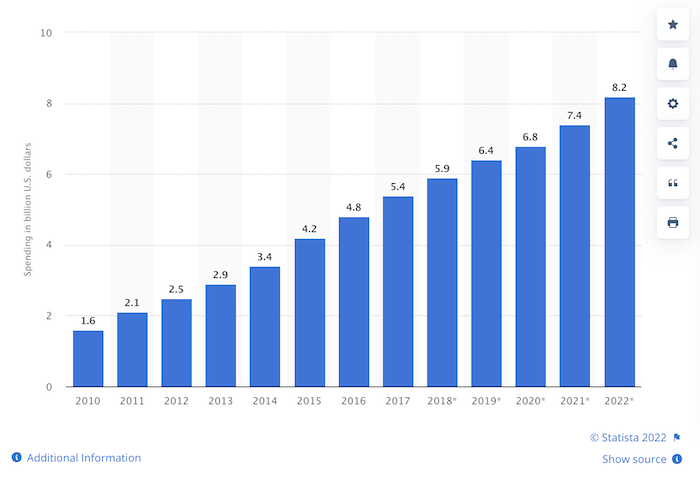
Affiliate advertising is a rapidly growing market and is expected to beworth $8.2 billionin the U.S. in 2022.
The cost of affiliate marketing can vary dramatically depending on the industry you operate in and the third parties you partner with. Commission rates vary between $3 and $200 and can be as low as 1 percent per sale or as high as 60 percent.
Pros:
only pay when you make a sale
easy to get started
lots of third parties and publishers
Cons:
can be required to give away a large percentage as commission
can be time-consuming to stay on top of affiliates.
7. Video Ads
Video ads are an increasingly popular form of video-based advertising. The most common form of video ads are YouTube ads, but other video platforms like Vimeo host ads, too.
The potential reach of video ads is huge. On YouTube alone, consumers watch more than one billion hours of videos every day. YouTube also ranks second in monthly user numbers for social network platforms and is the world’s second-largest search engine.
How to Create an Online Advertising Strategy for Your Business
The steps to create an online advertising strategy will be broadly similar regardless of your business, product, or service. You start by setting goals, defining your target audience, and assigning a budget. Next, you pick a channel and create ads. Then it’s simply a case of launching and optimizing as necessary.
Step 1: Set Goals
You should always set goals for your online advertising campaign. Having a clear idea of what you want to achieve with your strategy and how you measure those goals will keep you on track, increasing the likelihood of success.
One study found that76 percentof people who wrote goals down, made a list of actions, and ran weekly progress reports achieved their goals.
Making more sales is a typical online advertising strategy goal, but it’s not the only one. Others include:
increasing brand awareness
getting more subscribers
growing your social media following
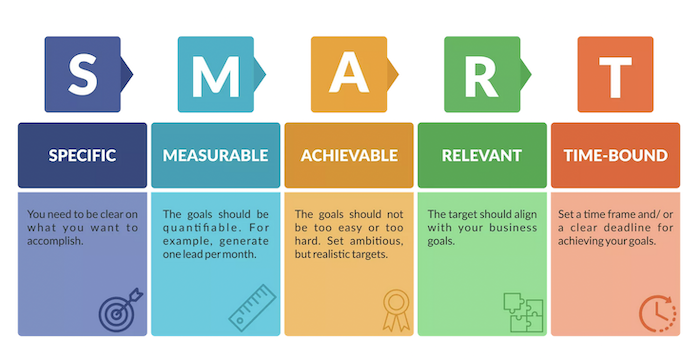
Whatever your goal, make sure it follows the SMART (specific, measurable, achievable, relevant, time-bound) framework.
Instead of saying you want to acquire new customers with your Google Ads campaign, state that you want to acquire 1000 customers in one month by spending $5,000 on ads.
Step 2: Find Your Target Audience
With a goal in place, it’s time to decide on your target audience. Who exactly do you want to reach with your ads?
As we’ve discussed, the beauty of online advertising is that you can target an incredibly specific audience. It’s time to take advantage of that. Consider things like:
age
gender
demographic
nationality or location
interests
Make sure you account for your goals. If you want to acquire tens of thousands of customers, you’re going to have to cast a broad net. If your aims are more modest, you can afford to be more specific.
Step 3: Assign a Budget
Assigning an appropriate budget is essential for any online advertising campaign. It will define how much you can spend and, to a lesser extent, which channels you can advertise on. I recommend basing your budget on a variety of factors, including:
your overall marketing budget
your product or service price
your goals
how long you want the campaign to last
any previous results
You don’t want to blow your budget on one campaign. Nor do you want to assign a tiny budget if you want the campaign to run for six months.
While you should always establish a budget upfront, be prepared to be flexible with that budget. The immediacy with which you can see results is another advantage of online marketing, so you should be prepared to increase the budget if you see success.
Step 4: Pick a Channel
Now that you have a set of goals, a target audience, and a budget, you can finally decide which channel you want to advertise on. The truth is you probably already have a paid advertising channel in mind.
That’s fine, but it’s important to make sure it matches your goals, budget, and audience. Budget-wise, advertising on Google Search can be incredibly expensive for certain keywords.
The average cost per click for keywords related to the insurance industry was$20.12 in 2021, for instance. If you don’t have the appropriate budget, you’re better off choosing another channel.
Similarly, there’s no point in advertising on Google if your goal is to increase your social media following. Or advertising on Facebook if most of your customers use TikTok instead.
If it’s your first time launching an online advertising campaign, stick to one channel. It will make creating ads and setting up the campaign a lot easier. You can start to advertise on multiple paid marketing channels when you get a few campaigns under your belt.
Step 5: Create Ads and Launch Your Campaign
This step is going to vary quite a bit by your chosen paid ad channel. In the case of Google Search ads, you’ll need to write ad copy. For display ads, on the other hand, you’ll need to design an image. Whatever channel you use, the bulk of your efforts should be spent here.
For example, if you’re advertising on Google Ads, improving your Quality Score can make a huge difference. This is a measure of how relevant your ad and landing page are. It’s been found that an above-average Quality Score can result ina 50 percent discounton your cost per click. Low-Quality Scores, on the other hand, can result in you paying four times as much.
Spending time improving your ad copy can also increase your clickthrough rates, as I show in my ad copy guide.
Step 6: Optimize Your Campaign
Creating an online advertising campaign doesn’t stop once you’ve hit launch. The wealth of data that these channels provide means you can start optimizing your campaign almost immediately.
Review your ad dashboard daily after launch and look for ways to optimize your campaign. Common strategies include:
changing your bid amounts
changing ad run times
adding negative keywords
changing your copy
changing images
changing a new ad targeting a different segment of your audience
You can also pivot your campaign entirely if things aren’t working out. There’s no point wasting budget on a campaign that isn’t generating any return. Instead, pick another paid channel and launch a new campaign.
Note: Don’t worry if this section seems overwhelming. You can work with anonline advertising agencythat will handle the entire process for you.
Online Advertising Strategies for Business to Take Your Strategy to the Next Level
Launching your first online advertising campaign is just the start. Once you’ve got a few campaigns under your belt, you can start to experiment with advanced strategies like the ones below to supercharge your results.
Use Tools to Enhance Your Ad Campaigns
You don’t need to spend money on anything else apart from your budget to see results with online advertising. There are marketing tools for almost every channel that can enhance your campaign and help you generate even more ROI.
Find and utilize these tools wherever possible. My keyword research tool, Ubersuggest, is a great example of a tool that can help you improve your paid ad campaigns by getting access to high-quality keyword data. This is useful if you want to make sure you’re targeting every relevant high-value keyword in your Google PPC campaign.
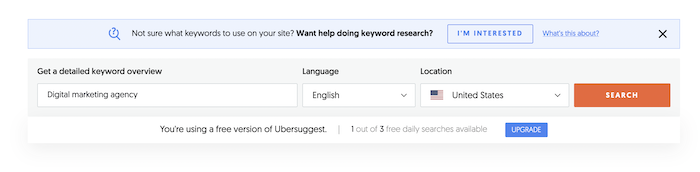
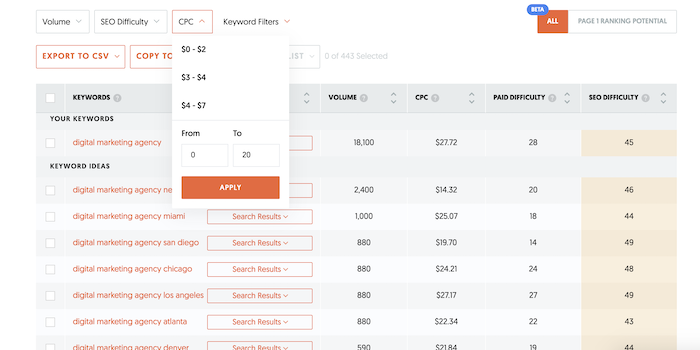
Head on over to Ubersuggest and click on the keywords dropdown in the left menu bar. Enter a keyword in the “Discover new keywords” bar. For this example, I’m going to use the keyword “digital marketing agency.”
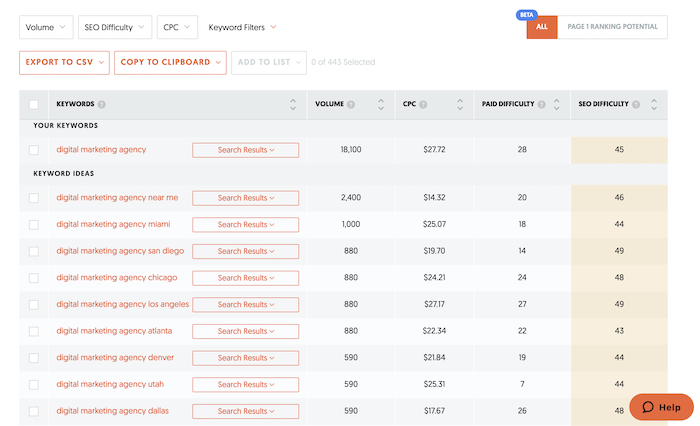
Hit search, and you’ll be served hundreds of relevant and related keyword ideas. You can export the keywords as a CSV file and add them to Google Ads immediately. Or you can filter them to make them even more relevant.
For example, say I don’t want to target any keywords with a CPC higher than $20. By clicking on the CPC filter and entering between $0 and $20, I can filter them all out.
That’s just the tip of the iceberg of what you can do with a tool like Ubersuggest. For more help, see my complete Ubersuggest guide.
Automate PPC Bidding
Automated bidding will feel like a lifesaver if you’re not confident in setting bids and optimizing campaigns. Google is the best-known ad platform for automated bidding, but plenty of others like Microsoft and Facebook offer some kind of automated or smart bidding service, too.
Google offers two forms of automatic bidding: a standard automated bidding service and a smart bidding service that uses machine learning to optimize for conversions. You can target five goals when using automated bidding on Google:
Increase site visits: Google will generate as many clicks as possible.
Increase visibility: Google will target impression share to show your ads at the top of the page.
Maximize conversions at your CPA: Google will drive as many conversions as possible at the target Cost per Acquisition.
Meet a target ROAS: Google will try to maximize the value of every click.
Maximize conversion bidding: Google will try to get the most conversion value while spending all of your budget.
The benefit of automated bidding is two-fold. First, you don’t have to worry about setting the right bids and can focus instead on other parts of the campaign. Second, Google will probably do a better job of setting bids than you.
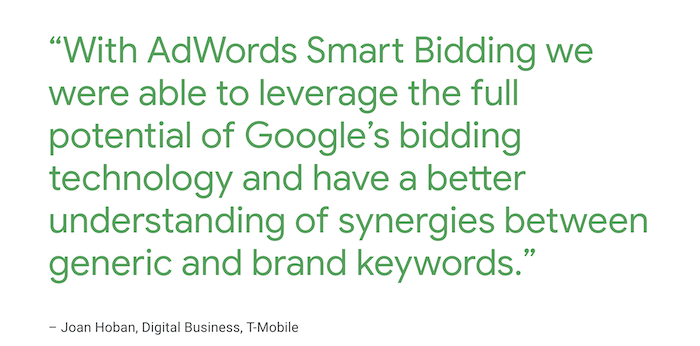
For instance, T-Mobile boosted conversions by 22 percent, decreased cost per acquisition by 27 percent, and increased conversion rate by 23 percent by switching to automated bidding on Google.
Create Hyper Personalized Ads on Facebook
Personalization should be part of every marketing strategy—and your online advertising campaign is no different. More than half of customers (60 percent) say they’re more likely to become repeat buyers after a personalized experience.
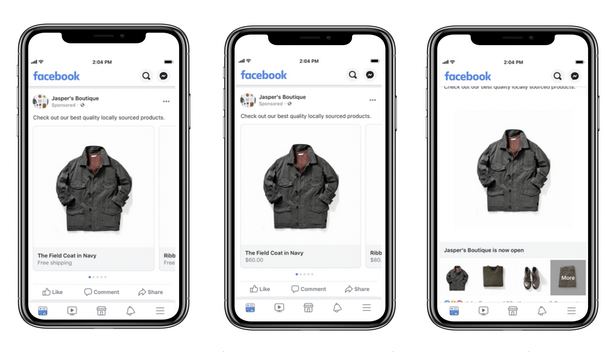
When you use dynamic formats and creative, you create a personalized experience for every person who sees your ad. Facebook will automatically change certain elements of your ad to suit the user’s tastes. These elements include:
The format: Facebook will show either the carousel or collection format.
The description: Additional information like price and delivery information may or may not be displayed.
The media and creatives: Dynamic video can be used to create auto-generated videos using your product catalog.
The destination: Facebook may send people to different destinations depending on where they’re most likely to convert.
The benefits of hyper-personalized online advertising can be massive. Facebook tested the dynamic formats and creative solutions across 12 online stores and found they increased views, add-to-carts, purchases, and sales. There was also a 34 percent increase in incremental ROAS, a 10 percent improvement in lift, and a six percent decrease in cost per incremental purchase.
Use Ads to Re-Target New Customers
Most retargeting strategies focus on trying to convert consumers who have visited your site but not made a purchase. Let’s flip conventional wisdom on its head and focus on converting customers who have already bought from you.
Here’s the theory: it costsfive times as much to acquire a new customerthan it does to keep an existing one. You’d be better off turning one-off customers into repeat buyers rather than converting new customers.
Retargeting ads are also the perfect vehicle for these messages. According to an IAB survey,92 percent of marketersbelieve retargeting ads perform the same as or better than search, 91 percent believe they perform the same as or better than email, and 92 percent believe they perform the same as or better than other display ads.
How should you re-target customers? I recommend three strategies:
Cross-selling: Pitch them products similar or related to the customer’s first purchase.
Upselling: Encourage them to purchase an add-on or upgrade their account.
Subscription: Encourage them to turn their one-off purchase into a subscription.
Experiment With Under-Utilized Platforms
I’ve got bad news for you. Everyone is advertising on Facebook. Most of your competitors are also probably advertising on Google, too. Ditto for display ads. Competitors with bigger budgets will target the same audience and the same keywords. That doesn’t bode well for you.
Better ads and more optimized campaigns are two ways to stand apart from the competition, but an easier way is to advertise on platforms where your competitors don’t.
Instead of Google, run search ads on Bing or even DuckDuckGo. Read my guide on Bing for advice on how to do it.
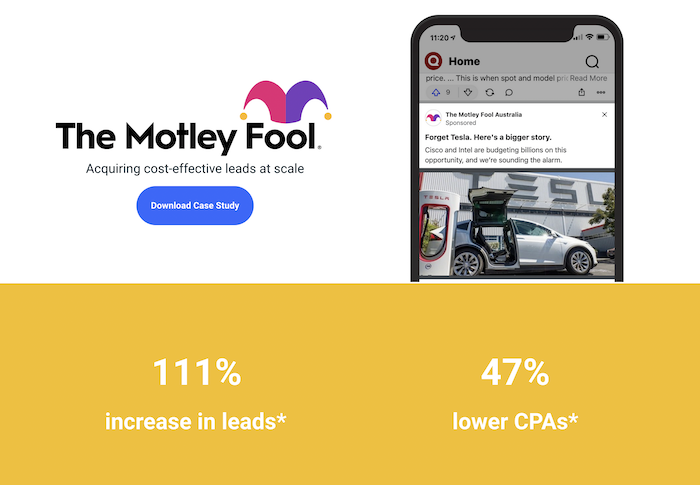
There are plenty of other alternative ad platforms that don’t get the love they deserve. Quora is an excellent source of engaged and highly targeted users ripe for being served great ads. Motley Fool Australia used Quora to increase leads by111 percentand lower CPAs by 47 percent, for instance.
Online Advertising for Business Frequently Asked Questions
What percent of my marketing budget should go to online advertising?
Your marketing budget should be between 2 percent and 5 percent of your revenue. The percentage of that budget you should dedicate to online advertising will depend on your other marketing strategies and your success with paid ads. The fewer other strategies you use and the more success you have, the more you can devote to online advertising.
What is considered online advertising?
Online advertising is any form of paid-for internet-based marketing. It includes PPC, social media ads, banner ads, display ads, video ads, and many other channels and formats.
What is the best type of online advertising?
There is no best type of online advertising. The best form of online advertising is the one that works best for your brand and audience, whether that’s search, social media, or something else entirely.
What types of businesses should do online advertising?
Any business with an online presence should consider online advertising. It’s cost-effective, highly measurable, and incredibly targeted, which makes it easy for any business to get started.
Conclusion: Online Advertising for Business
Online advertising is an incredible marketing strategy. It’s cost-effective, easy to measure, and accessible to virtually every business, big or small. I hope this article has shown you how easy it is to get started, too.
Disclosure: This content is reader-supported, which means if you click on some of our links that we may earn a commission.
Do you want to skip the read and get right to my top pick? The best VOIP phone services for most people are Nextiva, Ooma, or Ringcentral.
Buying VoIP for your business is going to save you money over a traditional phone line. And if you are already using a VoIP service from a clunky provider, you may be able to switch to something sleeker without losing anything except the frustration.
To write a truly helpful post for my readers, my team got in touch with leaders who have used VoIP in different ways.
You can find about 80 percent of what you need to know about VoIP anywhere on the web—here’s the 20 percent you can’t find anywhere else.
We spoke with:
Gregg, who manages IT services for a living. He knows the good and bad of different VoIP options and helps businesses stay protected from hacks.
Jason, who has been working in call centers for nearly 30 years and just bought VoIP for his enterprise organization. He’s attuned to what’s important for your employees, whether they’re remote or in an office.
Makan, who’s set up dozens of high-volume telemarketing teams. He’s learned how to reduce the risk of regulatory fines and identify top performers in an industry with exceptionally high turnover.
Sarkar, who manages sales teams in the B2B SaaS space. He walked us through how to sync VoIP and CRM software with the fewest possible headaches.
Look, I know what works for a company like mine. By speaking with a range of experts, my team and this article can help a wider array of buyers with different use cases or situations than my own.
There are companies looking to outfit offices in 20 countries. Others have to protect patient data. Some folks just want to stop using their personal mobile number for work.
Here are the seven best VoIP phone service providers you can start using right away. After the reviews, you’ll find an in-depth buyer’s guide.
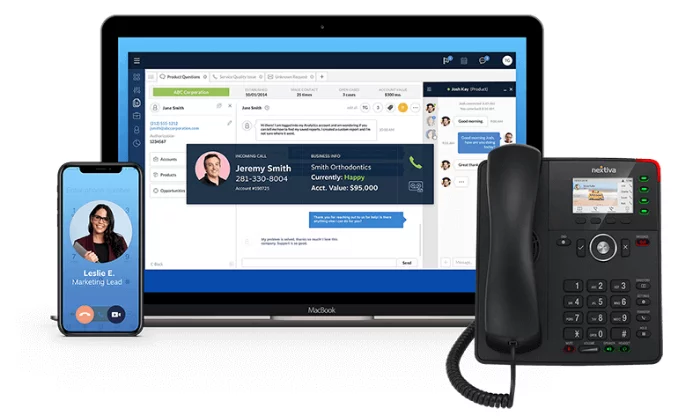
I hear a lot about the trends of working from home, but I don’t think anyone can say for sure what “office life” is going to look like two or three years from now. If you want your teams to stay functional no matter which way the wind blows, Nextiva is a solid choice.
It’s cloud-based VoIP, so your employees can come into the office, set up a desk at home, or use their phone on the go. Unlike an on-premises phone system, employees can use their phone without a VPN because they’re calling through Nextiva.
So, you have way less to worry about with security—which is definitely on the minds of managers who have people calling from hotels, coffee shops, and their home network.
The experts my team spoke with categorized it as a true plug-and-play system for businesses that want a dial tone without IT headaches. If your system is built on ten phones or fewer, you will have very little trouble getting Nextiva installed.
One thing that Jason pointed out, however, was that you’ll need to put some thought into compliance if you plan to take credit card numbers over the phone. But, for the most part, security is handled by Nextiva because everything is routed through their cloud.
Nextiva can scale to hundreds of phones if need be. There will be some backend configuration to get everything going, but Nextiva will help you deploy with a guided installation process.
And unlike some of the other companies that offer this type of flexibility, Nextiva can outfit your entire office. Fax machines, conference phones, multiple offices–whatever your setup, you’ll be able to transition it to Nextiva’s modern platform.
Level up your business phone by connecting it with email, text, and video—or centralize every channel within a single window for your employees.
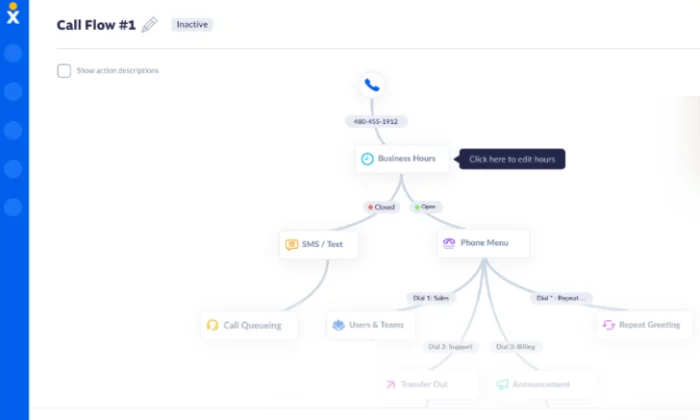
All the call handling and user administration features you’d expect are included. And when I say they are easy to use, check out the Call Flow Builder that lets visualize how routing is set up:
It can be tricky to configure auto attendants in some platforms, but it’s drag-and-drop easy with Nextiva.
The company has done a lot to make everything as easy as possible on end users. If you’re wondering whether or not you have the necessary internet speed at your office, you can test it right now on Nextiva’s website. Simulate the traffic required for two or 200 phones. You’ll get info on speed, but also jitter and everything that goes into whether or not you can reliably make calls.
You can also use the site to test the speed of remote workers who need to be on call, which Jason highly recommended. If their home network doesn’t support VoIP, you may be looking at an expensive hiring blunder.
Nextiva offers 24/7 support for every plan. That’s not typical, especially for VoIP at such an affordable price (which is currently on sale too!)
Essential: starting at $18.95$11.95 per month per user
Professional: starting at $22.95$20.95 per month per user
Enterprise: starting at $32.95$26.95 per month per user
These are the annual prices—it’s a little bit more per user to pay month to month, but you don’t have to sign a contract.
The Essential plan is going to work for many teams. It includes unlimited voice and video calling, a free local and toll-free number, and 1,500 toll-free minutes. That’s a lot more than you are going to get with other entry-level plans.
Unlike RingCentral, there’s no user cap for the Essential plan. This means you can offer more people unlimited voice and video at a low price, rather than having to upgrade once you hit 20 users.
For conference calling and business SMS, you’ll need the Professional plan. This comes with Salesforce, HubSpot, and Zendesk integration. Essential only has integration with Outlook and Google Contacts.
At the Enterprise tier, you get integrations with CRM software and single sign-on, which is a huge boon to remote workers.
Nextiva One is the company’s omnichannel solution. If customers reach out to you through a variety of channels in addition to phones, this might be a good idea.
Your employees can see all communication with each account, which is really helpful if people are logging help desk tickets, chatting, reaching out on social media, and so on.
Jason argued that omnichannel also makes administrators’ lives easier. “I don’t have 10 systems to manage,” he described to us, “it’s all within the same system.”
You can coordinate ecommerce with a call center or tie multiple brick and mortar stores into a single system.
You also have one bill as opposed to dozens and you’re not chasing down information across multiple platforms. If a customer has an issue, you can go back through the entire record quickly, regardless of how they got in touch.
Organization is just easier with Nextiva. Staying on the same page with customers and your employees is as simple as logging into the system, no matter where you are.
For teams that don’t have an office to coordinate activity, Nextiva is the best VoIP solution.
It’s a product that employees new and old can start using immediately on whatever device they have. Should they ever have an issue, Nextiva’s reputable customer service is there to provide support.
If you are looking at the way features break down in the different packages and you don’t find a perfect fit, just reach out to Nextiva. You can purchase any feature a la carte.
#2 – Ooma Office Review — The Best for Adding VoIP to Existing SMB Phone Systems
If you are holding off on replacing that aging phone system, Ooma can help you install business-class VoIP with minimal disruption to your work.
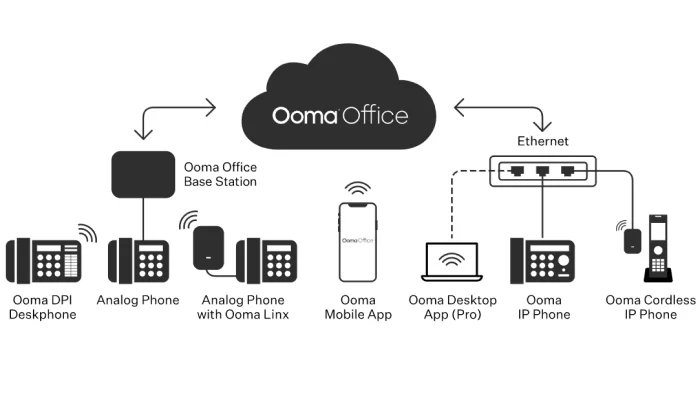
Any phone you have that’s still working—analog or IP—is going to hook right into your new Ooma system. You can also buy phones from them at a great price and they will be preconfigured, ready to go out of the box.
Employees can make calls and collaborate with their colleagues in the Ooma mobile app, whether they are in the office or on-the-go.
One thing Gregg pointed out was how expensive it can get to customize your setup if you have to pay per extension. With Ooma, every user gets a number of free extensions: one for conferences, one for online faxing, and one for a Virtual Receptionist.
Virtual Receptionist is Ooma’s term for an auto attendant. You can set it to play custom messages about business hours, let callers dial by name, select a preferred language, or route the caller to another extension.
With other vendors—especially ones that cost as little as Ooma—you often wind up paying extra to enable online faxing. Some VoIP phone service providers don’t even accommodate it.
When Jason sent his business requirement document to vendors, “two companies bailed out right away” because they weren’t able to set up fax machines. Most of the other vendors told him they don’t really do that, but they would try in order to get his business.
With Ooma, each of your users can set up their own fax extension for free.
Problem solved.
When it comes to integrating VoIP with existing equipment, Ooma minimizes the steps you have to take and maximizes your flexibility. Connect to Ooma Office via WiFi, ethernet, or use the base station to get analog devices on board.
Think of it as a cloud-based VoIP solution that’s really good at accommodating your existing equipment. It might take some time to configure a large office, but the administrator portal is straightforward. It’s not the prettiest interface of all time, but it’s stupid simple to use.
While Ooma offers solutions for enterprise, their VoIP phone services for small businesses really stand out from the pack.
There are no contracts—a rarity in this product space. Usually to get the best price on VoIP, you need to sign up for a year at least. Ooma’s price is what it is. For small business, Ooma pricing breaks down into two tiers:
Ooma Office: starting at $19.95 per month per user
Ooma Office Pro: starting at $24.95 per month per user
Upgrading to Pro, you get the desktop app, video conferencing, call recording, enhanced call blocking, and voicemail transcription. You’ll also be able to host conference calls of up to 25 people, whereas Ooma Office has a limit of 10.
You don’t have the choice of selectively upgrading users with Ooma Office—it’s all employees on one plan or all employees on another. But, at just $5 per user to upgrade, you’re still falling in the average range for VoIP.
And, if you upgrade, you can set people up on their computers with a softphone, which means you have less hardware to buy.
You can avoid buying phones without upgrading by having people call from the mobile app (which is included with Ooma office), though Gregg warned us that VoIP can be hard on a cell phone. “Yes, you save money because you’re not buying physical equipment,” he said, “but it can drain the battery life right out of the device.”
Transition to the cloud at your own pace. Keep your equipment and manage it yourself with way less work than a traditional set up. Get a quote, sign up with Ooma, and start saving money today.
#3 – RingCentral Review — The Best for High-Volume Outbound Calling
RingCentral gives you unlimited calling, texting, and video conferencing at a competitive price. If you just need the phones and texting, you can get an even better deal.
Forget about per-minute charges and set up employees with VoIP that’s easy to use. For call centers, customer service, sales—anyone who has people on the phone constantly will appreciate RingCentral. This is especially true if you have to train new employees all the time.
First off, they’ll be able to use the interface. It’s intuitive to anyone who has used a computer. Administrators and managers will find they can shorten the time it takes to turn rookie hires into skilled ambassadors for your company.
“You save a lot of money because you can identify hires that aren’t doing a good job and wasting their time,” Makan told us. He’s set up a lot of telemarketing call centers with RingCentral and has really valued the ability to “tell right away who’s worth the money.”
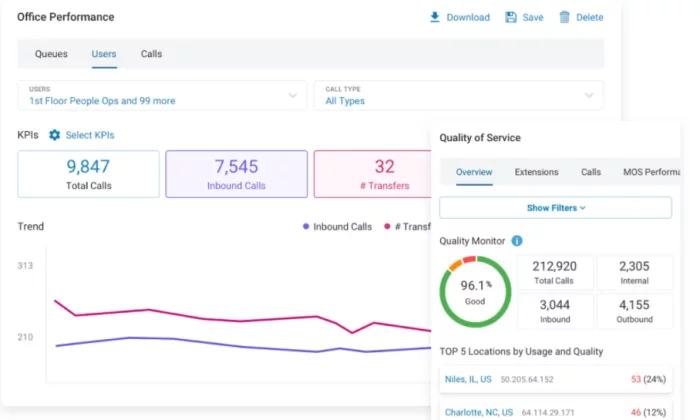
The ability to track calls, KPIs, and listen back to recordings was like night and day for him compared to working on a landline. Teams can listen back to calls that went well (or poorly) to get a sense of how to better capitalize on each opportunity.
The reporting features aren’t going to take a data scientist to glean insights from. Find your top performers and figure out what they’re doing. Identify people who aren’t a good fit and let them go.
I hear a lot of marketing word salad like “this tool optimizes performance,” all the time. RingCentral walks the walk.
“You can actually predict your sales,” Makan said, “I know it’s difficult to fathom, but it’s true.”
He was able to figure out that 2,500 calls lead to one listing. This told him the number of minutes people needed to be on the phone in order to stay profitable. Over time, he could see how many listings an employee should be generating in their first month, second quarter, and so on.
You’re likely going to measure different KPIs, but it’s the same idea. With the kind of visibility that RingCentral provides, you can distill the numbers to simple metrics that hold employees accountable. You know ahead of time what your sales are going to look like, and you can scale up or down accordingly.
There’s a lot about RingCentral that’s well suited for large-scale calling. Admins don’t have to be IT wizards to add new users and give them access to specific resources. They’ll be able to provision new hires quickly. When someone leaves, they’ll be able to switch around accounts and recycle the number, so you don’t wind up paying for lines you’re not using.
If you have turnover—as many high-volume calling occupations do—you need to be mindful of your database integrity. RingCentral makes it easy to limit access to resources and revoke it if need be.
You’re definitely going to be using a CRM (or some form of database) to call at scale. RingCentral integrates with a lot of them. You want to keep that information private.
Another liability for call centers that RingCentral helps you navigate is compliance, which is crucial if you are making a lot of cold calls or using an auto dialer. There’s a TCPA safe dialer, which helps agents avoid bringing a “robo-call” lawsuit down on your company. Instead of worrying about messing something up, they can focus on the person they are talking to.
The DNC list features are also easy to use. Integrate with third-party tools to constantly update your list, and quickly show your employees how to maintain your own internal list.
RingCentral is HIPAA compliant, which means the standard for privacy and security is incredibly high. Fines for HIPAA violations are very steep, and that’s not the worst that could happen.
Selecting from RingCentral’s range of packages, you can replace your phones with VoIP and save a little money or completely outfit an omnichannel call center.
RingCentral MVP (formerly RingCentral Office) has four tiers to choose from:
Essentials: starting at $19.99 per month per user
Standard: starting at $27.99 per month per user
Premium: starting at $34.99 per month per user
Ultimate: starting at $49.99 per month per user
These are the prices if you sign up for a year of service, which reflect a 33% discount on the monthly rate.
The Essentials plan is capped at 20 users. You get unlimited talk and text, as well as document sharing, which can be helpful for sharing sales and customer service scripts. You also get team messaging, which is especially helpful in the days where not everyone is coming into a physical office.
With Standard, you get unlimited fax, video conferencing and integrations with Google Workspace, Microsoft 365. There’s no cap on users, either.
But if you are going for high-volume calling, I really recommend getting Premium. You get the CRM integration that is so important for dialing into your metrics and communicating effectively at scale.
At $10 above the average cost of VoIP, Premium is a steal. Remember, that VoIP average is for voice only and with RingCentral MVP you’re getting texting, video, and advanced call handling features that other “average” plans do not include.
Managers will be able to listen in on live calls and “whisper” advice. The employee can hear them, the caller can not. From what I found, features like this from other vendors were usually reserved for plans that cost upwards of $50. So in that sense, I’d consider RingCentral MVP well below the average price-wise.
RingCentral offers contact center software, as well, which will unify your communications. Your agents will be able to see a complete record of a customer’s history. When did they call, when did they chat? It’s all right there. You’ll have to get in touch with RingCentral for Contact Center pricing.
This is my number one pick for people who have to make a ton of calls. RingCentral helps you protect yourself from a number of the liabilities that come with outreach at scale. It also gives you the viability and tools to stay efficient and maximize each employees’ ability to contribute.
#4 – Phone.com Review — The Most Affordable Professional-Grade VoIP
Phone.com is a smart choice for businesses that are looking for budget-friendly VoIP. You can have unlimited calling or pay less for a set block of minutes each month.
One of the cost-effective features of Phone.com is that you can mix and match plans. Give your sales team unlimited plans while saving money on the employees that only use the phones occasionally.
And, with the Basic plan, you’re still getting most of the standard VoIP features like call handling, auto attendants, hold music and so on. You’ll have to upgrade to get HIPAA-compliant video conferencing, for example, but you can host up to 10 people in a regular session with Basic.
With most other vendors, you have to upgrade the plan for all your users. Phone.com can really help you keep costs down by giving users the features they need. This is one of those licensing irregularities that Gregg told us about, where it can work out well if you know what you’re doing.
Phone.com lets you pick what you need. Call recording and inbound faxing is extra, though you’ll be able to send faxes from your phone with any plan.
Nextiva and RingCentral are a little bit more robust, especially when it comes to reporting and analytics. And, in terms of CRM integration, Phone.com is limited to AllProWebTools and Zoho.
But some businesses just need a reliable phone with call handling capabilities they can manage themselves. Phone.com does more than that, and it’s just enough cheaper than those other options to net your company serious savings without settling for a unreliable solution.
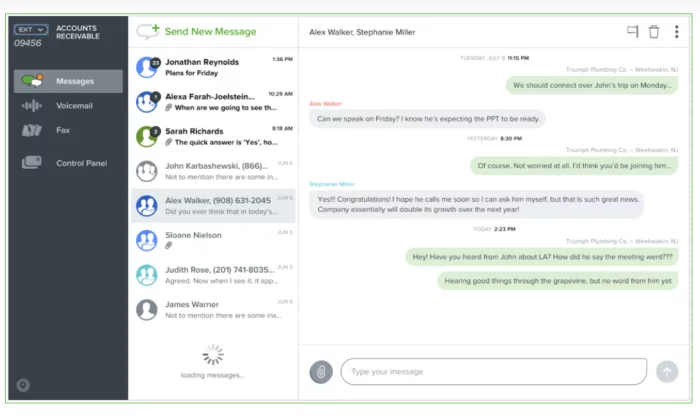
Offer your customers the ability to text when they have questions. Phone.com keeps all of your employees’ messages organized. Come for the phone system, stay for the messaging.
To use IP phones, you’ll have to be on an upgraded plan. The company offers really great prices on popular phones of all styles. You can use what you’ve got, too, as Phone.com supports a range of hardware.
Using your own equipment will definitely lessen the initial outlay, but in talking with Gregg we learned that older phones can get hacked. Just make sure that the processor isn’t too far behind what Phone.com is trying to sell you, and get ready to do some of the configuration yourself. You really can just plug and play if you buy equipment through Phone.com.
Pricing for Phone.com is low across the board. You’ll get the prices below with an upfront annual commitment, which are 20% lower than opting for month-to-month billing.
Basic: starting at $10.39 per user per month
Plus: starting at $15.99 per user per month
Pro: starting at $23.99 per user per month
Basic comes with 300 minutes, which are pooled for all your users. This just means Basic users share minutes instead of having to worry about going over individually each month.
Each user also gets 1,000 pooled text segments. A segment is limited to 160 characters, which is way less than most phones can send in a normal text message these days. So it’s not 1,000 texts per month, unless you like to keep things brief.
Volume licensing brings the price down, both for users and for additional phone numbers. With 25 or more users, the price of Basic drops down to $8.99, Plus to $14.99, and Pro to $21.99.
Considering that Pro can hold its own with many of the call center VoIP solutions I’ve looked at, it’s worth checking out if you need a lot of phones on a tight budget. With HIPAA-compliant voice and video, it could be a good option for medical practices looking to support telehealth.
You really have to get input from every person and department using the phone system. Figure out the technology and functionality you need to support. If Phone.com fits the bill, it’s going to be a smaller one than you’ll find anywhere else.
Phone.com gives you a low price that scales up better than OpenPhone, Grasshopper, and other lightweight VoIP solutions.
I wouldn’t use it to set up a call center—you’re going to have to fully rely on your CRM for all but the most basic reporting and analytics—but you’ll be able to get plenty of phones set up for normal business needs.
If you are thinking about cutting the cord with your traditional phone line, this option is going to save you the most money. Sign up with Phone.com today, no contract necessary.
#5 – Grasshopper Review — The Best If You Need More Extensions than Phone Lines
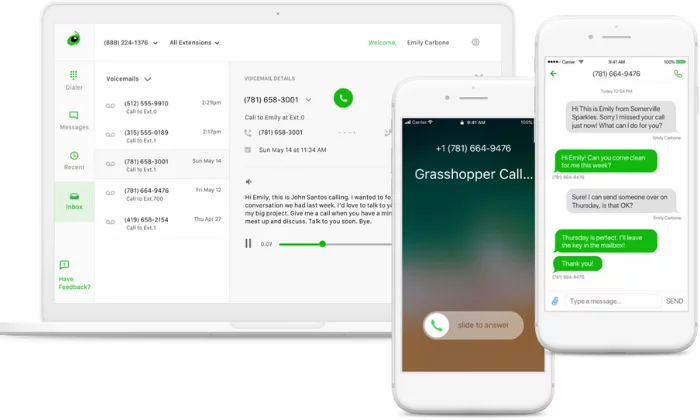
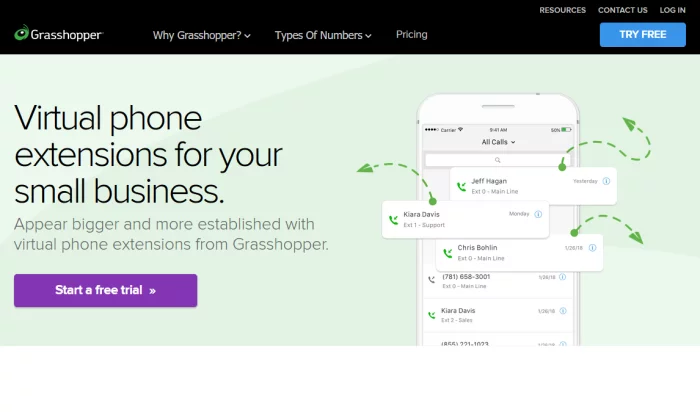
Grasshopper is a great option for small companies that want to establish a professional identity without buying a very complex system.
I’m thinking about the restaurant owner that wants numbers for a few locations without having to pay for a traditional phone line going to each one. Or maybe the law firm that wants a few numbers with lots of extensions.
If you outline your business requirements and it turns out you only need the essentials, don’t pay more for things you don’t need. Grasshopper is going to set you up with everything you need for one flat rate each month.
You’ll get a suite of features designed for the daily work of a modern business, without the clutter aimed at larger organizations. There’s no need to upgrade just to access a particular feature. Every Grasshopper plan comes with unlimited calling, as well as every feature the company offers, such as setting up a phone tree, personalized greetings, call routing, and more.
There are even a few features, like instant response, that you won’t always get with other providers. If you miss a call, Grasshopper will automatically send a text message.
Simultaneous call handling and call forwarding lets you pass off calls to teammates when you’re busy. Voicemail transcription makes it easier to catch up on calls after hours.
Manage everything I just listed directly from the mobile app. Route calls exactly where they need to go—it’s just a few swipes on your cell.
You also get unlimited extensions with Grasshopper Small Businesses plans, and several free extensions with their other plans. Route calls to other numbers, mobile devices, informational extensions to answer FAQs, or a polite out-of-office voicemail.
Getting charged for extensions was something Gregg said people should watch out for in the contact they sign. The total cost can “go up real quick” if you have to pay for an extra line just to set up a voicemail extension.
With Grasshopper, you don’t have to worry as much. The entry level plan comes with one number and three extensions—perfect for the sole proprietor or founder to greet their callers with a professional menu and connect them with the right person.
Let’s take a closer look at your three options with Grasshopper.
Solo: starting at $26 per month for one number and three extensions
Partner: starting at $44 per month for three numbers and six extensions
Small Business: starting at $80 per month for five numbers and unlimited extensions
As I said, it’s really just the basics. There’s no CRM integration or call recording, so think about Grasshopper as a way to replace your phone system rather than revolutionize it.
That said, if you’ve been trying to work magic with free VoIP like Google Voice, the ability to set up call routing may feel downright revolutionary.
It’s also going to cost less and be way easier to set up than it’s more robust competitors. Toll-free numbers might take a day to start working, but typically your number is ready to go when you sign up.
If you want to add an extra line, it’s $10 per month. That’s a lot more than Phone.com for extra lines, which is why I don’t recommend Grasshopper if you need a ton. Plus, the interface isn’t built for handling a big system anyway.
But for the small office, it’s perfect. It doesn’t matter where you or your business partners work—people can be out in the field when a call comes into the office, or in a different city altogether. Grasshopper makes it easy to ensure your calls get where they need to go.
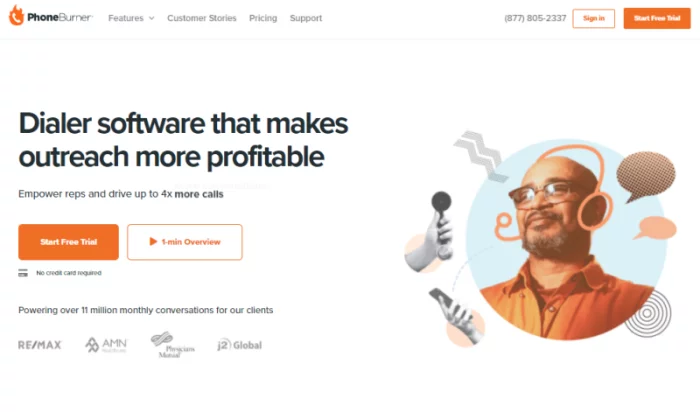
This product is a little different than the other VoIP options on my list. It’s a sales engagement platform, so it’s not designed to replace your phone system. Rather it’s designed to give outbound reps the perfect tool for prospecting, selling, and closing deals.
Is the team remote? Do people like to work out of the office? Not a drama. Your users can phone in from anywhere and start working through your hottest contacts.
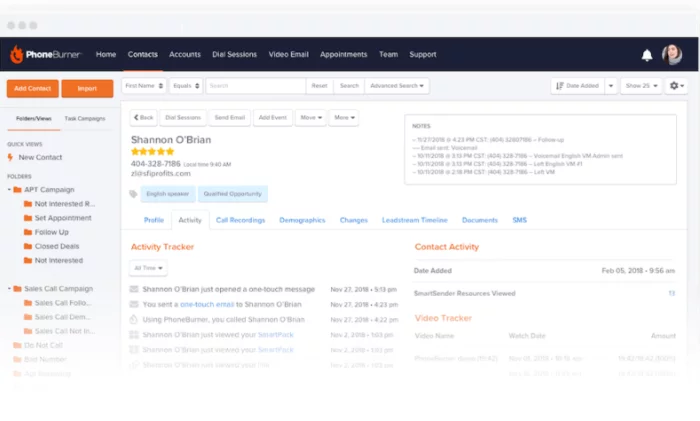
It contains a CRM and auto dialer software built into the platform. You’re not trying to make technology play nice—it’s all set up when you open the box. You can integrate with your own CRM if you want, or simply import your leads and start making up to 80 calls an hour.
I don’t know what your reps’ pace is now, but 80 calls per hour is smoking. There’s no “telemarketer” delay when the call connects, just crisp conversation like it’s over a phone line.
And, because the CRM is tied in, reps can see exactly who they’re talking to, what stage of the pipeline they’re in, and any notes left in the account.
Sarkar said that pretty much everyone in the B2B SaaS game is telephoning through sales engagement platforms now. The auto dialer makes your agents far more efficient by eliminating the busy work of dialing. “You barely have to click anything,” he said.
With PhoneBurner, you’re not manual dialing, tabbing through pages to find a number, or copy/pasting emails frantically before the next call. Instead, you can drop voicemails without waiting for the beep, send an appropriate email, or move a prospect to another folder with a single click.
For Makan, auto dialer software was crucial for large-scale outreach in telemarketing, but it was a pain to set up. You have to specifically program the CRM and the auto dialer. From there, it’s expensive to get the CRM software tuned to your industry. He mentioned one popular CRM option that cost $25,000 and $50,000, “just to get you all set up with the phones.”
With PhoneBurner, a lot of that work is off your plate. It’s not going to groom your database for you, but the fundamental CRM/auto dialer integration is already in place.
The company takes it a step further by offering one of the most comprehensive onboarding packages that I have seen for any product. Their team works with you on goals before you set up, runs you through a test session, and then trains your team on how to use the platform.
You also learn how to build reports so you can track performance. It’s easy to do this wrong, on any platform, but your PhoneBurner advisor is walking companies through the process, week in week out. They’ll get you set up with dashboards, leaderboards, and all of it is going to be customized to your goals.
Leads are distributed automatically, based on rules you set. Toggle between pre-set configurations, like Round Robin or First Come First Served, or customize your own settings. Make sure leads get to the right agent every time, with only a small amount of work on the manager’s part.
PhoneBurner isn’t cheap, but remember that this isn’t an apples-to-apples comparison with the other VoIP providers because you are getting the auto dialer and CRM built in.
Standard: starting at $124 per user each month
Professional: starting at $149 per user each month
Premium: starting at $166 per user each month
These are the prices if you sign up for a year, which basically gives you two months for free compared to paying monthly.
You’re getting unlimited dial minutes, which is obviously important if your reps are making a thousand calls each week. With PhoneBurner, that’s not hard to do.
Call recording is stored free for 30 days with the Standard plan, 60 days with Professional, and there’s no limit for Premium plans. There are also limits on the number of contacts you can store, which start at 10,000 on the Standard plan.
You’ll need to upgrade to Professional to get softphone capabilities. It’s not a big deal if you already have phones, but I imagine that’ll bother folks that want to use their tablet or computer.
With Premium, you get a dedicated inbound line, as well as some of the handling features. I would not recommend using PhoneBurner for serious inbound traffic—the other VoIP options are going to be way cheaper—but some teams will appreciate having a custom voicemail and the ability to forward calls.
On average, a rep can make 233% more calls with PhoneBurner than they can with a regular line.
Does the math pencil out for you? For Makan, it took 2,500 calls to generate a listing. What’s your metric?
#7 – OpenPhone Review — The Best Way to Run Your Business From a Mobile Phone
Jason warned us about going with the “newest and cheapest option,” so I was a little bit skeptical when I heard about OpenPhone. It’s only a few years old and it’s $10 per month.
That’s way less than the average cost of VoIP, cheaper even than some of the “budget” options I looked at.
But the more I discovered about the company, the more I liked it. OpenPhone is new, but certainly not fly-by-night. It’s a recent graduate of Y Combinator, the startup accelerator that helped launch AirBnB, DoorDash, DropBox, and Reddit.
Like those companies, OpenPhone has come to market with a new set of assumptions about how people are living and working. Instead of trying to replace a business phone system, as many Cloud-PBX’s claim to do, OpenPhone simply turns your mobile into a better phone for business.
It’s really aimed at the modern startup or small business, especially if the owner is one of those people who steers the ship from their phone. You’ll get a business number for your mobile phone. Go local, toll-free, or keep your own number, you choose. Porting your old number is 100% free.
Set up an auto-attendant so callers can get the information they need and connect with the right person. Establish a professional identity for your business in minutes. You’ll be reaching people on a stronger footing because you always know if an incoming call is business or personal.
There’s no hardware necessary and no more giving out your mobile number. Keep your privacy. Get numbers for your team and let them keep their privacy, too.
Where OpenPhone really steps away from the crowd is the shared inbox. You can have multiple people call and text from the same number. They can even make calls from that number at the same time.
A lot of phone systems don’t include text messaging, let alone allow multiple users text in the same thread. With OpenPhone, you can text the way you normal humans do:
Tag users with @mentions to bring the right people into the conversation quickly. Group messaging is really helpful for collaboration, especially since you can send files, videos, and GIFs.
You’re just not limited with texting the way you are on a lot of other VoIP phone services. You can send snippets from templates as part of a campaign or auto-reply to missed calls and texts.
Managing contacts isn’t hard either, as you get limited CRM integration with Google Contacts or via Zapier. You can use HubSpot for a more robust CRM solution as well, which allows you to store recordings and view message histories with ease.
Keep in mind this is not going to be a full-blown CRM solution the likes of which I’ve described with PhoneBurner and others. You’ll need to get into HubSpot to make changes to contacts, for example.
Because it’s a young company, there will be additional and deeper integrations “in the future,” which I know can be frustrating. But if you are a young company as well, HubSpot’s free CRM software plus OpenPhone is just about the cheapest way I can think of to deliver the essential benefits of connecting VoIP and your CRM.
Standard: starting at $10 per user each month
Premium: starting at $25 per user each month
Enterprise: contact sales
Standard has most of what I’ve mentioned already, along with unlimited calling and texting. Bear in mind that it’s unlimited within the fair usage policy. According to the terms of service, for the Standard plan, you’re looking at 1,000 texts and calling minutes per month.
Though it’s not truly unlimited, that’s pretty generous. Phone.com caps their entry level plan at 300 minutes and 1,000 text segments, which is likely a smaller number of texts.
The Premium plan comes with HubSpot integration and more collaborative features, like the ability to transfer calls and an advanced auto attendant that gives you a wider range of call routing features.
Extra lines are $5. So, for the price of standard VoIP (around $25 pretax), you could get a company of four set up on the Standard plan.
There are other free ways to get a business number for your mobile phone. Go for it. Getting off the ground you need to save every dollar—I get it—but there’s a point where the inconvenience of trying to work around something like Google Voice starts to cost you money.
OpenPhone solves most of those problems for $10 per month.
How much does a single missed opportunity cost you? For a barber, maybe it’s a call from a stranger who would have spent thousands of dollars as a regular over the next few years. If only you’d been able to catch them.
It’s well worth checking out, and I have a feeling you’ll be hearing a lot about this company in the future. Try OpenPhone for free today.
What I Looked at to Find the Best VoIP Phone Services
I’ve been a small business owner who has needed the cheapest possible business line before. Like having a real number that people can connect to by using the “Contact Us” button on my Facebook page. I think it was still TheFacebook.com back then.
Now, I have people reporting to me about our VoIP options in Brazil.
Growing from a one-man show to a global operation, I’ve been on a few sides of this conversation. We’ve built a marketing machine and I know how we use VoIP—but my team wanted to get a wider picture of what’s going on to help more of my readers.
Some of you have on-call IT support and months to demo the best options. Others are completely on their own running a business and can’t sacrifice more than a weekend in order to find the best VoIP phone service.
Either way, you need to be able to separate the options that are working well for other businesses from the one that’s going to work best for you.
My team reached out to other leaders in the field to see what things looked like from their perspective. We don’t sell VoIP, for example. So, it was really interesting to think through buying VoIP with Gregg, who runs a managed services provider.
VoIP is just one of the IT services Gregg’s company manages, but over a few decades, he’s seen plenty of things go wrong, helped people out of bad contracts, and restored their business integrity after hacks. He offered a lot of insight on VoIP security and what people can do to make sure they’re not spending money on stuff they don’t need.
Technically, Gregg is a competitor with some of the services I recommend, but he was very frank and offered advice you are not going to find on any review site.
We also talked to Makan, who set up call centers for telemarketing in real estate. These are call centers where each employee is making something like 1,000 calls each week. His practical advice is hard-won in an industry that has a staggering attrition rate.
“You’re going to let go of eight out of every ten people who work for you,” Makan told us. New hires have to be brought up to speed, coached, and—when they have to go—be safely de-provisioned in order to prevent your database from leaving with them.
And simple employee mistakes can cost thousands of dollars in legal fines because telemarketing is so highly regulated.
But if you can do it right, the payoff is huge. Makan was able to use call center analytics to surface important metrics that guided his hiring, onboarding, and training. “We no longer have to keep employees for like a year and a half to see if it works or not,” he said.
In searching for the best VoIP provider, you’ll read a lot about using analytics to optimize performance. It’s not just marketing lingo. Makan explained how you can basically predict your sales with VoIP tied to a CRM, and scale hiring up or down accordingly.
Sarkar, a sales manager in B2B SaaS, also pushed the importance of VoIP/CRM integration. We talked a lot about how your sales strategy informs the buying decision.
Are you in a mature market that needs to handle inbound inquiries, or are you selling a novel product that requires you to hit the phones and educate prospects over a cold call?
Configuring a CRM to work with your VoIP, can be a ton of work. Sarkar helped us see how some companies save a lot of time and effort by using a sales engagement platform like PhoneBurner.
There’s just a lot to think about, depending on where you’re coming from. Jason has worked in call centers since 1992. He’s seen the market evolve from desk phones to headsets to AI. His eye for distinguishing meaningful advances from shiny objects that get you nowhere is unrivaled.
Talking through his experience with purchasing enterprise VoIP was extremely helpful in understanding how buyers have to work through their options methodically and coordinate with multiple departments to find a VoIP service that works across the entire organization.
And even though the scale is different, a lot of his guidance serves as practical advice for the small business owner. How do you know if remote workers have good enough internet for VoIP? How do you evaluate the quality of integration between VoIP and your key business software?
You may not have to buy as many phones or connect as many locations as Jason, but these questions still matter.
We covered a lot of ground in the interviews and research. Here are the three biggest takeaways that I think will benefit anyone shopping for VoIP:
The ability to self-manage is crucial: It used to be that you had to call your service provider to make any changes to your phone system. Want to add a user? Change a call path? The options I chose are simple enough to administrate without having to loop in IT. Admins won’t need technical support to accomplish their daily work. The problem is that some of the “bigger names” in the industry are stuck in the past. “It’s very cumbersome and convoluted,” Gregg told us. “End users are not making changes to it.” Avoid those and go with something you can manage yourself.
Identifying all of your business requirements early will save a lot of pain: Check in with every department that’s going to be using VoIP. What do they need, what would be nice to have, and what’s superfluous in their eyes? Your solution has to cover executives and receptionists, who will be using VoIP in different ways. You may be able to replace equipment like fax machines and conference phones—or you may have to find something that plays nice with inventory you want to keep. Jason created a detailed business requirements document and sent it to vendors. A few dropped out right away, which saved everyone time.
VoIP plus your other software and channels is the key: I’m really going to hammer on the CRM integration below because it was so important to almost every expert we talked with. But let me emphasize here the opportunity you have by connecting VoIP to your other business software. If your voice communication is tied in with live chat, email, texting, video, and social media, employees have everything in one place. They are looking at a complete relationship during every conversation, regardless of where it started. It also makes your billing a lot less complicated, especially if you have multiple offices. One bill for all your communications.
I looked for VoIP you can use right away. Admins will be able to make sure everyone is set up, and new hires will gain fluency quickly in the modern system. No more six-month deployments.
Companies like Ooma, RingCentral, and Nextiva can set up large offices very quickly. And if you have a small office, you may be able to get started this afternoon.
I wanted to find a few different products that work across every channel. These omnichannel solutions are more expensive, for sure, but they were worth it for virtually every expert my team talked with. It makes everyone more efficient because they’re not logging into different accounts and losing track of conversations.
I also looked at products that have a more limited selection of integrations and channels. These are way cheaper. Not everyone is trying to run a call center with VoIP—it could just be they want an 800 number on their ecommerce website. As long as their callers are routed correctly or greeted by a professional voicemail after hours, it’s all good.
Really, a lot of people get VoIP because they don’t want to give out their personal number for business anymore. OpenPhone will do just that. Grasshopper is perfect for the small office that needs the essentials covered and nothing more.
Alternatively, you can find a great deal on basic plans from some of the larger VoIP service providers. Ooma Office is a good deal no matter how you slice it. The Essentials plan from Nextiva is well within the small business price range, and can completely remove the need for an expensive traditional phone line.
Let’s walk through the big factors you have to consider. Evaluate your options like an expert by taking in the perspective from industry veterans and sales leaders.
Baseline VoIP Features
I want to focus on what makes these products different, not overwhelm you by describing every feature for every product. Once you start digging into VoIP, you’ll find that 30-40 different features is the low end in terms of what you get.
Every option I picked covers what I consider the baseline VoIP features, with some minor exceptions. You won’t hear me call them out unless there’s something superlative about how a vendor does it.
To be make my list of recommendations, the providers had to include:
Call handling features like call forwarding, call transferring, call waiting, and extensions, so that you never miss a call, no matter where you are.
Menus and auto attendants that let callers dial a certain department, listen to business hours, and so on.
Call recording that provides a history and playback of all calls, which is useful for training and sometimes necessary for legal reasons.
A mobile app that turns your cell phone into a business line
Online fax to replace the need for traditional machines while also digitizing documents automatically.
Softphone capabilities to let you make calls from desktops and tablets with just a headset.
Video calls and conferencing for meetings, webinars, telehealth, and more.
Voicemail transcription that turns your missed calls into a quick read by text or email
Some of the “entry-level” VoIP packages aimed at companies with five to ten employees only come with limited versions of these features. You may have to pay extra for call recording, for example, or go with a more expensive plan to get unlimited online fax.
Plans vary between basic business phone systems and premium solutions for call centers. The latter come with much more customizable call handling features, multi-level auto attendants, and deep reporting features that a small team isn’t going to miss.
Making a Cost-Effective VoIP Purchase
Traditional phone service, after tax, would be somewhere around $50 – $70 per month. In my research, I found many users switching to VoIP because they were paying a lot more than that.
I think this is how people “cut their phone bill in half” by switching to VoIP. They were getting dragged over the coals by their current phone provider. For people with a reasonable phone bill, the savings may not be so dramatic.
“It’s not some magic savings,” Gregg told us. “You’ll be saving a little, but not as much as you would think with your monthly phone service.”
But, since you’re probably going to be paying per-phone, even a $10 savings each month will add up quickly. The more intelligently you can select a provider, the greater your savings will be.
Let’s run through how to assess the sticker price, the real price, and everywhere you can cut costs by finding a system that fits your business.
Gregg said VoIP costs about $25 per user per month on average, which is basically what I found in my research. This is if you are paying for the phones outright or using softphones. If you’re renting desk phones, it’s typically about $10 per month extra, bringing the cost of VoIP to about $35 per user each month.
Call it $40 per month after taxes and fees. It’s not providers padding the bill, just the unavoidable government-mandated surcharges for the Universal Service Fund, which brings telecom to rural parts of the country and supports 911 emergency numbers.
Now you are definitely going to see VoIP for cheaper than $25 per line. I’ve included simple VoIP solutions like Phone.com and OpenPhone that are less than half that.
Typically, the tradeoff with the really low cost plans is that you’re getting a set block of minutes per month, whereas plans of $25+ tend to come with unlimited calling in North America.
For sales, customer service, and other use cases that require people on the horn all day, unlimited calling is a must-have. When you go over your set block of minutes, your VoIP savings can disappear.
If you are using auto dialer software over VoIP, you really need to avoid per-minute pricing. Makan did the math out during our conversation: if you have 100 employees expected to make 200 calls a day, you’re looking at 100,000 minutes per week. That’s way too much call volume to survive being billed by the minute.
Some providers, like RingCentral, Ooma, and Nextiva, offer plans in the $20 range for unlimited calling. So you can pay below average, but not have to worry about massive overage charges.
Another factor that can potentially lower the total cost of VoIP is understanding the licensing. For instance, is it going to cost you extra to add an extension? Are you paying per user, per line, per call path? Vendors don’t all charge the same way.
Gregg cautioned us that a lot of people don’t understand exactly how they’re paying in the contract. They go to customize something on their end, thinking it’s free, and then get shocked when the bill comes at the end of the month.
With Grasshopper, even the cheapest plan they offer comes with three extensions for free. This is great for a small business that wants one line for a few departments, or a startup that needs a basic phone tree.
Phone.com costs less to add a new number than Grasshopper, but you don’t get free extensions. The different arrangements can be confusing, but if you take the time to understand what you need, you can play it to your advantage.
If you are really trying to get VoIP on a budget, Jason warned us that you have to be a little cautious. It’s really easy to spin up a VoIP company these days—the technology is not new—and he laid out some horror stories of badd apple vendors pretending to offer reputable service and dropping clients as soon as they get their money.
“And since it takes about 30 days to port over a number, you’re kind of out of luck if that happens,” he said. The U.S. Department of Justice has prosecuted these cases, clawing back millions of dollars from phony VoIP fraud schemes.
Better to be safe than sorry, and use a VoIP provider like Grasshopper or Ooma that’s been around awhile. Or, a household name like RingCentral that is a publicly traded company. “I can’t imagine they would dump you in 10 days or anything like that,” Jason said.
Cloud-Based or On-Premises System
You can get VoIP infrastructure installed in your office (on premises), or use the internet to connect to the service (cloud-based). Either way, you’re paying less than you would for a traditional phone line, but there are important differences to understand.
There is a much higher initial cost of equipment if you go with an on-premises deployment. You have to buy the PBX, phones, routers, switches, etc., whereas a cloud-based provider hosts all of that themselves.
You can buy desk phones with a cloud-based solution and many people do. But, you don’t have to so long as you outfit employees with a softphone or a VoIP mobile app.
“When it’s cloud-based, you don’t have the big outlay,” said Gregg. “But you’re not really missing out by not getting the equipment because these systems come with a ton of functionality.” Some of the key capabilities he talked about were:
Your employees can work from anywhere in the world with internet
You’ll be able to self-manage features menu systems and call routing
You can scale up without buying equipment, and scale down without waste
You don’t have equipment to maintain and monitor
These are four of the top reasons why I only recommended cloud-based solutions.
Like any solution someone else is hosting, you do sacrifice a little backend control. You are limited to the features they provide, whereas an on-premises system can be completely customized to fit your exact needs.
But the end user can do the vast majority of what they need to with Ooma or Grasshopper. A shop-owner with zero IT experience can add an extension for a new employee or make changes to information about holiday hours provided by their auto attendant.
Most people get the control they need without the responsibility that comes with maintaining a system. If you need hundreds of phones and super customized configuration, an on-premises system may be your only option. That’s going to require IT overhead—hiring an MSP like Gregg to install, maintain, monitor, and replace your equipment—or hiring an in-house staff.
For many business owners, it would be a dream not to stress about the phones. The cloud-based providers I looked at offered nearly 100% uptime, and some offer financially-backed SLAs.
Like Gregg told my team, “You’re not so worried about the end at the main office being up at all times because your employees are connecting directly to the cloud-based server.”
The simplicity here is even more important if people are telecommuting or working out of the office a few days a week. It’s much harder to secure communications between external users and an on-premises system.
I’ll say more about that in the security section, but modern employees need access to company services at all hours. As such, cloud-based is becoming a lot more popular.
Greg told us flat out, “If you’re SMB in the ten phones range—give or take—it’s not worth it to do on-prem anymore.”
Larger companies will have more to think about, but VoIP providers like Nextiva, RingCentral, and Ooma can help you get set up regardless of what kind of deployment you need. With these vendors, you can really get the best of both worlds or make the transition to cloud at your own pace.
What Kind of Internet Speed Do I Need for Clear Calls?
Calls have to be clear. You can’t compromise on that, or you’ll wish you had your landline whatever the price.
So how do you make sure your setup handles VoIP?
Here’s the nuts and bolts of what I found: VoIP is not going to work on DSL. Cable might be okay for a small office, but it won’t be the greatest.
Fiber is what you want. It has the bandwidth you need and the upload/download speeds are the same, unlike cable.
Everyone we talked to about VoIP told us that running low on bandwidth is going to start causing issues—dropped calls, echoing on the line, and terrible conversations.
Here’s the thing, VoIP doesn’t need a blazing fast connection.
Gregg said that 100 kbps is good. 140 kbps is “like the most ideal, pristine phone call.”
So, if you’re on a 1 mbps line, you could potentially make ten phone calls. “Granted, you always wanna overcompensate for fall offs and whatnot, but that’s all you need speed wise,” he added.
Nextiva and RingCentral have VoIP plans aimed at smaller companies that don’t have commercial office infrastructure. They will let you test your connection right on their website. You’ll get all the information you need to figure out if you’re ready for VoIP, or you need to upgrade your internet first.
We’re not talking about a massive pipe here, the problems you run into are the stability of the connection. If you’re downloading a song, who cares if it takes two or three extra seconds? You wouldn’t notice. But when you’re having a conversation, even a slight delay is going to be a huge pain.
Any delay over 150 ms (that’s milliseconds) and your meaningful conversation is now impossible. For reference, a call over a landline has a delay of about 45 ms, so 150 is definitely the upper limit of what you want.
Any higher than that, you’re talking over someone or they missed what you said.
Making cold calls, helping an irate customer—it’s hard enough already. No one wants to repeat what they’ve said. And it’s not going to be good if someone mishears a credit card number.
“Where it becomes an issue,” said Gregg, “is if you have a cable modem that only has 5 mbps on your upstream, and everybody in the office is uploading stuff to Dropbox, OneDrive, and things like that, eating up that bandwidth.”
Remember the dark days where someone couldn’t be on the internet and the phone at the same time? Don’t go back. Make sure you’ve got the bandwidth to accommodate all of your users with all of their tasks.
Network and Hardware Considerations
Now you can have all the bandwidth in the world and still get bad VoIP quality if your network isn’t configured properly.
Small businesses don’t have to worry so much about this. According to Gregg, “If you only have five phones, maybe even as high as 10 phones, sure you could just dump them in on a network.”
He advised running a separate VLAN for anything beyond 10 phones in a single location in order to avoid quality issues. Separate the phones from the computers and prioritize voice traffic in the routers. This way, whatever your employees are doing won’t affect the quality of your calls.
Even with the so-called “plug and play” systems, you’re going to want to put some thought into network configuration if you are putting in more than 10 phones. “I mean you can just plug them in,” said Gregg, “but I wouldn’t be too hopeful about the quality.”
But it’s not just phones to think about. “The fax machines in the conference rooms really threw me for a loop,” Jason explained. “I’m like: I’m just buying a phone system!”
You have to be methodical. Where do the phone lines need to go? Are they connected to the security system? If you have PoE, you can just plug the ethernet cable into the phones, but if not, you’ll have to make sure there’s power running everywhere you want a station.
With a cloud-based service, you’re going to have to let the vendor behind your firewall.
Jason had an issue where one of his guys missed a key thing about the firewall requirements, and it delayed his VoIP deployment by about six months. “I was not too happy,” was all he said about that.
If you have a lot of traditional phones and fax machines that you want to keep using, I’d recommend Nextiva, RingCentral, or Ooma. They offer analog telephone adapters (ATAs) that allow you to VoIP-enable landline devices.
This allows you to phase out your old system gradually, instead of trying to Hercules your company through a massive (and much more expensive) transformation. It’s going to be painful to switch no matter what, but how long can you justify investing more money in an old PBX that’s twice as hard to use for half the functionality?
One last thing about using old phones. It’s great if you can use what you have or get a deal somewhere rather than going through the vendor.
Yet Gregg has encountered problems with aging phones. Hackers will try and log into the phones to start making spam calls. “We were seeing upwards of 100,000 attempts a day on a single phone system,” he recalled. The processors on the older phones weren’t powerful enough to withstand all the incoming requests, and the attack crashed the system.
So, definitely be on the lookout for deals and try to make the most with the equipment you already own. But just be cautious about buying a phone that has an older processor, because it might be a vulnerability.
Plus, when you buy a phone directly from your VoIP vendor, it’s pre-provisioned. It’s got a secure connection out of the box. When you start piecemealing things, you may lose that desirable plug-and-play functionality.
Make Sure Remote Workers Are Up to Speed
Cloud-based VoIP gives you complete freedom to go remote with ease. Connecting external users to an on-premises system has a lot more hurdles in terms of cost and security.
But even if you go cloud, which I highly recommend, there are a few things to be thinking about.
Remote workers need a solid internet connection for VoIP. When Jason hires someone working from home, the job post says they have to have a locked and secure WiFi.
He also has them take a speed test to make sure that their connections are robust enough to be able to take phone calls. He requires a minimum of 20 mbps download and 10 mbps upload.
It’s just a generic speedtest, nothing fancy. He sends them the link, they send back screenshots to verify. Jason said most people “blow those upload/download times out of the water,” but you need to be sure.
With telecommuting employees, you also have to think about training and management at a distance. I know I’ve said that the premium VoIP plans from vendors like RingCentral and Nextiva are aimed at the call center crowd. Well it’s also true that those features become really important for collaboration when there is no office.
Sharing documents within the platform, like phone scripts, or the ability for a manager to listen in on a new hire’s first live calls—you can provide more support to develop your employees, even when people are working from home.
For a small team, OpenPhone can work really well. People can share an inbox, tag calls, leave comments, and ensure that no opportunities are missed.
People love to be able to work on the go, even if they’re not fully remote. One thing that surprised Jason was how important the mobile app was to the executives. They wanted everything forwarded to their cell.
Mobile apps are great, but they’re not without their downsides. Gregg said VoIP on mobile was great for saving money, but he wasn’t so keen on it as a full-time stand-in for using a computer or desk phone. “It’s nice in a pinch,” he said, “but if you wanna watch a cell phone battery drain out before your eyes, that’s a great way to go.”
Integration with CRM
My team asked Jason what the biggest thing you can do to help reps and agents is, and he said integration with your CRM.
This was a tune we heard from everyone, and it dovetails with my own experience. CRM software is a total game changer when it comes to growing your business and providing service to customers.
Look for a VoIP phone service that has integration with your CRM. If you don’t have one, Nextiva and PhoneBurner have one built in that you can start using immediately.
The technology’s not new by any means, but CRM software has gotten really good in the last couple of years, and a lot less expensive. When you combine a CRM’s ability to track customer information with quality voice communication, the resulting experience for your employees is amazing.
A customer calls and their account information pulls right up on screen. There’s no digging for a file or asking for a customer to provide their name, ID, order number, etc.
Sarkar talked with us about how it increased his sales reps’ efficiency. “You get to have more conversations by cutting out the extra time you spend figuring out who’s calling.”
Really, every interaction is streamlined, which makes your reps and agents way more productive. If a customer has an order, the rep can see where it is. There are no extra steps to verify who’s calling, or ask them to dig up a purchase order number.
Saving seconds on every repetitive task adds up quickly. Employees can click-to-dial numbers within the CRM. Account information is centralized and agents can leave notes about calls. Everything is stored in a way that makes sense.
Makan put it well when he said, “Compared to a traditional phone system, voice over IP integrated with the CRM is hands down like: before iPhone [versus] after iPhone.”
The ability to record calls within the CRM was a huge factor for a lot of the people we spoke with. “In the past,” Jason said, “the systems that I’ve had for recording were kind of separate from the CRM, so I had to go chase that down. If somebody called in, I’d have to be like who do you talk to? When did you call? And that would be kind of a nightmare.”
When Jason moved to a new VoIP provider, integration with their CRM was the deciding factor. His company communicated on so many channels, all of which are recorded. The integration makes the process of listening back much easier.
“If you complain about a rep or something like that,” Jason said, “I can take your phone number, plug it in, and find every single call you’ve ever made over the last year, every chat, every email, every contact. It’s super simple. [It] saves me on time tracking down calls.”
For Makan, call recording was essential for assessing employee performance. “Traditionally, you give someone a dummy phone,” he said. “You don’t know how many calls they made, who they talked to, or what the level of conversation was.”
With VoIP, you can do quality control much easier. Listening back to the calls is easy. What went right? What could be improved? Identify who needs training and who’s not a good fit.
Makan explained how it really helps managers conserve their time and energy for quality candidates. They know who to invest in and who to send on their way. “I mean, you can tell in like 60-90 days. Any excuse they give, you can just listen to the quality of the calls.”
Be on the lookout for VoIP providers that showcase direct integrations with your CRM (and other software, for that matter). You absolutely have to demo it to see how that integration drives and works on a day-to-day level. If you want that “super simple” experience Jason was talking about for recording calls, the integration has to be tight.
Also be aware that the initial setup of your CRM and VoIP is going to take some time, especially if you are tying in multiple channels like talk, text, and chat. You need to customize it to fit your industry and use-case because the software is fairly general purpose out of the box.
“You can really geek out on it,” said Makan, “and that’s the challenge.”
Sarkar was a big fan of sales engagement platforms because they have the CRM built-in and they are already tuned for the job. Obviously you don’t want to use them for customer service, but something like PhoneBurner is going to supercharge a sales team with a lot less configuration required.
Convenient Compliance Tools Employees Can Use Without Thinking
There are a lot of regulations protecting consumers from getting robo-calls or having their credit card information stolen. So if you are making a lot of calls or taking financial information over the phone, there’s going to be telemarketing and privacy laws you don’t want to mess with.
I’m glad those regulations are there, but new hires (or just plain carelessness) can break a law by accident and get your company a heavy fine. I found that a single call to someone on the national Do-Not-Call registry could result in a five-figure penalty.
A single slip up could cost anywhere from $11,000 to $43,000. And that’s per call, as in you could get multiple fines if one of your employees screws up. If it happens multiple times, I doubt the government’s going to hit you with a smaller fine.
Or think about HIPAA compliance for healthcare providers. Accidentally exposing a patient’s protected health information can result in jail time. This is true even if the company didn’t know a violation had occurred.
And yet companies make calls and share private information all the time without going bankrupt or winding up in the slammer. This is because they use good VoIP providers that make compliance convenient for employees. Your agents get the proper tools so that they can focus on the customer instead of how to stay in the clear of arcane compliance laws.
Regardless of how big a business you are, if you are making a lot of outbound calls (especially if you’re using auto dialer software), you need to update your DNC list and use it to scrub those numbers from your call lists.
RingCentral, Nextiva and include easy-to-use features to make sure your DNC list is up to date. PhoneBurner has integrations with DNC.com in order to keep people safe.
Makan, whose agents made thousands of calls a week, said that Zoho CRM in conjunction with RingCentral was the cheapest possible way to set your employees up for success. You just have to keep up on your DNC list grooming, “because that’s something you’re gonna run into a lot, and they need to scrub the numbers that they call up.”
Recording calls is another area where compliance is important. These laws vary state to state. In New York, you don’t have to tell people the call is being recorded. In New Jersey, you do.
Products like RingCentral let you automatically notify people that the call is being recorded, so you’re covered. This allows your teams to think less about how to make legal calls.
Jason told us about one of the features that sold him on going with their VoIP provider. It’s illegal to record credit card numbers, so employees need to remember to pause the recording while they take that information.
“And as you can imagine,” he said, “if you take 1,000 or 1,500 calls a month, you’re bound to forget that a couple of times, or miss it, or forget to pause, or forget to unpause, which is a big no-no in our area.”
The VoIP service he chose automated this process within their CRM so employees didn’t have to think about it. As soon as their cursor was in the payment info box, the call stopped recording.
“So my reps don’t have to remember to turn that off, and that’s just super easy,” Jason said. “I don’t have to worry about PCI (Payment Card Industry) compliance. I don’t have to worry about, ‘Hey, if you forget, tell me so I can go delete the call out of the system.’ What if we delete the wrong call?”
Take every opportunity you can to automate compliance. The potential liabilities from a single oversight are enough to justify the cost of spending a little more each month on your VoIP, CRM, and training.
Security
No one wants to pay for $20,000 worth of phone calls they didn’t make. That’s what happened to a client of Gregg’s before they properly secured their VoIP. Someone hacked it and used it to start blasting out scam calls.
Security is a major concern for any internet-based service, and VoIP is no exception.
It’s pretty straightforward for on-premises systems if all your phones are in one location. Set rules in your router so that no one can connect to the phone system except the phone service provider.
Gregg said, “As long as that’s configured you’re solid, and you can’t get hacked because the traffic can’t get there from anybody else.”
Securing an on-premises system gets a lot harder if you have people working from home, which is why a lot of companies are opting to go the cloud-based VoIP route. Residential addresses don’t have static IP addresses, so you can’t set rules in your router.
“The only appropriate way to do it is using a VPN service,” explained Gregg. “If you leave the ports open so that anyone can connect, you’ll see that the phone system will get hammered constantly.”
With cloud-based VoIP, the provider is ensuring that the right people are calling into their system. You still have to maintain good security hygiene at your company—long passwords, principle of least privilege, and de-provisioning old accounts.
These last two points are really important. You need to make sure that employees only have access to the data that they absolutely need. If possible, they should have read-only access. And when employees leave, you have to de-provision them.
For one thing, you don’t want to pay for old accounts that aren’t in use. If you have high turnover, be careful to re-use old numbers you’re already paying for, rather than buying extra ones. You don’t want to be shocked by a bill that has dozens of lines you’re not using.
“People need to be aware of sabotage,” said Makan. “If you get a disgruntled employee, they can wipe out the database, if you don’t back it up. Or they copy it. Or they just start corrupting the numbers and changing things in there.”
If you adhere to the principle of least privilege and are on top of booting old users out of the system completely, the risk of sabotage is near zero. If not, you’re putting your data integrity in jeopardy.
VoIP phone services like RingCentral, Nextiva, and Ooma make it easy for administrators to keep track of who has what privileges. You won’t need an infosec credential to keep all the accounts locked down.
Conclusion
My top recommendations are Nextiva, Ringcentral, and Ooma. They are affordable, reliable, and easy to set up.
If you need a full-fledged VoIP platform on the cheap, consider Phone.com.
Grasshopper is great if you’re more worried about having enough different extensions instead of unique, dedicated phone lines.
Need something that’s more suited to support your sales teams’ efforts? Look at PhoneBurner for a sales engagement platform that includes an auto dialer.
If you’re a solo operator or just someone who is sick of having to use your personal number for running your business, OpenPhone gives you an easy and cheap way to get a professional number and VoIP service.
Recapping my top picks and what they’re best at:
Nextiva – Best overall (For a limited time get 25% off, plus a free phone, when you signup!)
Ooma Office – Best for adding VoIP to Existing SMB Phone Systems
RingCentral – Best for high-volume outbound calling
Phone.com – Most affordable professional-grade VoIP
Grasshopper – Best if you need more extensions than phone lines
PhoneBurner – Best off-the-shelf VoIP for sales teams
OpenPhone – Best way to run your business from a mobile phone
Don’t forget to consider your requirements, budget, and the criteria we talked about as you go through the process of choosing the best VoIP phone service for your business.
Are you currently using a VoIP provider? What’s your experience with using VoIP?
from Neil Patel's Digital Marketing Blog https://ift.tt/F0Nxd6D
via IFTTT