Monday, 11 February 2019

Exploring the Mobile Customer Experience: Three discoveries for designing an effective mobile experience

Mobile adds a challenging layer of complexity when optimizing your online marketing funnel. Testing a winning desktop experience can often produce the opposite effect on mobile performance, leaving us to diagnose where and why our good idea went wrong.

We know that users interact differently on mobile and that there are slightly differing variables at play. Yet with the rapid evolution of the space, the exact nature of those differences are still being discovered. Below you’ll find some of the mobile discoveries we’ve made in the last year of testing. And to help you put these discoveries into action, we’ve created the free MECLABS Mobile Micro Course.

Discovery #1. Design for your customer

On the extreme end, many webpages and offers try to accomplish too much. The eye path is cluttered with competing ads and calls-to-action, a saturation of colors and images, and too many boxes and options — all of which distract the user. Another extreme is when marketers fail to address critical questions in the mind of the consumer. Webpage space is peppered with hero images, irrelevant art, artistic code and design and generic qualitative claims.

For desktop, and especially mobile since concision is key (as discussed later in this article), a webpage’s objective(s) is the barometer you use to measure the relevance of your design and page elements.  The goal of your page should be narrow enough to avoid confusing and overwhelming the customer. Yet your design and copy should contain enough relevant value to keep users engaged and progressing toward a macro-conversion.

Design and copy can showcase our style, but ultimately, it’s all for the customer. A webpage should be designed to perform, not to impress. Usability and clarity trump clever design every time. This is not to say that page design is not important, but that each element of the design should support and contribute to the core message — and that core message itself is the sum of your perceived value proposition.

If a significant portion of your traffic is mobile, then it is important to treat mobile as a separate experience since users almost always behave to some degree differently than on desktop. If your traffic is predominantly mobile, then don’t treat mobile as the secondary experience; treat it as the primary. Usability is even more important for keeping consumers engaged in mobile since mobile is a compressed customer experience.

“If mobile is your primary audience, always design mobile first. Your mobile audience should not get a lesser experience if they are your primary [or significant] audience,” said Jonathan Yates, Digital Marketing Lead at MECLABS Institute.

Discovery #2. Long-form is not your enemy, irrelevance is

Take a look at this example from a test conducted for a well-known university seeking to increase enrollment:
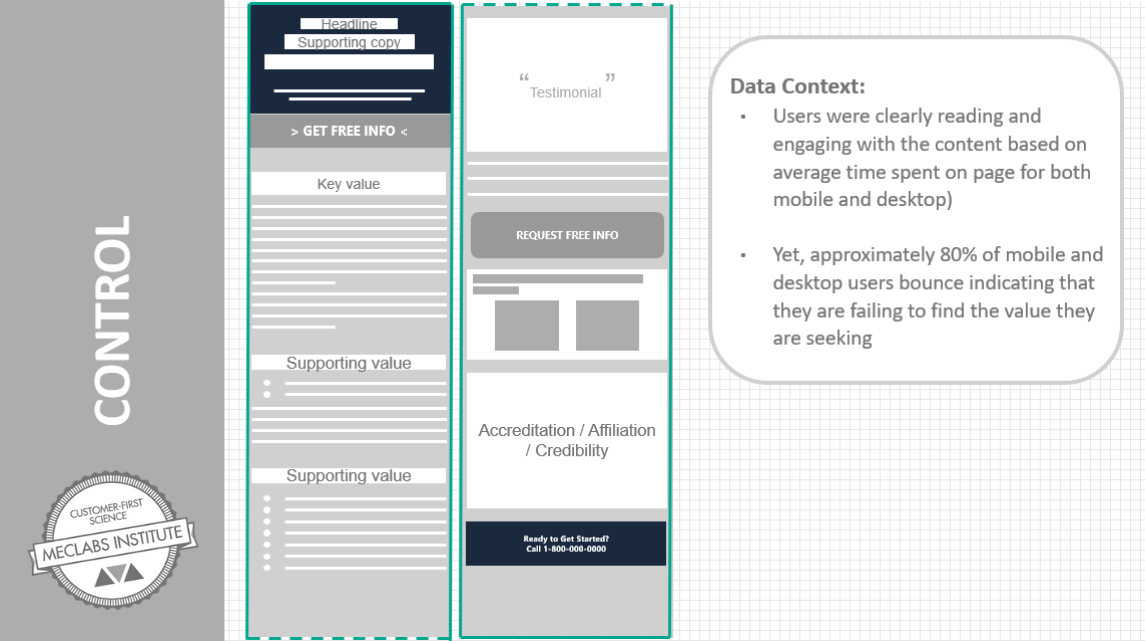
In our analysis of the control page, we determined that while customers are motivated and interested, the messaging and sequence of information fails to provide a clear, controlled thought sequence that matches the key questions in the mind of the consumer.
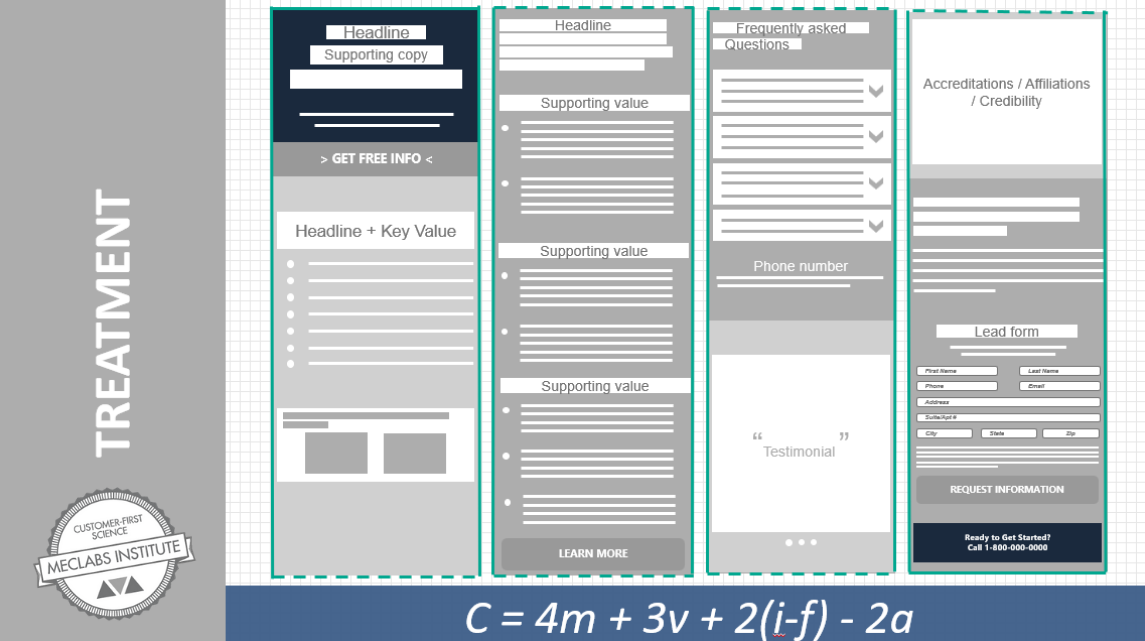
To optimize the thought sequence on this page, not only was the information resequenced to better match the user’s thought sequence but against many mobile best practices, information was added to create a longer-form page.

While marketers often shy away from information-heavy mobile design, it isn’t the amount of information that influences user engagement, but rather the perceived relevance of that information. It is far more important to understand the necessary sequence of questions and conclusions in the mind of the user than to adhere to rigid best-practice-rules.

There is an inverse relationship between the complexity of a product or service and the amount of information required to make a purchase a decision. When communicating a more simple, transactional product, less information might be sufficient. But failing to provide enough information can be equally detrimental to conversion as overwhelming the customer.

In this case, the longer-form version with revised messaging produced a 32% increase in conversion rate.

“Don’t be afraid to have a longer page. If the content is valuable and relevant, prospects will read it. Just remember to make it clear …” Yates said. (He led the marketing experiment above.)

Discovery #3. [BUT] Concision is critical  

While the amount of information should be informed by the questions and micro-decisions on the part of the consumer, it is the marketer’s responsibility to make that information as easy as possible to consume.

In the test above, more information was added but also translated from desktop-style long-form paragraphs to simple, easy bullet points with clear headlines and visuals to guide the user. Put simply, the customer should inform what and how much information is needed, but the marketer should design the information in the clearest, simplest and easiest format for the customer.

Mobile is a compressed customer experience. On the desktop, a user has greater autonomy over how they choose to experience a page since the eye path can vary due to screen-size and design. However, in mobile, the customer experience is necessarily sequential and linear — meaning that the customer experiences one page element at a time instead of multiple competing elements. This is why it is critical to ensure that the information presented is relevant, easy-to-digest, and aligned with the customer’s sequence of questions and conclusions.

Countless marketing mistakes are made because of assumptions based on insufficient data or rationale, and every marketer should be skeptical toward the litany of “best practices” and noisy ideas in the marketplace. Mobile shopping and browsing continue to grow and become ever more important, and the only way to truly understand it is through testing.

Understanding always trumps ideas over time. There are common variables and important differences between your desktop and mobile user behavior that vary depending on your product, model, industry and audience. So, to be truly effective in mobile, we must treat mobile as different and seek to understand how, to what degree and why.

Stay tuned for more research and insights as we continue to learn about what works in mobile marketing and why.

Related Resources

Most Popular MarketingSherpa Articles of 2018

Mobile Ad Campaign Optimization: 6 tactics from a high-performing marketer to increase conversion

MarketingSherpa Podcast Episode #1: The role of the human connection in your marketing

The post Exploring the Mobile Customer Experience: Three discoveries for designing an effective mobile experience appeared first on MarketingExperiments.


from MarketingExperiments http://bit.ly/2BrkHi1
via IFTTT

Why Gmail’s New Promotions Tab Is a Big Plus for Your Email Campaigns

Email marketers have gained access to a powerful new platform for reaching subscribers: Gmail’s new Promotions tab. Google’s latest update to the Gmail app includes a tab that’s tailor-made to showcase your most compelling B2C offers—and this gives your top content a chance to shine like never before.

Marketers have long known that email delivers the highest ROI of all digital channels, but ROI can fluctuate widely depending on how sophisticated a campaign’s targeting is.

Emails containing personalized offers are far more likely to survive spam filters, generate clicks, and deliver revenue. But even for brands that invest heavily in email personalization, the daily struggle to stand out against the spam can often prove difficult.

Gmail’s latest update aims to sharpen the contrast between meaningful emails and non-personalized junk. How? By bundling the offers most relevant to each recipient under a specialized Promotions tab, which highlights specific features of those offers, like promo codes and expiration dates.

Here’s how your brand can start taking advantage of this new feature right now — using the creative assets you’re already showcasing in your emails.

Gmail’s Promotions Tab Helps Your Personalized Offers Stand Out from the Spam

Personalized emails are powerful, so long as they are opened. In the beginning you have to create a compelling subject line and snippet of preview text to capture each subscriber’s attention. Any email with a subject line or preview snippet that fails to captivate subscribers is likely to be ignored, sent to the trash — or worse, blocked by Gmail’s spam filter. It doesn’t matter how well designed your tailored promotions are if they go unseen.

Gmail’s new Promotions tab gives your most compelling offers a far greater chance of capturing subscribers’ interest, while also keeping your brand in full control of each email’s messaging and visual appearance. Now, instead of a text-only subject line and preview snippet, your offers can show up in a specialized tab within Gmail’s iOS and Android apps — bundled by category and featuring enticing details and imagery.

In short, the Promotions tab can supercharge your power to engage subscribers with each personalized email you send — meaning your most relevant offers will get more clicks and generate more revenue.

And best of all, you can do all this without creating any new assets. With a personalization solution capable of managing a content library of creatives, you won’t need to spend any more time or resources developing new assets or messaging for Google to feature in the Promotions tab. All you need to do is paste the generated code from the Litmus tool into the email templates currently used in your campaigns and the promotional content will appear in the preview.

Sound good? Let’s take a closer look at how it works.

Litmus’s Gmail Promotions Builder Makes It Easy to Customize Email Previews

Each email preview in the Promotions tab consists of modules, including:

  • A single image preview
  • A green badge with offer details
  • A gray badge with a discount code, your brand’s logo
  • The offer’s expiration date

Although Gmail is able to pull content for all these modules directly from each email you send, you’re also free to customize the modules — which means you can fully control each preview’s appearance within the Promotions tab as well as the promo details you’d like to highlight.

You don’t need to write a single line of code, thanks to Litmus’ Gmail Promotions Builder. Litmus has teamed up with Gmail to create this easy-to-use tool, which makes the preview customization process as simple as entering a few details into a form.

Once you’ve generated the code and pasted it into your email template, Gmail users on iOS and Android will see exactly the offer details you’ve specified — along with your brand’s logo and a featured image — bundled with other brands’ relevant offers in the Promotions tab.

That’s all there is to it. It’s like upgrading from a text-only ad to a full-color spread on the front page — with just a few seconds of work, using the email assets you’ve already got.

One final important note: annotating an email doesn’t guarantee Gmail will feature it in the Promotions tab. To be featured, you still need to make sure your emails are personalized for each subscriber, containing content tailored towards that subscriber’s desires and goals.

Jordan Grossman, Product Manager at Gmail, even said, “Gmail doesn’t create value in the Promotions tab. It’s the best emails that create value. The new Promotions tab rewards brands who send truly valuable email by making them easier to find with a richer means of delivering that value.”

Google is getting smarter every day at recognizing relevant emails — and just as before, the most surefire way to generate engagement is to keep your content updated and relevant for every customer on your list.

Find out what else you can do to optimize your emails with “Go Further with Email Deliverability and Privacy.”

Read the guide


from Oracle Blogs | Oracle Marketing Cloud http://bit.ly/2Bsz8Cw
via IFTTT

Friday, 8 February 2019

Seven Smart Strategies to Take Your Social Media to the Next Level

This year it’s estimated that 2.77 billion people will be active on social media. While it can be overwhelming to think about adopting all of the new technology permeating the market, these key areas stand out as being worthwhile investments to drive results in your social media campaigns for 2019.

1. Martech Integration. Social is rightfully coming into its own as a demand generation hub. It’s long been a challenge for social media teams to show their ROI. Gone are the days of having to manually create tracking URLs, and then copying, pasting, and repeating for each individual campaign. With new advances in social media platform tools, we’re seeing automated campaign tagging, UTM parameter generation, and analytics reporting at level we’ve never had previously. Integrations into marketing automation platforms like Eloqua will allow marketers to track engagements, score leads, develop nurture campaigns, and funnel leads to sales with more efficiency than ever before.  

According to IDC, 75% of B2B buyers and 84% of C-level executives are now incorporating social media as a key part into their decision-making process. Being able to monitor social media conversations can help:

  • Both marketing and sales gauge product and content interest
  • Determine pain points
  • Provide insights into what messaging might resonate with a potential buyer.

Marrying social and marketing automation will also make building relationships with prospects and customers throughout every stage of the customer lifecycle much easier.

2. AI. The AI market is estimated to be worth $9.98 billion by the year 2022 and taking a larger and larger role in mining mentions, automating replies, and inching customers towards an engagement. If done right, AI can help deal with the 24/7 demand of instant response followers now expect. Chatbots don’t ever sleep and are available to answer questions from users in every time zone. In addition, AI can help marketers personalize at scale in several ways. Marketers can now automate “likes” and “thank you for sharing” messages to:

  • Help followers feel connected
  • Analyze content and optimize it to keep channels fresh and relevant
  • Identify super fans to incorporate into your advocacy programs

3. Personalization. More than ever before, customers expect brands to know what they want. Machine learning algorithms can now analyze interactions in real-time on social media, web, and email, converting them into tangible data marketers can take action on. Customized messaging based on historical engagement can drive hyper-focused, relevant, timely messaging that helps your audience feel understood. According to CEB, B2B buyers who feel a “high brand connection” are 60% more likely to consider, purchase, and even pay a premium than “low brand connection” competitors. Customers may have concerns over privacy risks, but when messaging is relevant, such as suggesting a product they’ve been looking for, or sending a sale notification that they may be interested in, the benefits tend to outweigh the cons, leaving customers appreciating the convenience.  

4. Listening. Like in all good communication, social goes two ways. You need to always be listening. Having the right listening platform in place will help you identify opportunities to engage in conversations about your brand. Incorporating real-time listening into your strategy can enable you to monitor your competition, gain insights into what message-driven content is resonating with audiences, and identify new trends. A few ways to easily get started:

  • Identify product questions and answer them quickly to develop potential leads
  • Address complaints to get customers the support they need
  • Identify and engage with influencers and advocates

If you aren’t actively listening to your social channels, you’re putting yourself at a disadvantage.

5. Video and Livestreaming.  Video remains one of the easiest, most efficient ways to engage with your audience in an authentic way. According to Social Media Examiner, 80% of what we consume online will soon be video content. Going live doesn’t require a full video team, in fact, I would argue as long as you have a decent microphone and wi-fi connection, it’s one of the best ways to connect with your audience organically in real-time. Stream interviews with influencers give a behind the scene look at events, take a deep dive into product demos, highlight your executives, or simply talk about your company best practices. People are eager to learn, especially from brands they respect and admire. Take the time to make your audience part of your broader brand community and show the faces behind the brand.

6. Content. It’s never been more important to invest in relevant, educational, high-quality content customers actually want to see, rather than continuing to produce the same old, tired whitepapers and talking head videos. Quality, not quantity, is the answer to standing out in a landscape that is increasingly saturated. If you don’t have content that your followers find interesting, they won’t just stop engaging with you, they’ll tune you out completely. Experiment. It may be as simple as producing more solution-focused, rather than product-focused, content. Great content will relate business goals with customer needs and desires. Chances are your customers know how great your product is, so you don’t need to beat them over the head with that messaging. Invest in content that educates, inspires, and is also unique and fun.

7. Influencer Marketing. According to a recent study conducted by Linqia, 39% of marketers plan on increasing their influencer marketing budget this year. As brands seek to engage audiences with more authentic and engaging content, influencers will find have a larger amount of  collaboration opportunities to work with. Rather than one-and-done sponsorships, brands will start to develop long-term relationships that involve multi-touch collaborations throughout the year (such as, webcasts, blogs, livestreams, chats). Working with an influencer repeatedly not only establishes a solid relationship, it also allows brands to keep continuity in their messaging and removes the potential risk a brand can face from a first-time influencer engagement.

Social has become a critical channel for marketers across every touch point, from brand awareness to customer advocacy. The marketing landscape has changed. Customers expect brands to meet them where they are, and that’s on social.

Learn more about how to incorporate social media into your mobile marketing campaigns with “Go Further with Mobile Marketing.”

Read the guide


from Oracle Blogs | Oracle Marketing Cloud http://bit.ly/2TKCl7e
via IFTTT

Thursday, 7 February 2019

7 tips to creating a memorable slogan

What is a slogan? A slogan is a catchphrase that represents a product or company and communicates the key benefit you want consumers to associate with your business. And if crafted with care, it can keep your brand front and center in the minds of consumers — until they’re ready to buy. Read on for inspiration and tips to help you create a compelling, unforgettable slogan:

Slogans with staying power

If you’re creating a new product or business slogan, you want something that represents your brand and is easy to remember. Some well-known slogan examples are:

  • Just Do It. (Nike)
  • I’m Lovin’ It (McDonald’s)
  • Finger Lickin’ Good (KFC)
  • Melts In Your Mouth, Not In Your Hand (M&Ms)

Although the above slogans are likely already at the tip of your tongue, there are many other great ones. Recognize these?

  • Because You’re Worth It. (L’Oreal)
  • What’s In Your Wallet? (Capital One)
  • Shave Time. Shave Money. (Dollar Shave Club)
  • They’re G-R-R-REAT! (Kellogg’s Frosted Flakes)
  • M’m! M’m! Good! (Campbell’s)
  • Get In The Zone (AutoZone)
  • The Quicker Picker Upper! (Bounty)
  • Save Money. Live Better. (Walmart)
  • Maybe She’s Born With It. Maybe It’s Maybelline. (Maybelline)
  • Challenge Everything (EA)

To help you create catchy slogans for your business, here are seven tips to get your creative juices flowing:

1. Keep it short and simple

If Las Vegas had tried to use “Whatever you do while you’re in Las Vegas, Stays in Las Vegas” instead of “What Happens Here, Stays Here,” it might never have caught on as one of the most popular slogans of all time. Keep your slogan under 9 or 10 words.

2. Be consistent

Consistent branding is key whether you’re a small business or household name. Make sure your business slogans complement your existing logo, company name and projected image. For example, General Electric’s slogan “Imagination at Work,” draws attention to their brand with a simple, yet powerful logo that celebrates human imagination and innovation. All of their products from lightbulbs to CT scanners, bare this testament to creativity and quality.

3. Focus on what makes you different

Figure out what your unique selling proposition is and use it. Is your delivery business done with a fleet of electric cars? Does your dental practice cater to those with high anxiety? Crossoak Family Dentistry features a big chicken on its website, along with the slogan “We cater to cowards.” Incorporate what makes you special into your slogan if possible.

4. Make it timeless

Verizon had a good run with “Can You Hear Me Now?” but it was only a matter of time before technology made nearly all cell phone calls clear. You have to change with the times, but when you’re working on a slogan you want to think of its longevity. That’s why references to technology and phrases like “the only” are risky. Good slogans use wording that can stand the test of time, like Rolaids and their “How Do You Spell Relief?”

5. Ensure it can stand alone

Your slogan shouldn’t be a mystery! You want a slogan that tells your audience what your business is without needing any additional information. For example, Cartoon Network’s “The Best Place for Cartoons” tells people exactly what they’ll get when they tune in.

6. Consider your target market

You’ll also need to consider if your customers are local, national or international. While some locals get Philadelphia’s new slogan, “PHL: Here For The Making,” it may have left tourists scratching their heads. And if you do business internationally, keep in mind that translating your slogan to another language can significantly change the meaning. When KFC launched in China, their “Finger Lickin’ Good” slogan translated to the less appetizing “Eat Your Fingers Off.”

7. Get input

Being creative is a tough job, but there are ways to avoid going it alone. Use VerticalResponse’s Surveys feature to get opinions from your followers. Take to social media like Facebook or Twitter to host a slogan contest with a designated hashtag to track entries. Or consider some free tagline generators, like Slogan Generator, to get your brain warmed up.

Done right, a memorable slogan will stick around long after consumers interact with your brand. Use these tips, or leverage expert designers, to create a catchy slogan that fits your business.

Join 140,000 small business owners

Get expert tips and email inspiration delivered to your inbox every two weeks.

Editor’s note: This article was originally published in 2015 and has been revised for accuracy and relevance.

© 2019, Contributing Author. All rights reserved.

The post 7 tips to creating a memorable slogan appeared first on VerticalResponse Blog.


from VerticalResponse Blog http://bit.ly/2HYrVja
via IFTTT

15 Ways to Be a Wiser Content Marketer

It’s great to be smart. It’s wonderful to have clever strategies and tactics that help us do our work better....

The post 15 Ways to Be a Wiser Content Marketer appeared first on Copyblogger.


from Copyblogger http://bit.ly/2DWJfBd
via IFTTT

Wednesday, 6 February 2019

5 Things Successful Content Marketers Do to Make Sure Their Work Gets Read

There’s a lot of content created every day — and most of it gains almost no attention. In 2015, Moz...

The post 5 Things Successful Content Marketers Do to Make Sure Their Work Gets Read appeared first on Copyblogger.


from Copyblogger http://bit.ly/2Df5SPo
via IFTTT

The Sound of Silence: Reading into Your Customers' Lack of Noise

When a comedian is on stage and the punchline he’s practiced for a week is met with stony stares from the audience, what’s that sound he hears? Besides the random uncomfortable cough from an audience member, the sound he hears is probably his heart constricting and his cortisol levels rising. It’s at that time when a person fully understands the expression, “The silence was deafening”.

For your business, silence can be a sign of trouble. Your community of customers should be a place where ideas and interactions thrive, where they talk with other customers and engage with you (the service provider) in ways that demonstrate their ongoing interest to better leverage your solutions to achieve their business goals. Once a decision is made to purchase subscriptions or licenses, why would a customer not want to do as much as possible to maximize their use of that investment? And while there are many capable customers who make every effort to independently extract value from the solution, in especially with the current state of enterprise cloud software, most customers know it helps to talk with others in order to fully learn. Silence in your customer community usually means only one thing: disengagement. And disengagement is often the real tell-tale sign of trouble.

Customer on the Way Out? Don’t Misread the Signals

It’s true that customers can be noisy. The noise in fact can seem to detract from your progress as a service provider as you spend sometimes inordinate amounts of time and money on reactive support to dampen it. Too many providers, though, misread noise as a clear indicator of eventual customer churn. While it can mean that, it doesn’t have to. More often than not noise means the customer is seeking help, advice, and guidance. Rather than adopt an ever-ready state of perpetual defensiveness, it’s best to take a step back and assess your products and the state of your service. Read into the noise and try to recognize certain clues. Is the noise a sign that your service is not delivering the quality of guidance your customers need and, arguably, deserve? Is the service being delivered by people who are well equipped to share ideas for best utilizing the products to meet the needs of specific use cases? Do the people delivering the service understand the customer’s industry? Do they understand the customer’s business?

Modern customer-centric service providers are moving away from thinking of service and support as a reactive model and conceptualizing customers more from the vantage of their full lifecycle. Providers need to view their customer relationships through a broader lens and approach each interaction as an opportunity to strengthen engagement over time. And they need to come to happy terms with knowing that when customers stay with you for the long haul, silence is not something you should expect to hear from them. If you want silence, try visiting a monastery.

Listen to your customers and read all the signs that they’re giving off, especially the digital ones. Find out how by reading “Getting the Digital Handshake Right.”

Read the Guide


from Oracle Blogs | Oracle Marketing Cloud http://bit.ly/2MP1P0E
via IFTTT