Sneak previews for content can excite and intrigue your customers across a wide variety of sectors from designer apparel to cars to computers—and even in less-obvious verticals like snack food and camping gear. The best example is for films.
I love movies directed by the Coen Brothers. When someone loves a brand (like I love the Coen Brothers), we’re always delighted to hear they’ve got a new project.
Netflix knows this. They see the brand value of the Coen Brothers and know that a segment of their audience is interested in more content. That’s why they added the recent Coen flick The Ballad of Buster Scruggs to their platform to serve it up directly to you. Netflix is keen on keeping its audience’s attention–whether that’s through adding more content that its audience loves or engaging them with sneak previews. Many streaming services regularly tease or promote new content via sneak previews.
And as a marketer, you can use sneak previews to improve how youpersonalize your contentfor customers.
It’s not just products that capture customers’ imaginations—it’s the whole experience of hearing from a brand that truly “gets us.”
Like innovative film directors, our favorite brands stay a step ahead of our evolving taste—and they keep surprising us with new variations on the themes we adore. That’s why we stick with them, even when some of their products resonate less than others. We each have a preferred taste for brands—and the combination of different brands that you receive messaging about makes up your shopper’s preferred “diet” of content. If you can identify andmatch this “diet” with the right content, you’ll not only increase conversions but become a valuable curator of content for your subscribers. Just like Netflix, who serves up Coen Brother films to keep me entertained.
When customers truly love your brand, they can’t wait to see what you come up with next—and they’re excited to tell their friends.
Here’s how to tap into the power of early-access content to build customer excitement for your next product launch.
Early-access emails pay for themselves on product launch day
Many movie fans (myself included) look forward to the preview trailers almost as much as the film itself. It’s so tantalizing to get glimpses of the stars, visuals and concepts in the season’s upcoming releases—and each time we hear the name of a favorite actor or franchise, our excitement intensifies.
Given that movie trailers are “bite-sized” and free, it’s no surprise that their YouTube views often number in the tens of millions, far outranking many movies’ actual ticket sales. But even if just a small percentage of those viewers end up buying tickets, a well-crafted trailer will pay for itself—and then some.
In retail, sneak previews also help build up the hype for a release. In fact, based on my observations of working with North American retailers, I have observed that early access emails may consistently outperform other types of content and even outperform the actual product offer.
Sneak-preview excitement creates a shared world for your customers
Sneak previews provide a feeling of exclusivity, and that’s the really great thing about these types of emails. They make your audience feel like they’re part of an exclusive club. Contrast that with most email offers, which lean heavily towards driving a conversion with a discount or promotion.
A preview screening is like access to a secret little world—a private space into which only select recipients are permitted. Those lucky few who get an invite feel they enjoy a special bond with the brand.
I’d wager that early-access emails outperform so many others due to this exact same feeling of exclusivity—of getting a peek past the velvet rope. Cultivate this sense of a shared world with your customers, and you’ll find they look forward not just to this week’s releases, but to next season’s, too.
A track record of hits builds anticipation for more delightful surprises
One reason I love the Coen Brothers is that I never know where they’re going to take me next. It’s almost hard to believe that the same team who directed The Big Lebowski was also responsible for the bleak thriller No Country for Old Men—or the musical odyssey of O Brother.
Walking into a new Coen Brothers movie, I savor the sense that I’m about to experience something totally new—while at the same time, I know I can expect startling plot twists, crackling dialogue, well-rounded characters, and all the other Coen trademarks. I trust them to make movies that feel like Coen movies, whether they’re nihilistic westerns or screwball comedies.
The more deeply you know and understand your subscribers, the better-equipped you’ll be to transform trust into excitement.Tailor your emailsin response to each customer’s tastes and purchase patterns, and you’ll lend much greater credibility to your early-access content. If you were spot-on with your last ten recommendations, today’s sneak preview will feel far more relevant—and worth paying attention to.
Over time, you can even start to guide your customer’s ideal “content diet” to better match what an ideal customer’s content diet looks like, allowing you to gradually increase customer lifetime value simply by providing relevant and meaningful content to each subscriber.
The energy of a product launch can be highly contagious, if you let it flow into your content. Build a rising sense of anticipation in every pre-launch email, and subtly remind subscribers of your previous “hits.” Make every sneak-preview email feel like a top-secret movie trailer, and your premiere will be sure to catch a lot of eyes and get more than few click-throughs and downloads.
Welcome to Episode 24 of On the Fly, our video series with small bites (two mins or less) of marketing and customer experience advice and training from experts, given to you during the current disruption.
“If you change your words, you could very easily change your world,” says Phil Jones.Phil is a bestselling author, speaker, and sales expert. He joins us this week with an important reminder about the power of words and the art of conversation. Your customers will have a lot of questions for you right now. Be prepared for them, says Phil. Also, come up with questions to ask them to gain further clarification so you can further help them. Stay in control of the conversation. t
During a crisis, marketers must adjust and adapt their marketing strategies to better serve their customers in a dynamic time. Following the steps below can help you identify and implement changes in order to offer your customers some stability and inform them on how your brand can help during a difficult situation. Find out what several successful businesses did and what you can learn from their examples.
Lean on your third-party consultants and marketing technologies
Marketers should already possess the tools needed to stay nimble and current in their communication with their customers. Leaning on your existing consultants and third-party marketing technologies can help you navigate this change. Think about leveraging yourA/B testing platformas a CMS (content management system) to:
Quickly update company? messaging,
Rearrange site content,
Target specific segments of visitors,
Stay in compliance with local ordinances,
And provide site visitors with peace of mind and much more.
Update necessary messaging immediately
Act swiftly and get necessary messaging live as soon as possible. During the initial stages of the COVID-19 pandemic, many industries faced immediate changes to their operations, procedures, and policies. It is imperative that change is well-articulated to your site visitors.
Listen to analytics and launch monitoring or insights campaigns
It is crucial to keep a close eye on site visitor behavior throughout the full lifecycle of the pandemic. Tracking trends can help you gain a better understanding of how conversion has shifted during this time and your audience sentiment. This will help position you to navigate the current climate and work towards the future. Another way to do this is to utilize your existing A/B testing platform to run monitoring campaigns toglean insights into specific visitor segments. This will assist in identifying over and underperforming segments of visitors, so that you can better target and personalize content as it pertains to an evolving situation. For example, during COVID-19, it can be helpful to filter reports by date ranges that correspond with different phases of the virus. You may see visitor sentiments shift between lockdown and reopening.
Create resources to address questions and concerns
With many call centers at capacity or unable to respond to customers’ inquiries, adding helpful resources to your site can help relieve strain on customer support departments and increase transparency with visitors. Think about adding a FAQ page dedicated to changes in procedure specifically stemming from the crisis you are facing or incorporating new content into existing FAQ pages or resources. This is a great way to promote the positive changes you have made to your procedures or to highlight a recent corporate social responsibility initiative that your business took in response to the crisis.
During COVID-19, many companies provided links and resources to CDC guidelines to eliminate questions around why certain types of change is required. For example, most airlines added a link toa CDC articlesupporting their new mask-wearing requirement to help educate visitors about why this change is necessary.
Continue communication and A/B testing
It is critical that companies continue to engage with their customers, even those in industries that have been hit hard. Businesses that went radio silent will not be top of mind when the crisis abates, and customers are ready to re-engage. Instead, consider a steady stream of relevant information, inspiration, or appropriate promotions. It can also be very beneficial to continue with A/B testing. Even if the campaign roadmap you had in mind likely no longer makes sense, look to test messaging or other changes that could improve the visitor experience in the current climate.
For example, many retailers who previously did not offer free shipping are now doing so during the COVID-19 crisis. Testing which "Free Shipping" messaging resonates best with your audience could prove to be an easy "win". Or with travel clients, a fine line might exist between providing just the right amount of reassurance messaging and putting too much information in the reservation booking funnel. Having too much reassurance messaging might hurt the chances of converting even the most carefree traveler just as easily as a funnel with no reassurance messaging could cause a more cautious traveler to think twice before converting. That threshold can be determined by running an A/B or multivariate test.
Pivot and think outside the box
Rethink products or services that don’t really make sense during a crisis. Can these products or services be rebranded or changed to be made relevant to the current sentiment among visitors?
During the current pandemic, we saw hotel chainsoffer up hotel rooms to those in need, some retailers moved from a buy-one-get-one model to abuy-one-give-one model, and food deliveries have switched to contactless delivery. Put yourself in the customer’s shoes and see if your current offerings make sense. If they don’t, see if they can be made more relevant or if they should be abandoned altogether.
Move forward and plan ahead
Look beyond the current forecast of these trying times and start thinking about creating a strategic roadmap for the next three, six, or twelve months. Conduct market research, look at current and projected trends, and work with existing business objectives to create a testing and personalization roadmap to aid in the recovery. With shifting visitor behaviors, it is critically important to be able to test which changes resonate with which segments of visitors.
Want to learn more about how the Oracle Maxymiser Consulting team can take your optimization program to new heights? The Oracle Maxymiser Consulting team is made up of passionate strategists, designers, developers, quality assurance professionals, trainers, analysts, and platform experts. We’re excited to understand your business needs and work with you to drive ROI.
Marketing automation software is designed to streamline marketing and sales efforts and automate repetitive tasks, so your teams better manage their time and get more done. For example, tasks like social media posting, email nurture, and lead scoring can be done automatically, freeing up time for your sales team to meet with prospects and perform…
Evolving customer expectations means changing your business now! Here is how to accelerate your transformation with new data & intelligence technology.
Rapidly evolving technology and the effect of themobileinternet on daily lives have had a pretty deep impact on customers. Customers have developed new habits of exploring, discovering, connecting, and buying on the go.
Customers are ordering and having food delivered, consuming music, podcasts and TV on demand, buying products and services online, etc.
All in real-time. In any order. On a whim.
Personalized Customer Experiences lead to Continuous Growth & Cost Improvements:
Today, the experience a brand provides its customer within this moment of engagement is now more important than the actual product or service being delivered. Companies who will thrive will embrace the view that experience is more important than the product itself, that journeys are not linear and switch moment to moment, and thatcustomers are the real innovatorsas they experiment fearlessly with your products and services and expect you to respond.
Transforming Your Customer Experience
While marketers understand the customer’s expectations of a personalized experience, most marketers struggle to ingest the amount of available customer data and have even bigger challengesacting on that data.
Most marketers are segmenting and personalizing usingabout five customer attributes. The result is that every customer is treated the same and the brand experience is unremarkable. Think about buying a suit that comes in three sizes – small, medium and large.
Consumers will only know that these brands “exist.” They see it, maybe they try it and form some early opinion about it, but that’s it. Much like meeting a new person at a party, customers quickly loose interest and leave in search of a brand that offers a more meaningful relationship. To the customer—at best, they know that your brand exists.
Consumers will only know that these brands “exist.” They see it, maybe they try it and form some early opinion about it, but that’s it. Customers quickly lose interest and leave in search of a brand that offers a more meaningful relationship. To the customer—at best, they know that your brand exists.
The top 10% of marketers are using about 20 customer attributes to segment and personalize the marketing message. However, classifying customers using this relatively small number of attributes does not provide an accurate and personal view of the customer, and the human connection can fall flat.
For the top 10%, there is a chance for a customer relationship to develop. Consumers begin to attach deeper meaning or think about the brand in certain ways. Loyalty may be fragile, but is beginning to develop.
The top 1% of marketersare fanatical about data and customer attributes to always strive to make the “human” connection magical. In addition to capturing customer engagement and interaction data, the top 1% of marketers are using identity resolution to accurately connect purchase, service, lifestyle and life-stage data to increase the number of useable customer attributes. The top 1% of marketers use 100s of customer attributes. While these marketers start with segments similar to the data-driven marketer, they can enhance their use with advanced decisioning tools and predictive models to produce even morepersonalizedhuman-connection messages.
For the top 1%, customers might incorporate a business or a product into a part of their lives, or think of the brand as something that shapes or defines them, that it is tailored to exactly fit them, the customer.
The World’s Best Marketersare always increasing the use of customer attributes to continuously delight their customers in new ways. For the world’s best—very few companies (or people!) are able to take the relationship beyond that, the brand is indispensable and would be forgiven no matter what happens. To customers, these brands are their first and only choice.
These World-Best class marketers use 1000s of attributes per customer in their decisioning tools and delivery systems to deliver exceptional experience with massive and intelligent data. These marketers orchestrate marketing messages to produce contextual and nuanced communications that deliver exceptional customer experiences in a seamless and highly relevant context across advertising, marketing, commerce, loyalty, service and support. Customers develop strong feelings based on their experience and will actively defend and promote your brand. This is the tailored suit, but now customized with personal accessories to deliver a unique experience.
Thus,the biggest predictor of success in customer experience is the number of customer attributes used intelligently to deliver exceptional customer experience!
Your job as a brand is to accelerate the use of attributes to be able to thrive and win in your designated industry.
What Success Looks Like
Sofia is a frequent traveler and has a membership at an airport VIP lounge. Since her flight to San Francisco is delayed, she decides to spend the time waiting in the lounge. She walks into the lounge and scans her membership card. The concierge sees that Sofia’s flight has been significantly delayed. Luckily, the system has a new flight option for Sofia and the concierge locks it in. Unfortunately, Sofia has two more hours to spend in the lounge before taking the alternate flight, so she grabs a drink. Within two minutes, she receives a message from her mobile app with a choice for two discounted offers from the airline to make up for the delay. She can choose from preferred entry to see the Mapplethorpe exhibit at the San Francisco Museum of Modern Art or tickets to Yoshi’s to see the Pat Metheny Group’s sold-out small venue show. Sofia picks the tickets to see Pat Metheny and her trip just got a whole lot better.
How did this all work? The airline has a deep knowledge of Sophia’s current activities, personal interests and passions enabling them to craft an exceptional and very human customer experience:
Signalsincluded the flight delay, Sofia’s entry to the VIP lounge and the re-booking on an alternate flight.
Key attributesconsidered in the decisioning included Sofia’s airline status, VIP club membership, the determination that she was traveling for pleasure, her preferred channel for communication, an interest in jazz fusion (based on previous purchases on airline credit card), and her membership in multiple art museums.
Deliveryactions that changed the negative experience of a flight delay into an exceptional experience included booking Sofia on the best alternate flight, confirming the seat assignment and offering a choice of two highly relevant offers.
Consider how many customer attributes you are really using in your marketing efforts and the customer experience you are creating. If you are using about five attributes, you are certainly not alone. Can your business transform to provide exceptional customer experiences? Look for my next blog post on developing your transformation action plan to learn more.
But what if you don’t have the time to go through a 21-part training series? Or what if my SEO tool doesn’t give you the step-by-step instructions you need?
What other options do you have?
Well, today I thought I would make your life easier by sharing 21 of my own SEO and content marketing worksheets and templates to help you get higher rankings in less time and, best of all, with less effort.
Marketing definitions
Let’s start off with the basics.
In marketing, we all use terms that might be a bit confusing.
Or more complicated ones like CAC, BANT, LTV, or even NPS.
I’ve created marketing acronyms glossary that breaks down what each marketing acronym stands for and what it means.
So, when you are reading any marketing blog or book, you’ll now know what these “unusual” acronyms and words mean.
Local SEO
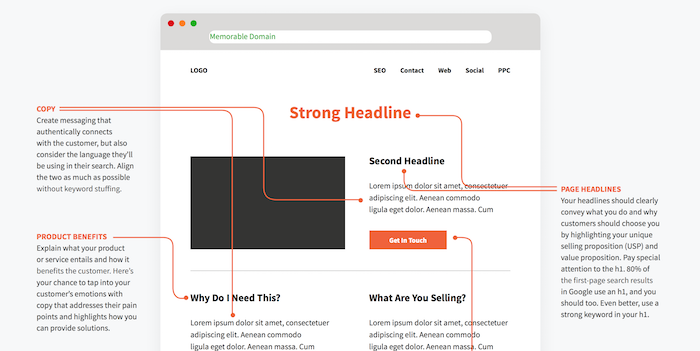
If you want to rank for local-based terms, it’s not just about optimizing for keywords. There’s much more to local SEO and a lot of it has to do with your landing page.
Here’s a template that breaks down the anatomy of an optimized local landing page.
What’s cool about this template is that it breaks down the percentage of impact each element will have when it comes to your SEO.
Keyword research
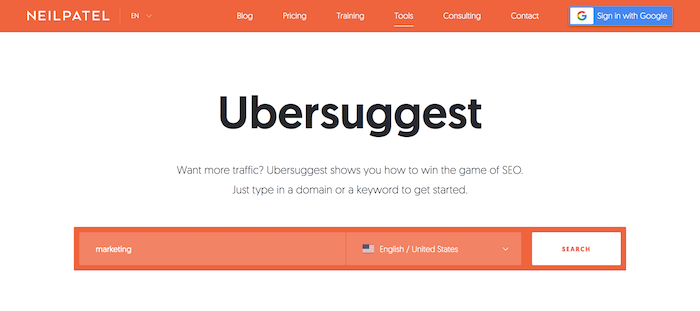
The easiest way to find keywords is to use tools like Ubersuggest.
Just type in a keyword…
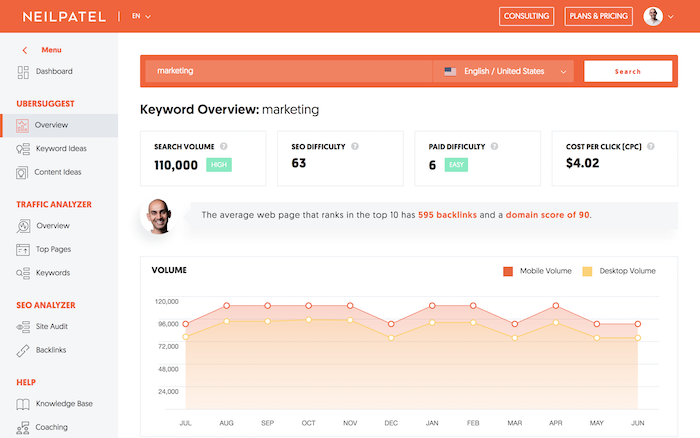
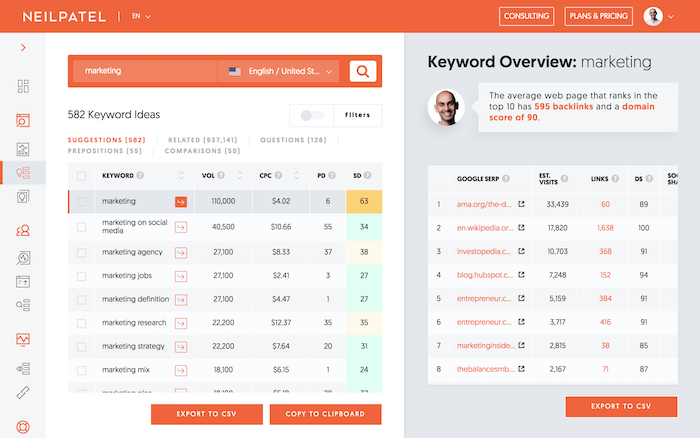
You’ll see a report that looks like this…
Then click on “Keyword Ideas” in the left-hand navigation.
But as you go through the list of thousands of thousands of keywords, how do you know which ones are valuable?
Sure, in general, if a keyword has a high “volume” it means it is searched a lot, which is good. And if it has a high “CPC” it means that advertisers are willing to spend a lot to advertise on that keyword, which again is good because it typically means that the keyword drives qualified traffic that causes purchases.
And if a keyword has a low SD (SEO difficulty) that’s great as well because it means the keyword is easier to rank for.
When looking for keywords, ideally you want ones that meet all 3 of those requirements.
But just because a keyword doesn’t meet all of those 3 requirements doesn’t mean that it isn’t good for you and your strategy.
There’s actually a lot of hidden gems out there that don’t meet all of those requirements because marketers don’t know they are lucrative.
So to help you find the best ones, I’ve created a 220 profitable keyword cheat sheet. It breaks down keywords that have buyer intent for all industries.
Now, I want you to go back to Ubersuggest to perform a keyword search and look for keywords that contain some of the phrases within my profitable keyword cheat sheet. Those are keywords you’ll want to target.
Seriously, just spend 5 to 10 minutes hunting for keywords. Perform at least 10 searches and you’ll find some gold.
As you are doing the keyword research, you’ll find that it may be difficult to remember and keep track of all the amazing keywords you are finding, which leads me to the Ubersuggest keyword planner spreadsheet.
You can use it to keep track of the keywords you want to focus on first, second, third…
Trust me, it will make your life simpler.
SEO factors
There are over 200 factors in Google’s algorithm.
But let’s face it, you aren’t going to optimize for each of them because it takes too much time.
And even if you have the time, where do you start, and which ones do you fix first?
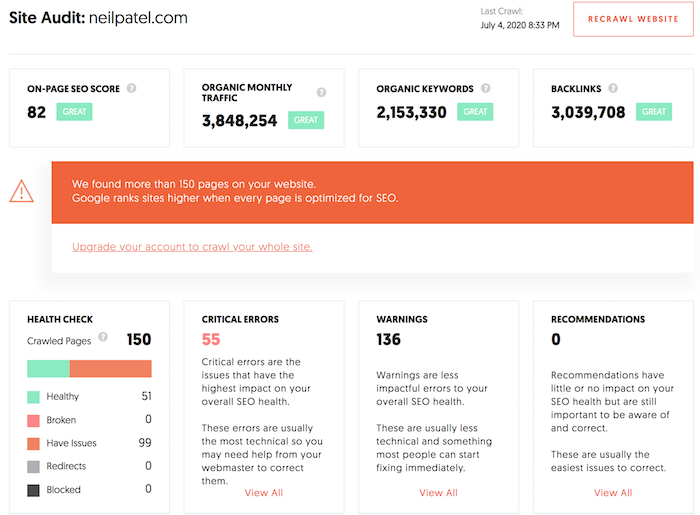
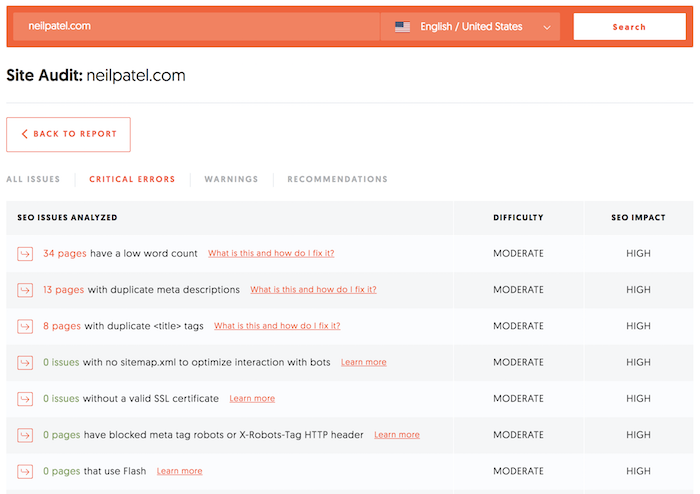
And if you click on any of the error boxes, it will break down what to fix in order.
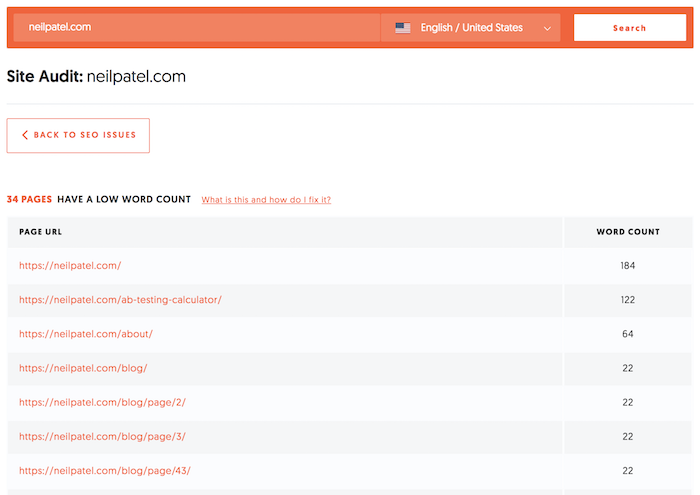
You can then click through and get details for each SEO error.
And although I highly recommend that you fix your errors in the above report (it’s a great way to boost your rankings), you don’t want to just keep playing defense.
You want to start playing offense with your marketing and make sure that you are doing things right as you release new pages or make changes to your website.
So I’ve created an SEO factors cheat sheet that breaks down important factors that you need to think about when creating new pages on your site.
It’s great to pass along to your team members and your content writers as well (and even your developers!) so you can make sure that everyone is on the same page.
And don’t worry, it doesn’t break down all 200 factors as that would be too overwhelming… it focuses on the important ones that you need to get right from day 1.
But if your team does want something more detailed, I’ve also created a thorough SEO checklist that is 20 pages long.
Anytime my team is doing major changes like a redesign or change our site structure, I make sure that they go through that checklist as it helps ensure we at least maintain our rankings if not increase them.
Supercharging your content
Content marketing is a key ingredient to more search traffic.
But these days, there is so much content on the web. How do you make sure that your content stands out and ranks?
But of course, you probably don’t have the time, resources, or team to do the custom research we did.
So how do you create content that contains data, amazing insights, and research that people love? Well, I’ve created a data sources document that you can use to easily find all of the information I just mentioned.
It will break down sites that contain unique data, charts, and research that you can cite within your content so you can naturally build more backlinks like me.
And on top of that, if you really want to supercharge your content and make sure that it not only drives traffic but more importantly sales, here are a few more templates and worksheets I’ve created for you:
WHIPS – the WHIPS template breaks down the cycles people go through before they purchase. Such as someone could be a window shopper, in which they are interested in purchasing something, but maybe not from you. Or they may know that they have a problem and are just looking for the right solution. No matter what situation your potential customers are in, the WHIPS template breaks down each of them so you can create the appropriate content that fits their needs.
20/20 Rulebook – whether it is you who writes your own content or if you have writers, have them follow the 20/20 Rulebook. It breaks down the 20 rules that your content needs to follow if you want it to do well. Now in many cases, you won’t follow all of them, but your goal is to get as close to 20 as possible.
Content creation template – if you want my framework to write blockbuster blog posts, follow the content creation template. It’s a 20-page process, but once you use it a few times you’ll quickly get the hang of it and find that it’s easy to remember. And I’ve found that when people use it to write 6 blog posts, by the 7th they don’t even need to look at it because they know the steps by heart.
Content editing
I know my content has grammatical and spelling errors every once in a while, but my content does well.
One of the reasons is I follow the templates and worksheets that I’ve mentioned above.
But it is because I put a lot of emphasis on editing.
See, once you write content, let it sit for a day. It will give you time to think about how it can be made better.
And the next day, you’ll want to go in and edit it.
Don’t worry, editing doesn’t have to take a lot of time… I’ve broken down our editing hacks into 3 worksheets:
10 Commandments – this worksheet breaks down the 10 things to look for when editing. If you are short on time, start with this worksheet because you can typically get your editing done in less than 30 minutes by following the steps.
Editing checklist – and if you have someone dedicated to editing on your team, have them complete this checklist each time they edit any content.
Step-by-step editing guide – for those of you who really want to master editing, here is a 27-page guide that breaks down each step of the editing process. I’ll be honest with you, it is a bit overkill, but it is great if you have someone dedicated to just editing.
You may find the editing process a bit overwhelming, and if that is the case, stick with the checklist or the 10 commandments.
You can also use this editorial calendar to help you out. It is an Excel file, but you can load it up using Google Sheets for free.
Fine-tuning your content
Whoever says editing is the last step of content marketing is lying.
Going the extra mile by fine-tuning little things and making those small tweaks is what can help your content go viral.
Look, no matter how good of a marketer one might be, you will make mistakes. Even if you make very few, there is always room for improvement.
If you have already published hundreds (if not thousands of blog posts), don’t worry. You can tweak them still.
So, lets fine-tune your content to get that extra traffic.
Every little bit adds up, right?
It’s how I grew my SEO traffic to over 4 million visits a month:
Headline formula – as David Ogilvy once said, you spend 80 cents on the dollar in the headline. And it’s true, 8 out of 10 people will only read your headline, but only 2 people will click through and read the rest of your copy. So follow this headline formula swipe file to create amazing headlines.
Constructive criticism – having the attitude that you can always get better will help you beat your competition. The moment you think you know it all is the moment you lose. This worksheet will teach you how to critique your own content without being biased. I love using it to critique my competitions’ articles as it helps me better understand how to beat them.
WordPress SEO cheat sheet – you’re probably using WordPress like me. And if you are, fine-tune your blog with this cheat sheet. It’s an Excel file, but you can use Google Sheets to open it up.
Don’t forget to build links
Link building sucks. But if you don’t build links, you won’t rank well.
I wish there was another way… but there isn’t. 🙁
As you are building links you may be wondering, am I building the right links or the wrong links?
Are my existing links good? Do I need to disavow any of them?
For this reason, I’ve created a link-building scorecard. You can use Google Sheets to view it.
It will help you keep track of your links, which ones are good or bad, and what you need to fix so that you can reduce your risk of a Google penalty.
Once you download the link building scorecard, you’ll also want to download these two worksheets:
Link building search operators – this worksheet teaches you how to use advanced search parameters within Google to find new link building opportunities. It is simple yet very effective.
Outreach templates – once you find link opportunities, you’ll have to send outreach emails to convince sites to link to you. Here’s my outreach template. It contains 24 pages of outreach emails that you can use to build more links.
Conclusion
I know I’ve given you a lot of templates, worksheets, and cheat sheets, but you don’t have to use them all.
Use the ones you need and just save the rest for later. It will make your life easier, helping you get results faster and in less time.
And if you are wondering how much time you should spend on each task, here is the SEO taskmaster worksheet.
It breaks down all of the SEO tasks you need to complete, how long each will take, the importance of each one, and how to prioritize them because there is no way you can do everything in one day.
So, what do you think of all of these templates? Are you going to use them?And what has worked for you that I didn’t discuss here?
 Like innovative film directors, our favorite brands stay a step ahead of our evolving taste—and they keep surprising us with new variations on the themes we adore. That’s why we stick with them, even when some of their products resonate less than others. We each have a preferred taste for brands—and the combination of different brands that you receive messaging about makes up your shopper’s preferred “diet” of content. If you can identify and match this “diet” with the right content, you’ll not only increase conversions but become a valuable curator of content for your subscribers. Just like Netflix, who serves up Coen Brother films to keep me entertained.